

Introduction
On October 30, 2026, Google Cloud published a Lakehouse walkthrough on querying Databricks-managed Iceberg tables from BigQuery without copies. IT Brief covered the update on November 14. The update removes a copy of the data, but every team still has to decide where raw data gets cleaned.
This decision is the ETL vs ELT choice. It sets where the compute bill lands and who can see raw customer records. This article explains how the two patterns differ, what each one costs, and how to choose with a five-question checklist.
ETL vs ELT at a Glance
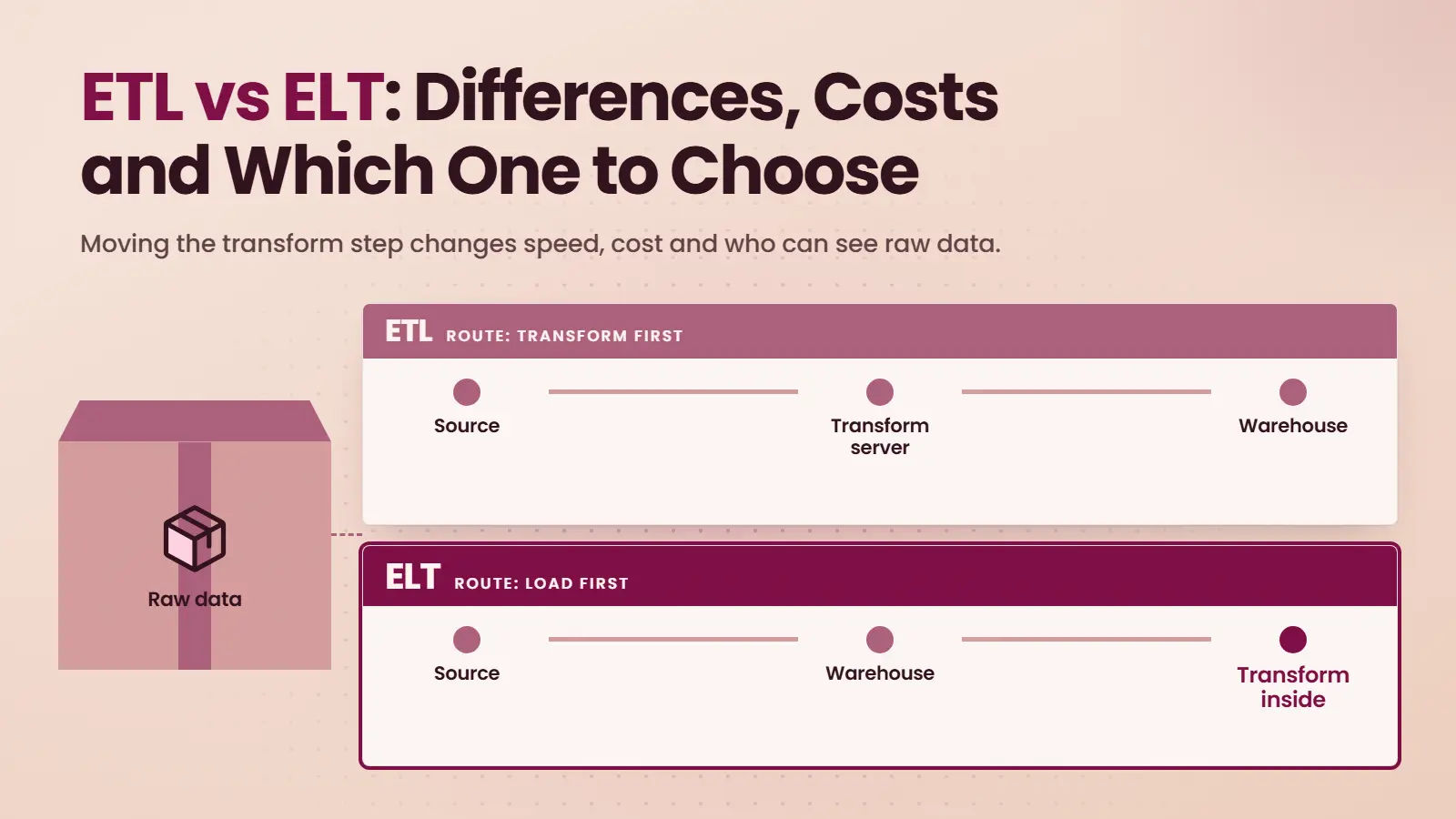
ETL vs ELT comes down to when the data is transformed. ETL (extract, transform, load) cleans data on a separate server before loading it. ELT (extract, load, transform) loads raw data first and transforms it inside the warehouse. The table below compares the two on the points buyers ask about most.
|
Factor |
ETL |
ELT |
|---|---|---|
|
Where Transformation Runs |
Separate server or service |
Inside the warehouse |
|
What Lands in the Warehouse |
Cleaned, modeled tables only |
Raw data plus modeled tables |
|
Time to First Load |
Slower, waits on transforms |
Faster, loads before transforming |
|
Where the Bill Lands |
Pipeline servers and licenses |
Warehouse compute credits |
|
Sensitive Fields |
Masked before storage |
Stored raw unless masked first |
|
Typical Fit |
Legacy and regulated systems |
Cloud warehouses and lakehouses |
|
Main Skill |
ETL tool or Python |
SQL and dbt |
ELT gives the warehouse a bigger job in return for a simpler pipeline, while ETL keeps the warehouse clean at the cost of a separate transform layer.
What is ETL?
ETL is a pattern for data integration in which a separate server transforms data before loading the warehouse. Extraction from source systems comes first, and loading comes last. The warehouse only receives clean, structured tables. Transformation logic lives in the ETL tool or in code.
An ETL pipeline suits sources that must match a fixed schema before anyone uses them. A nightly load of ERP ledgers into a reporting database is a common case. The pipeline rejects bad records before they reach reports.
What is ELT?
ELT is a pattern that loads raw data into a cloud warehouse or lakehouse first and transforms it there with SQL. The warehouse does the heavy work, so no separate transform server is needed. Raw data stays available, which lets a team rebuild a model later without pulling from the source again.
An ELT pipeline usually has two stages. A connector copies source tables into a raw schema, and SQL models build clean tables on top. This setup is common wherever teams already run cloud integration on Snowflake or BigQuery.
Key Differences Between ETL and ELT
The difference between ETL and ELT starts with where transformation runs, and every other difference follows from it. Moving the transform step changes speed, cost, compliance exposure, and skills. Each of these gets its own section below.
Where Transformation Happens
Transformation happens before the warehouse in ETL and inside the warehouse in ELT. ETL needs a staging area and its own processing engine, such as an AWS Glue job or an on-premises server. ELT pushes the same work down to warehouse compute.
Both patterns are batch integration techniques at heart. Either one can still run every few minutes.
Speed and Data Freshness
ELT usually gets new data into the warehouse faster, because loading doesn’t wait for transforms. ETL holds data back until every rule has run. The trade-off is safety, since nothing half-processed reaches users. In both patterns, report freshness depends on how often the transform step runs.
Cost and Where the Bill Lands
ETL vs ELT cost differs mostly in where the bill lands. ETL spends on pipeline servers and tool licenses. ELT moves the transform spend onto warehouse compute, which bills by usage. Neither pattern is cheaper by default.
A hypothetical nightly job shows the trade-off. Assume the transform takes one hour and runs 30 times a month. On AWS Glue, a 10-DPU job at the published Glue pricing of $0.44 per DPU-hour costs $4.40 a run.
Snowflake prices the same hour in credits. Its warehouse sizes table lists four credits an hour for a Medium warehouse and one for an X-Small. The table below assumes a hypothetical $3 per credit, since the real rate depends on edition, region, and contract.
|
Setup (Hypothetical) |
Rate |
Per Run |
Per Month |
|---|---|---|---|
|
AWS Glue, 10 DPUs (ETL) |
$0.44 per DPU-hour |
$4.40 |
$132 |
|
Snowflake Medium (ELT) |
4 credits an hour at $3 |
$12 |
$360 |
|
Snowflake X-Small (ELT) |
1 credit an hour at $3 |
$3 |
$90 |

ELT cost swings with warehouse size and runtime, so an oversized warehouse can make ELT the expensive option. Flexera’s 2026 State of the Cloud Report found wasted cloud spend rose to 29%, the first increase in five years.
Right-sizing and auto-suspend are the first steps in Snowflake cost optimization. Snowflake bills per second after the first minute, so idle time costs nothing once a warehouse suspends.
Modeling spend before a migration shows which row of the table a workload falls into. A cost estimate turns the question into a number.
A real case shows how much the compute choice matters. Data Prism replaced an oversized PostgreSQL environment behind Scout’s data platform with Snowflake and OpenSearch, and monthly infrastructure cost fell from about $4,000 to $40. Processing on more than 200 million records dropped from 84 hours to two.
Data Privacy and Compliance
ETL has the edge on privacy, because sensitive fields can be masked before they reach the warehouse. ELT stores raw records first, so names and health details sit there until a model cleans them. Under HIPAA or CCPA, every extra place raw data lives is another system to secure. ELT can still meet these rules.
The usual fix is to mask or hash regulated fields in flight, then load and transform the rest in the warehouse. This hybrid is often called ETLT. Access rules for the raw schema then come from wider data management.

Maintenance and Skills
ELT is easier to maintain for teams that know SQL, because transformations live as version-controlled models in the warehouse. ETL logic often sits inside a proprietary tool or custom Python, which fewer people can change safely. Still, ELT needs testing too. Untested SQL models break as quietly as any ETL job.
When to Choose ETL or ELT
Choose ELT when data lands in a cloud warehouse and the team works in SQL. Choose ETL when rules or old systems demand clean data before storage. Most teams on Snowflake, BigQuery, or Databricks should start with ELT.
When ETL is the Better Choice
ETL is the better choice when data must be cleaned or masked before anyone stores it. Regulated health and payment data often falls in this group. ETL also suits legacy targets, such as on-premises databases that can’t run heavy transforms. Heavy cleanup of messy files before loading is the third case.
When ELT is the Better Choice
ELT is the better choice when the target is a cloud warehouse or lakehouse with elastic compute. It suits teams that want raw history kept for new models later. It also fits fast-moving analytics, where analysts add metrics every week.
Hybrid ETLT: Using ETL and ELT Together
Many mid-market stacks use ETL and ELT together, with each source routed to the pattern its data needs. SaaS sources such as HubSpot and Stripe often load raw for ELT. So, the ELT vs ETL question rarely has one answer per company.
The split belongs in the integration architecture from day one. Adding masking after raw data has spread across schemas is much harder.
Hybrid setups usually pair managed connectors with SQL models. Data Prism’s data integration services build hybrid pipelines in Python, dbt, Dataform, and Dagster, with Fivetran or Airbyte where a managed connector fits.
ETL and ELT Tools by Category
ETL and ELT tools fall into a few categories, and most stacks combine more than one. Ingestion tools copy data into the warehouse, while transformation tools model it there. Orchestrators schedule both steps. The table below lists common names in each category.
|
Category |
Common Tools |
Usual Pattern |
|---|---|---|
|
Ingestion (ELT Tools) |
Fivetran, Airbyte |
ELT |
|
Transformation |
dbt, Dataform, Databricks |
ELT inside the warehouse |
|
Orchestration |
Dagster, Apache Airflow |
Both |
|
Serverless Integration |
AWS Glue, Azure Data Factory |
Both, often ETL |
|
Classic ETL Suites |
Informatica, Talend |
ETL |
ELT tools cluster around the warehouse, while ETL tools sit in front of it. A fuller comparison of ETL tools covers how each one handles a migration.
Orchestrators and streaming tools are a separate choice. The roundup of pipeline tools sorts them by category.
Moving From ETL to ELT: What to Expect
Moving from ETL to ELT means rewriting transformation logic as warehouse SQL and running both systems side by side for a while. The move is rarely a lift-and-shift, because ETL tools hide logic in visual mappings and scripts. Teams usually migrate one source at a time, in parallel, until the numbers match.
Reconciliation takes much of the effort, since row counts and totals must agree between old and new outputs. A staged integration process with a reconciliation step catches mismatches before reports change.
ETL vs ELT Decision Checklist: Five Questions
The decision gets simpler with five questions, answered per data source rather than once for the company. Each answer points one way. A source with mixed answers suits the hybrid ETLT route.
- Does the target run on a cloud warehouse or lakehouse? A yes points to ELT.
- Must regulated fields be masked before storage? A yes points to ETL or ETLT.
- Does the team work mainly in SQL? A yes points to ELT.
- Will analysts need raw history for new models later? A yes points to ELT.
- Is the target an on-premises system with little spare compute? A yes points to ETL.

For most cloud teams, the ETL vs ELT checklist lands on ELT as the default, with ETL kept for regulated or legacy sources. Run it again whenever a new source or compliance rule arrives.
The checklist settles the pattern, but sizing and masking details decide whether it holds up in production. Data Prism offers pipeline development with a free audit first. The audit starts with your databases, SaaS platforms, and workflows, then maps where each pattern fits.
Book a Free 30-Minute Meeting
Discover how our services can support your goals — no strings attached. Schedule your free 30-minute consultation today and let's explore the possibilities.
Book a Free Call

