

Introduction
Make AI Automation Consulting Proposals Comparable First
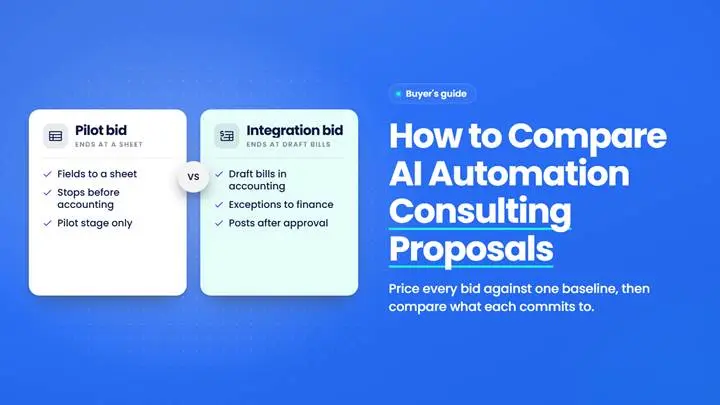
Two bids are comparable only when both price the same job. The pilot bid stops at a spreadsheet. The integration bid ends with draft bills in the accounting system. Until the scopes match, the fee difference tells you nothing about value. To fix this, write a one-paragraph baseline for every vendor to price against.

A useful baseline covers five points. Each point closes a gap where a vendor would otherwise make an assumption.
- Workflow boundaries set where the automation starts and stops. They also state if the system prepares a draft, does a production action, or stops for approval.
- Volume and variation give the real load. Include the monthly invoice count, peak periods, document formats, and the exceptions the solution must handle.
- Systems and environments name the shared inbox and the accounting system. They also name the test or production access the vendor needs.
- Delivery stage tells if the bid covers an assessment, proof of concept, pilot, or production rollout. It also tells what each stage delivers.
- Success measures state the goal. An example is less manual entry time, with uncertain invoices kept in human review.
To write the baseline, first map each handoff in the current finance process, from the inbox to the posted bill. The map shows where process automation can do the work and where a person must still decide.
Sample baseline for the invoice project: Move supplier invoices from the finance shared inbox into the accounting system as draft bills. Attach the source invoice to each bill. Volume is 1,000 invoices a month in mixed PDF formats, including scans and credit notes. Uncertain results go to finance review. Nothing posts without approval. Price the assessment, pilot, and production rollout as separate stages.
After you send the baseline, close the gap between the two invoice bids. Ask the pilot vendor to price the production integration. Ask the integration vendor to give separate prices for the pilot and the rollout. Compare equal results first and fees second.
Choosing which vendors to invite comes before this step. A separate guide covers shortlisting agencies.
Compare Deliverables, Assumptions, and Exclusions
Evaluate the Proposed Technical Approach
A buyer who does not write code can still evaluate automation proposals on the technical approach. Ask each vendor to follow one normal invoice and one exception from the inbox to the accounting system. The vendor must name the tool and the person at each step. Gaps become clear when the vendor explains a blurred scan.

Federal agencies also find this step difficult. A GAO review examined 13 AI acquisitions at four agencies. Some officials had problems getting technical experts to evaluate contractor proposals.
First, find where AI adds value. A model can extract fields from unfamiliar layouts. Fixed rules can check required fields, approval limits, and duplicates. If every decision goes through a model, the proposal is harder to test.
Next, ask how the systems connect. The vendor must name the integration method, for example, an API connection or a file import. The vendor must also say who gives access and what happens when the connection fails.
Then ask who handles exceptions. Ask where uncertain results appear, who reviews each one, and how the system records corrections and approvals. Good AI integration work includes human review in the process.
A Data Prism order automation project handled exceptions in the same way. The system sent each file it could not safely match to a manual sending folder. The system did not process these files automatically.
Lastly, ask about data security. The vendor must list the systems the automation can access, where processing occurs, and what the system logs or keeps.
For low-code tools such as Zapier, Make, or n8n, the proposal must name the account owner for the credentials. The proposal must also state in writing that the vendor never uses invoice data to train models.
Compare two proposals. One proposal shows how an unreadable invoice gets to a reviewer. The other promises "end-to-end AI automation" and says nothing about failed documents. The first proposal is easier to evaluate.
Check Evidence and Acceptance Criteria
To evaluate AI automation proposals, start with the evidence. Each proposal contains two types of claims. Some claims describe work the vendor has already shown. Other claims describe results the vendor expects. Acceptance criteria change the second type into something both sides can test.

For a demo, ask if the inputs are typical and include exceptions. A clean invoice does not show how the system handles mixed layouts.
A case study or permitted reference needs a similar workflow. Look for a baseline and a measurement period. Also look for enough context to see how the vendor got the result. A case study from a marketing project tells you little about finance automation.
Good evidence also names the difficult cases. On a Data Prism cruise data project, OCR (text-reading software) could not read some deck-plan pages. AI correctly extracted cabin data from about 75% of these pages.
Check a forecast in the same way. Ask which assumptions produce the number, starting with invoice volume and time saved per invoice. Then ask how often a person must take action.
Get answers on acceptance terms in writing. Ask who supplies the test data and which scenarios must pass. Then ask who approves the result and what happens if the system does not reach the agreed threshold.
The criteria below are examples. Replace the sample numbers with your own:
Use a buyer-approved set of 100 typical invoices. The automation must correctly capture the supplier, invoice number, date, and total on at least 95 invoices. Each invoice with a missing or uncertain field must go to the finance review queue. The system must not post these invoices automatically. No bill can post to the ledger without a recorded finance approval.
The buyer and vendor agree on the real thresholds, the sample mix, and the failure process. The criteria test extraction accuracy, exception routing, and posting controls separately. An automation can read fields correctly and still post an invoice without approval.
Compare Ownership, Support, and Total Cost
Compare each bid over one cost period, such as the first 12 months, with the same volume. Include implementation, licenses, model usage, hosting, support, internal staff time, and work the quote excludes. Mark uncertain amounts as estimates and name who pays each one. For the invoice project, public list prices give the usage costs.

Assume two pages per invoice. The invoice project then sends 2,000 pages a month to extraction. AWS lists Textract AnalyzeExpense at $0.01 per page in the Oregon region. Extraction usage is then about $240 a year.
Model usage needs a second assumption: about 3,000 input tokens and 300 output tokens per invoice. Anthropic lists Claude Haiku 5.5 at $0.10 per million input tokens and $0.50 per million output tokens. Model usage is then about $5.40 a year.
|
Cost Line |
Pilot Bid |
Integration Bid |
Who Pays |
|---|---|---|---|
|
Implementation Fee |
From proposal |
From proposal |
Buyer |
|
Extraction Usage |
About $240, if Textract |
About $240, if Textract |
Buyer, unless bundled |
|
Model Usage |
About $5.40, if Haiku 5.5 |
About $5.40, if Haiku 5.5 |
Buyer, unless bundled |
|
Hosting and Support |
From proposal |
From proposal |
Buyer |
|
Production Integration |
Request quote |
From proposal |
Buyer |
|
Finance Review Time |
Buyer estimate |
Buyer estimate |
Buyer |
|
Excluded Work |
Request quote |
Request quote |
Buyer |
Usage costs are small compared with fees and staff time. So the comparison depends on the lines each proposal prices differently. If a vendor does not give a figure, a software cost estimator can give a rough range. Mark this range in the table as a buyer estimate.
Fixed Fee vs Retainer
A fixed fee pays for a defined result. A retainer pays for capacity over time. Put both on the same period before you compare them. Check milestones, included hours or capacity, overage rates, and the minimum commitment. Then confirm if the retainer includes implementation.
The agency pricing guide explains pricing models in more detail.
Ownership and Exit
Ownership decides if the buyer can change vendors without a rebuild. Check who controls the accounts, configurations, source code where applicable, credentials, and documentation. Ask who responds to incidents, what support covers, and how another team would take over. Unclear answers are an early sign of vendor lock-in.
OMB M-25-22 is the April 2025 federal guidance for agencies. The guidance lists four protections against lock-in: knowledge transfer, data and model portability, clear licensing terms, and pricing transparency.
Use an AI Automation Proposal Comparison Scorecard
A scorecard puts all earlier checks into a two-table template. A buying team can use the template to compare AI automation consulting proposals.
The first table is a gate: a pass-or-fail check, separate from the scoring. Each mandatory requirement gets Pass, Fail, or Unverified. A high weighted score cannot clear an Unverified requirement. The gate table below lists the must-haves for the invoice project.

|
Mandatory Requirement |
What Counts as Pass |
Where to Find Evidence |
|---|---|---|
|
Human Approval Before Posting |
Bills stay in draft until finance approves |
Workflow section |
|
Export of Workflow Configuration |
Buyer can export the full configuration |
Handover terms |
|
Buyer Owns Accounts and Credentials |
Automation runs under buyer-controlled accounts |
Access terms |
|
No Training on Invoice Data |
A written clause rules out training on buyer data |
Data security terms |
Criteria outside the gate share weights with a total of 100%. Each confirmed item gets a score from 1 to 5. A 1 means poor fit. A 3 meets the requirement. A 5 is better than the requirement and has supporting evidence.
Unknown items stay Unverified and make the score provisional. The Source column gives the proposal page, appendix, or demo for each score.
|
Criterion |
Sample Weight |
Pilot Bid |
Integration Bid |
Source |
|---|---|---|---|---|
|
Scope Fit to Baseline |
25% |
1-5 |
1-5 |
Proposal page |
|
Technical Approach and Exceptions |
20% |
1-5 |
1-5 |
Walkthrough |
|
Evidence and Acceptance Tests |
20% |
1-5 |
1-5 |
Demo or reference |
|
12-Month Total Cost |
20% |
1-5 |
1-5 |
Cost window |
|
Support, Ownership, and Exit |
15% |
1-5 |
1-5 |
Handover terms |
The sample weights are placeholders. Replace them with the team's own priorities. You can also use both tables as an AI automation proposal checklist template. First, run a readiness scorecard on the buyer's side. A weak internal baseline can make every vendor score wrong.
Clarify Gaps Before Selecting a Provider
Talk Through Your AI Automation Project Scope
Book a Free 30-Minute Meeting
Discover how our services can support your goals — no strings attached. Schedule your free 30-minute consultation today and let's explore the possibilities.
Book a Free Call