

Introduction
What Are AI Automation Services?
AI automation services are work an outside team does to build and maintain systems where AI models handle steps in a business process. The AI reads and sorts incoming requests, then drafts a reply or routes each one. Workflow tools carry out the actions, such as updating the customer database (CRM) or booking the job. A person still reviews the cases the AI flags as unclear.
So, what does an AI automation agency do? The agency sells AI automation as a managed service, from scoping to upkeep. AI automation services for businesses replace the need to buy separate tools and wire them together in-house.

AI Automation vs Traditional Automation
AI automation handles messy inputs like emails and PDFs, plus steps needing judgment, while rule-based automation runs fixed if-then steps. Robotic process automation (RPA) is a third option, where software bots copy the clicks a person makes on screen. Each approach breaks differently. The table compares the three on five practical points.
|
|
Rule-Based Automation |
Robotic Process Automation (RPA) |
AI Automation |
|---|---|---|---|
|
Input Type |
Structured fields in fixed formats |
Structured data inside app screens |
Emails, chats, PDFs, and free text |
|
Handles Change |
New cases need new rules |
Breaks when screens change |
Adapts to new wording and formats |
|
Best Fit |
Stable, high-volume steps |
Old systems with no way to connect |
Reading, sorting, and drafting |
|
Upkeep |
Edit rules as the process shifts |
Fix bots after screen changes |
Check outputs and AI instructions |
|
Typical Failure |
Unmatched cases drop through |
Bot stalls after a layout change |
Confident but wrong answer |
The three approaches work best together. Most real systems use fixed rules for actions, such as creating a record, and AI for reading and deciding. RPA still earns a place where an old system can’t connect to other software and a bot has to click through screens.
Why an AI Automation Services Agency Matters for Small Businesses
Types of AI Automation Services
What AI Automation Services Do for Each Department
The useful starting question is which daily handoffs eat staff hours. A handoff is any moment where one person copies, checks, or forwards work. Sales, support, operations, finance, and reporting each have a few, and the manual tasks behind them repeat every day.

Sales and Lead Management
New inquiries often sit in an inbox until someone is free. Automation sends an instant reply and routes each lead to the right rep. After a sales call, the system summarizes the conversation and updates the CRM record. The payoff is fewer cold leads and cleaner records.
Customer Support
Support teams spend much of the day sorting messages before answering any. AI sorts each message by topic and urgency, then answers common questions from the firm’s own help content. Well-built support chatbots pass anything outside approved content to a person, with the history attached. Customers repeat themselves less, and staff keep the harder cases. For a chatbot-only project, this list shows how chatbot development companies compare.
Operations and Admin
Operations work often spans an online store, a project tool, and a shared spreadsheet. Automation passes each new order or task between the systems. One documented case used connected systems to tie a store, a project tool, spreadsheets, and a database together. The first win usually comes from removing copy-and-paste between screens.
Finance and Invoicing
Chasing late payments by hand eats into a small finance team’s week. AI can send payment reminders on schedule and match each deposit to the right invoice. The system flags odd entries, such as a duplicate charge, for review. Sound financial automation keeps a person checking AI output before anything goes into the books.
Reporting and Data
Performance data usually sits across many platforms, and gathering the numbers by hand eats hours. Automation pulls each source into one dashboard on a schedule. One reporting platform built for a roofing marketing agency connected more than 15 business platforms to feed ROI dashboards. Weekly summaries then reach the owner without anyone rebuilding a spreadsheet.
How AI Automation Agency Services Work
How the Math Works for a Property Management Firm
Picture a 40-person property management firm, with round numbers for illustration only. Tenants send maintenance requests by email, text, and a web portal, and one coordinator handles every message by hand. A high-volume, repeatable intake process like this one makes a natural first project.

The coordinator reads each request and types the details into the work-order system. The coordinator then picks a vendor and replies to the tenant. At about six minutes each and 600 requests a month, intake eats 60 hours. After-hours emergencies wait until morning.
The automated version keeps the same steps but hands the reading and routing to software:
- A request arrives by email, text, or the portal and lands in one queue.
- An AI model reads the message and labels the trade and the urgency.
- Fixed rules create the work order and pick a vendor from the approved list.
- The tenant gets a confirmation with the work-order number.
- Emergencies, such as flooding or no heat, trigger an alert to the on-call manager.
- Unclear or unusual requests go to the coordinator, keeping a human in the loop.
The AI reads messy free text, while plain rules pick the vendor, so the firm, not the AI, decides which vendor gets each job.
The math uses a simple formula: monthly savings equals hours saved times the hourly staff cost, minus running costs and the retainer. In this illustration, automation clears 480 of the 600 requests and saves 48 hours. At an assumed $30 an hour, counting wages and benefits, the gross saving comes to $1,440 a month.
Subtracting an assumed $200 in usage fees and a $500 retainer leaves $740 a month, so a $6,000 build pays back in about eight months.
The payback still depends on clean inputs. A messy vendor list would break the routing rules on day one, and flagged requests would pile up if nobody owned the exception queue. None of the math holds without a real baseline.
Benefits and Limitations of AI Automation Services
How Much Do AI Automation Services Cost?
The cost depends on scope, integrations, usage, and upkeep, so few agencies publish prices. A single workflow linking two apps costs far less than a multi-department build. Usage billing then adds a running cost on top of the build fee.
Most AI automation agency pricing follows one of four models: a fixed-price project, a monthly retainer, a setup fee plus a retainer, or per-automation packages. A cost estimator helps rough out a budget before the first call.
Hourly rates give another reference point. Clutch’s AI development pricing guide, updated in September 2026, puts the average at $25 to $49 an hour, with rates varying by location and seniority.
Six factors move a quote up or down more than anything else.
|
Cost Driver |
Why the Price Rises or Falls |
|---|---|
|
Number of workflows and systems |
Each extra app adds connections to build and test |
|
Rules vs AI decisions |
Fixed rules cost less, while AI steps need more testing and review |
|
Data cleanup |
Messy records add hours before the build starts |
|
Volume and usage-billed costs |
More runs mean bigger platform and model bills |
|
Support level after launch |
Monitoring and fixes raise the monthly fee |
|
Compliance needs |
Audit logs, access controls, and reviews add work |
The build fee is rarely the full bill. Automation platforms charge by the number of tasks or runs, or by user. AI model providers charge by the amount of text processed, so running costs climb with volume. Ask for the running cost at your own volume, since platform choice shapes the monthly bill.

The exact price depends on the project. The practical step is to scope one workflow and get a quote for both the build and the monthly running cost. The free audit described at the end of this guide covers this step.
Is AI Automation Right for Your Business?
How to Choose an AI Automation Agency
Knowing how to choose an AI automation agency starts with the complaints buyers already post. Reviews of automation agencies often describe support fading after onboarding and delivered work falling short of the pitch. Both problems are easier to catch before signing, through six direct questions.
- Who owns the workflows, code, and accounts at handover? Everything should sit in your company’s name.
- What does one run cost at your volume? Multiply the per-run figure by monthly volume before accepting a quote.
- What happens when a connected app or AI model changes? The agency should explain how the system gets tested and patched.
- What is the human fallback? A sound build sends unclear or high-stakes cases to a person.
- Can you see a working system on realistic data? A polished demo on clean samples says little about messy inputs.
- What does support cost after launch? Get the retainer and the work covered in writing.

Some warning signs show up in the first call. A promise of guaranteed ROI overstates what automation can deliver. So does a favorite tool pitched before any questions about the problem. Vague ownership terms and prices revealed only after a long contract deserve the same caution.
Many buyers search for AI automation agency reviews, or check whether an AI automation services agency is legit, before booking a call. Review sites show only part of the picture. A reference call with a past client works better, so ask what broke after launch and how fast the fix came.
The right partner also depends on the work. A workflow automation agency connecting existing tools differs from a firm building custom agents, and a guide to agency types explains which fits which problem.
A shortlist makes the six questions faster to run. For process work across several apps, ten BPA companies compared side by side give a starting list, with a client result and a price signal for each.
AI Automation Agency Trends Buyers Should Watch
Final Verdict on Hiring an AI Automation Services Agency
AI Automation Services Agency: The Complete Guide for Businesses
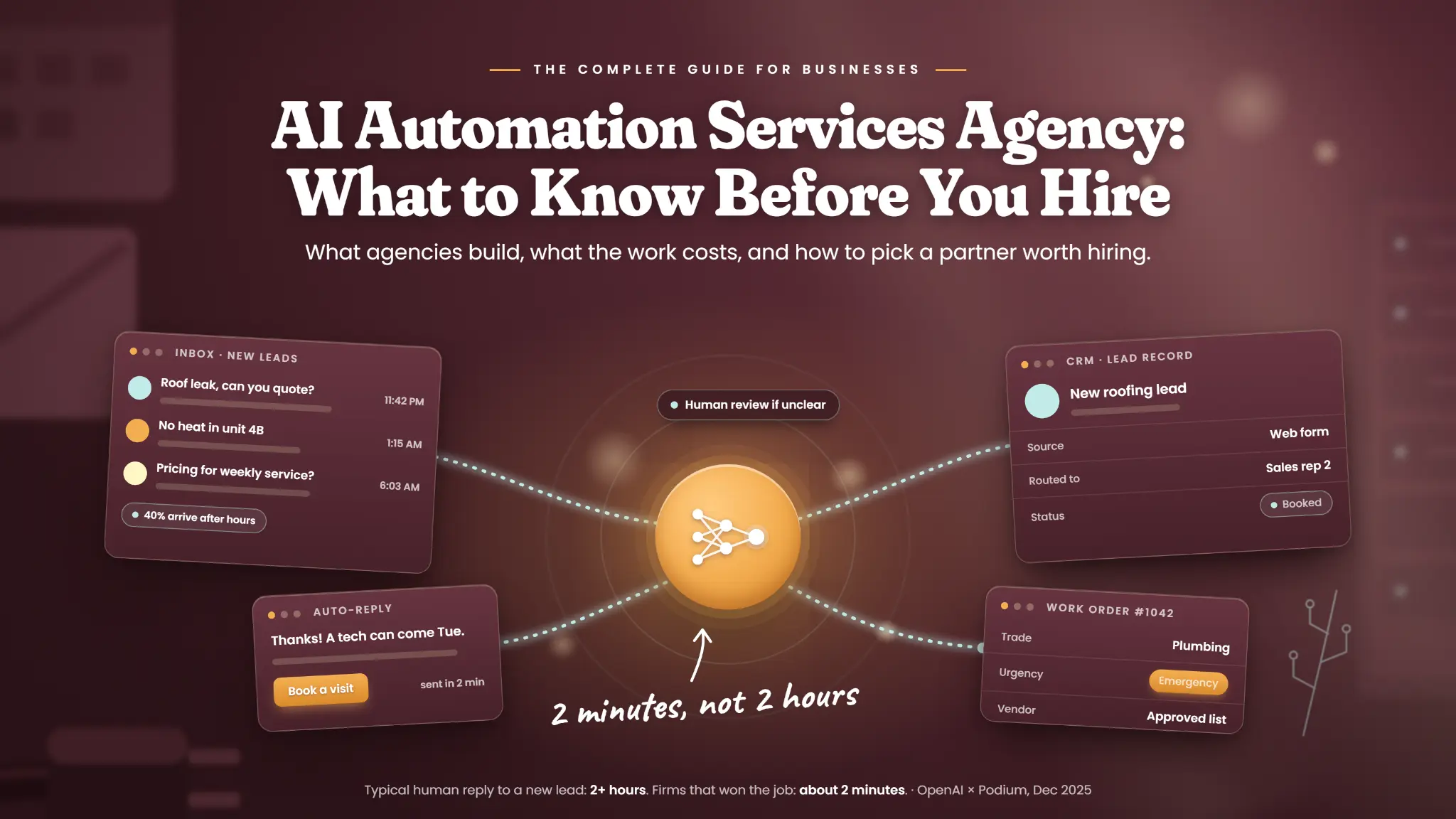
Slow replies cost small businesses real jobs. OpenAI found the typical human reply to a new lead took more than two hours. The businesses that converted the most leads answered in about two minutes, and roughly 40% of inquiries arrived after hours.
An AI automation services agency builds the systems to close the gap, but the wrong agency wastes the budget. This article explains what these agencies build, what the work costs, and how to pick a partner worth hiring.

TL;DR
- AI automation services pair AI models with workflows to clear manual work.
- An agency audits, builds, connects, and maintains the automations.
- Rule-based tools suit fixed steps, while AI handles messy inputs.
- Pricing depends on scope, integrations, usage billing, and upkeep.
- Good partners show working proof, hand over ownership, and plan for failure.
- Low-volume or unstable processes rarely justify an agency build yet.
What Are AI Automation Services?
AI automation services are work an outside team does to build and maintain systems where AI models handle steps in a business process. The AI reads and sorts incoming requests, then drafts a reply or routes each one. Workflow tools carry out the actions, such as updating the customer database (CRM) or booking the job. A person still reviews the cases the AI flags as unclear.
So, what does an AI automation agency do? The agency sells AI automation as a managed service, from scoping to upkeep. AI automation services for businesses replace the need to buy separate tools and wire them together in-house.
AI Automation vs Traditional Automation
AI automation handles messy inputs like emails and PDFs, plus steps needing judgment, while rule-based automation runs fixed if-then steps. Robotic process automation (RPA) is a third option, where software bots copy the clicks a person makes on screen. Each approach breaks differently. The table compares the three on five practical points.
|
|
Rule-Based Automation |
Robotic Process Automation (RPA) |
AI Automation |
|
Input Type |
Structured fields in fixed formats |
Structured data inside app screens |
Emails, chats, PDFs, and free text |
|
Handles Change |
New cases need new rules |
Breaks when screens change |
Adapts to new wording and formats |
|
Best Fit |
Stable, high-volume steps |
Old systems with no way to connect |
Reading, sorting, and drafting |
|
Upkeep |
Edit rules as the process shifts |
Fix bots after screen changes |
Check outputs and AI instructions |
|
Typical Failure |
Unmatched cases drop through |
Bot stalls after a layout change |
Confident but wrong answer |
The three approaches work best together. Most real systems use fixed rules for actions, such as creating a record, and AI for reading and deciding. RPA still earns a place where an old system can’t connect to other software and a bot has to click through screens.
Why an AI Automation Services Agency Matters for Small Businesses
AI tools are easy to try, but steady results are much harder to get. Many projects stall once the demo ends, and the owner pays for the gap. With AI automation services for small businesses, the partner and the method decide the outcome more than the software does.
Adoption is spreading unevenly. A May 2026 Census Bureau release put the share of US businesses using AI at 19.8%, based on Census data as of May 3, 2026. Firms with 20 or more employees were the heaviest users.
Adoption and results are different measures. A May 2025 IBM study of 2,000 CEOs found only 25% of AI initiatives delivered the expected return on investment (ROI) over the previous few years. Only 16% scaled across the enterprise.
A small firm with no engineers feels a failed project faster. A chat assistant nobody tunes misses the after-hours leads the assistant was meant to catch. A good agency earns the fee by picking the right process first. The agency then records a baseline and measures results against the baseline after launch.
Types of AI Automation Services
Agency work falls into four broad types, from back-office business automation to customer-facing AI agents. Most projects mix two or more, since one process usually touches several systems. Knowing the type still helps a buyer scope the work and compare quotes.
Business Automation Services
Business automation services handle repetitive admin work such as data entry, document handling, and scheduling. An AI model reads a form, an email, or a PDF and pulls names and amounts into clean fields, so nobody retypes the details. Agencies often sell the work as process automation, starting with a map of each step.
Workflow Automation and the AI Workflow Automation Agency
Workflow automation links the CRM, email, forms, and spreadsheets into one flow, triggered by an event such as a new form entry. AI handles the judgment steps, such as classifying a request or drafting a reply. An AI workflow automation agency adds value once a flow spans many tools and needs monitoring.
Simple flows with two tools and one trigger often suit in-house low-code builds. A workflow automation agency pays off when silent failures would cost real money.
IT Automation Services
IT automation services handle internal requests such as ticket routing and new-hire accounts. The split from business automation comes down to who gets served. Business automation serves customers and sales teams, while IT automation serves systems and staff.
AI helps here by reading a messy ticket and sending the request to the right queue. Permissions stay rule-based, so an AI model never grants access alone.
AI Agents and Custom AI Solutions
AI agents go further than a single automated step. An agent reads a request and then acts across connected systems. Good builds hand the conversation to a person when confidence runs low or the action carries risk. Scoping the handoff points is an early step in agent development.
What AI Automation Services Do for Each Department
The useful starting question is which daily handoffs eat staff hours. A handoff is any moment where one person copies, checks, or forwards work. Sales, support, operations, finance, and reporting each have a few, and the manual tasks behind them repeat every day.
Sales and Lead Management
New inquiries often sit in an inbox until someone is free. Automation sends an instant reply and routes each lead to the right rep. After a sales call, the system summarizes the conversation and updates the CRM record. The payoff is fewer cold leads and cleaner records.
Customer Support
Support teams spend much of the day sorting messages before answering any. AI sorts each message by topic and urgency, then answers common questions from the firm’s own help content. Well-built support chatbots pass anything outside approved content to a person, with the history attached. Customers repeat themselves less, and staff keep the harder cases.
Operations and Admin
Operations work often spans an online store, a project tool, and a shared spreadsheet. Automation passes each new order or task between the systems. One documented case used connected systems to tie a store, a project tool, spreadsheets, and a database together. The first win usually comes from removing copy-and-paste between screens.
Finance and Invoicing
Chasing late payments by hand eats into a small finance team’s week. AI can send payment reminders on schedule and match each deposit to the right invoice. The system flags odd entries, such as a duplicate charge, for review. Sound financial automation keeps a person checking AI output before anything goes into the books.
Reporting and Data
Performance data usually sits across many platforms, and gathering the numbers by hand eats hours. Automation pulls each source into one dashboard on a schedule. One reporting platform built for a roofing marketing agency connected more than 15 business platforms to feed ROI dashboards. Weekly summaries then reach the owner without anyone rebuilding a spreadsheet.
How AI Automation Agency Services Work
Most AI automation agency services follow the same six stages, whatever the department. Timelines depend on scope. Buyers most often skip the baseline and the monitoring, and without both, nobody can prove the payoff or catch a broken workflow early.
- Discovery starts with a process audit that maps how work moves today and which tasks repeat often. The audit feeds an AI strategy and a ranked shortlist of processes.
- The roadmap sets the build order, and a baseline records hours, volume, and error rate for each process. The baseline becomes the yardstick for ROI.
- The build stage wires each automation into the software the team already uses. Careful AI integration keeps the work inside the CRM or inbox.
- Testing runs real cases, including half-filled forms and long email chains. The round ends with fixes and a rule for when a case goes to a person.
- Launch and training put the system live and show staff how to review output. The team leaves able to run the system day to day.
- Monitoring and improvement continue after launch, because AI models change over time and connected apps get updated. Regular checks against the baseline catch small errors early.
How the Math Works for a Property Management Firm
Picture a 40-person property management firm, with round numbers for illustration only. Tenants send maintenance requests by email, text, and a web portal, and one coordinator handles every message by hand. A high-volume, repeatable intake process like this one makes a natural first project.
The coordinator reads each request and types the details into the work-order system. The coordinator then picks a vendor and replies to the tenant. At about six minutes each and 600 requests a month, intake eats 60 hours. After-hours emergencies wait until morning.
The automated version keeps the same steps but hands the reading and routing to software:
- A request arrives by email, text, or the portal and lands in one queue.
- An AI model reads the message and labels the trade and the urgency.
- Fixed rules create the work order and pick a vendor from the approved list.
- The tenant gets a confirmation with the work-order number.
- Emergencies, such as flooding or no heat, trigger an alert to the on-call manager.
- Unclear or unusual requests go to the coordinator, keeping a human in the loop.
The AI reads messy free text, while plain rules pick the vendor, so the firm, not the AI, decides which vendor gets each job.
The math uses a simple formula: monthly savings equals hours saved times the hourly staff cost, minus running costs and the retainer. In this illustration, automation clears 480 of the 600 requests and saves 48 hours. At an assumed $30 an hour, counting wages and benefits, the gross saving comes to $1,440 a month.
Subtracting an assumed $200 in usage fees and a $500 retainer leaves $740 a month, so a $6,000 build pays back in about eight months.
The payback still depends on clean inputs. A messy vendor list would break the routing rules on day one, and flagged requests would pile up if nobody owned the exception queue. None of the math holds without a real baseline.
Benefits and Limitations of AI Automation Services
Most owners hear about the upside first and the upkeep later. The gains are real, but the limits tend to surface after launch. A clear view of both keeps expectations honest before anyone signs.
The main benefit is time back, along with fewer typing errors and faster replies. A November 2025 St. Louis Fed analysis put generative AI time savings at 1.6% of all work hours across its 2025 surveys. The figure counts users and nonusers alike, which is why targeted processes matter more than broad rollouts.
The limits start before launch, since someone has to map the process and test odd cases. Upkeep never stops, because AI models change and connected apps get updated. Judgment calls and exceptions still need a person.
Data quality sets a ceiling on every result. Duplicate contacts and missing fields spread faster once automated, and cleanup often takes longer than the build. Firms with messy systems may need data engineering work first.
How Much Do AI Automation Services Cost?
The cost depends on scope, integrations, usage, and upkeep, so few agencies publish prices. A single workflow linking two apps costs far less than a multi-department build. Usage billing then adds a running cost on top of the build fee.
Most AI automation agency pricing follows one of four models: a fixed-price project, a monthly retainer, a setup fee plus a retainer, or per-automation packages. A cost estimator helps rough out a budget before the first call.
Hourly rates give another reference point. Clutch’s AI development pricing guide, updated in September 2026, puts the average at $25 to $49 an hour, with rates varying by location and seniority.
Six factors move a quote up or down more than anything else.
|
Cost Driver |
Why the Price Rises or Falls |
|
Number of workflows and systems |
Each extra app adds connections to build and test |
|
Rules vs AI decisions |
Fixed rules cost less, while AI steps need more testing and review |
|
Data cleanup |
Messy records add hours before the build starts |
|
Volume and usage-billed costs |
More runs mean bigger platform and model bills |
|
Support level after launch |
Monitoring and fixes raise the monthly fee |
|
Compliance needs |
Audit logs, access controls, and reviews add work |
The build fee is rarely the full bill. Automation platforms charge by the number of tasks or runs, or by user. AI model providers charge by the amount of text processed, so running costs climb with volume. Ask for the running cost at your own volume, since platform choice shapes the monthly bill.
The exact price depends on the project. The practical step is to scope one workflow and get a quote for both the build and the monthly running cost. The free audit described at the end of this guide covers this step.
Is AI Automation Right for Your Business?
Most businesses can find a task worth automating, but fewer have a process ready for an agency build. The real test is whether the work repeats often enough, and stays steady enough, to pay back the build. Volume and stability matter more than enthusiasm.
The clearest sign is a task repeated daily in the same way. Staff retyping data between tools is another, and so are slow replies to leads. The process should also be written down, with someone inside the company ready to own the system.
A short AI readiness assessment, such as the readiness scorecard, takes about three minutes.
An agency build is overkill in some cases. A task done twice a week rarely repays a custom build, and a process still changing every month will break whatever gets built around the old version. Scattered data needs cleanup first, and with no internal owner, small failures pile up.
For one or two simple workflows, a cheap template tool may be enough. A closer look at when an AI automation agency for small businesses is worth hiring covers the trade-off.
How to Choose an AI Automation Agency
Knowing how to choose an AI automation agency starts with the complaints buyers already post. Reviews of automation agencies often describe support fading after onboarding and delivered work falling short of the pitch. Both problems are easier to catch before signing, through six direct questions.
- Who owns the workflows, code, and accounts at handover? Everything should sit in your company’s name.
- What does one run cost at your volume? Multiply the per-run figure by monthly volume before accepting a quote.
- What happens when a connected app or AI model changes? The agency should explain how the system gets tested and patched.
- What is the human fallback? A sound build sends unclear or high-stakes cases to a person.
- Can you see a working system on realistic data? A polished demo on clean samples says little about messy inputs.
- What does support cost after launch? Get the retainer and the work covered in writing.
Some warning signs show up in the first call. A promise of guaranteed ROI overstates what automation can deliver. So does a favorite tool pitched before any questions about the problem. Vague ownership terms and prices revealed only after a long contract deserve the same caution.
Many buyers search for AI automation agency reviews, or check whether an AI automation services agency is legit, before booking a call. Review sites show only part of the picture. A reference call with a past client works better, so ask what broke after launch and how fast the fix came.
The right partner also depends on the work. A workflow automation agency connecting existing tools differs from a firm building custom agents, and a guide to agency types explains which fits which problem.
AI Automation Agency Trends 2026: What Buyers Should Watch
Agency work keeps changing through 2026, and some changes affect what a buyer should ask. Most trend coverage chases new features, but only a few shifts change a buying decision. Three deserve a question in every agency conversation this year.
Agents are moving into front-office work. Stanford HAI’s 2026 AI Index put organizational AI adoption at 88%, and small businesses can now buy agents to answer messages and book appointments. The practical question is when the agent hands a conversation to a person.
Connection standards are settling too. In December 2025, Anthropic donated the Model Context Protocol to the Linux Foundation’s new Agentic AI Foundation. The protocol is an open standard for connecting AI applications to external systems. Integrations built on shared standards are easier to move between vendors.
Rules keep shifting as well. The European Commission says strict obligations for high-risk AI systems start on December 2, 2027. Colorado also rewrote its AI law in 2026. Ask any agency how a build would adapt if new rules reach the workflow.
Final Verdict on Hiring an AI Automation Services Agency
Hiring an AI automation services agency is worth doing when a costly process repeats often, and someone in-house will own the result. Wait when the process changes monthly, or the data sits scattered. Build in-house when one or two simple tool-to-tool workflows are all the business needs.
The decision depends less on the AI and more on the process. Count how often the work happens and what each manual pass costs. Then name an owner for exceptions after launch.
Everything above points to one first step, which is choosing one process and one owner. Data Prism, which has a US office in Atlanta, offers a free audit through a 30-minute strategy call with a senior data engineer. The call scopes one workflow and covers pricing, since pricing depends on the project.
Frequently Asked Questions
What are AI automation services?
The services combine AI models with business workflows to handle repetitive work, such as sorting emails or updating records. A provider builds and maintains the automations, while people review the cases the AI can’t settle.
How much do AI automations cost?
Cost depends on scope, the number of integrations, and ongoing upkeep. Agencies usually price by project, by monthly retainer, or as a setup fee plus a retainer, with AI model and tool usage billed on top.
How long does AI automation take to set up?
Setup time depends on scope. A single workflow between two tools goes live faster than a multi-system build, and testing with real cases from the business adds time before launch.
Can small businesses afford AI automation?
Yes, as long as the first project targets one high-volume workflow. AI automation services for small businesses often begin as a pilot, so the owner sees results before paying for a wider build.
What is the difference between business automation and IT automation?
Business automation targets department work like routing leads or chasing late payments, while IT automation targets the systems underneath. Typical IT tasks include new user accounts and help-desk ticket routing.
Book a Free 30-Minute Meeting
Discover how our services can support your goals — no strings attached. Schedule your free 30-minute consultation today and let's explore the possibilities.
Book a Free Call