

10 Best Business Process Automation Companies to Hire

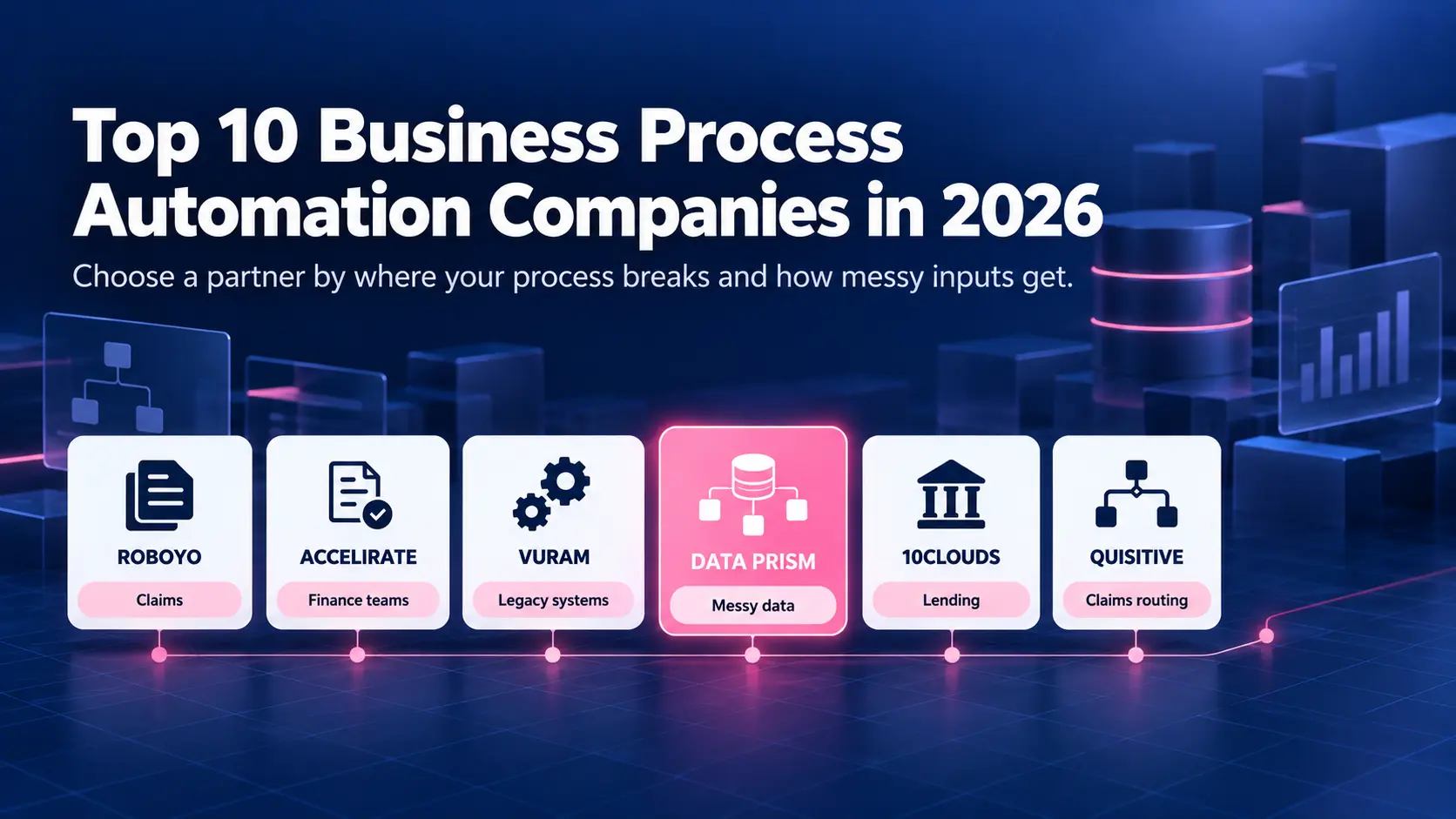
Cover graphic reading Top 10 Business Process Automation Companies in 2026, with six company cards and Data Prism lit up.
Written byPrincipal Data/AI Architect
Technically reviewed byMuneeb ud DeenBusiness Automation Consultant
Published
Updated
Reading time
15 min

Summarize with AI

Introduction

At BABR, a UK firm in insolvency and commercial finance, three employees spent a full workday compiling one marketing report. This guide compares 10 business process automation companies able to take over work like this, using published client results, industry fit, and price. The goal is a shortlist of two or three firms in one sitting.

Data Prism automated the BABR report and also publishes this list. So, the method below holds Data Prism to the same bar as the other nine, and every result cited comes from a published case study.

Quick Answer: The Best Business Process Automation Companies by Need

The best business process automation company depends on the buyer’s size, platform, and industry. Five picks cover the most common needs.

  • Data Prism is the best overall pick for small and mid-size firms building AI workflows, with up to 92% less manual effort for Lovey Prints.
  • Roboyo is the best pick for enterprise RPA, with UiPath robots verifying AOK Niedersachsen claims in under one minute.
  • Quisitive is the best pick for businesses on Microsoft, as a Microsoft Frontier Partner building on Azure and Dynamics 365.
  • Flobotics is the best pick for healthcare, with AI agents built for revenue cycle work such as denials and prior authorization.
  • Azilen Technologies is the best pick for tight budgets, with the lowest published hourly rate on this list at $25 to $49.

How These Business Process Automation Companies Were Ranked

Shortlisting started with business automation companies building process or AI automation for clients, each with at least one published case study. Companies passing this check were then ranked on automation capability, technical depth, and verified client projects. Every result below comes from each company’s own published case study.

Data Prism also publishes this article, which is a plain conflict of interest. Because of this, Data Prism’s entry faced the same bar.

Company facts were checked on October 21, 2026. Clutch rates and the comparison tables were updated on November 17, 2026.

Agent-focused firms appear in a separate AI automation shortlist.

What Is Business Process Automation and AI Automation?

Business process automation hands the repetitive steps of a business process, such as data entry and approvals, to software. AI automation adds models for inputs without a fixed format, such as emails and scanned PDFs. A person still reviews any case the model flags as unsure.

The best first processes are stable, high-volume tasks with written rules, such as invoice capture, claims intake, and multi-app reports. A separate AI process automation guide shows where AI adds value and where fixed rules are enough.

AI adoption is still early. The US Census Bureau’s Business Trends and Outlook Survey put AI use at 17% to 20% of US businesses between December 2025 and May 2026. AI use reached 37% among firms with 250 or more employees. The Bureau broadened the question in November 2025, so treat the figures as a snapshot.

Business Process Automation vs RPA vs No-Code Tools

Robotic process automation (RPA) is one tool inside business process automation. RPA bots copy a person’s clicks on screen, while business process automation redesigns the process and connects systems through APIs. So, is RPA still a thing? Yes, robotic process automation services remain the simplest route into stable legacy screens with clean inputs and no API.

No-code tools like Zapier or Make often cover linear tasks between a few apps, where a failure costs minutes of cleanup. Many business process automation services build on both tools, since no-code automation suits many first versions.

Intelligent process automation (IPA) adds AI models to bots and APIs. The models read emails and scans a bot alone can’t parse, which is the idea behind intelligent automation. The table compares the four approaches.

Approach

How It Works

Best For

Business Process Automation

Redesigns the process and connects systems through APIs

Multi-step processes across several apps

Robotic Process Automation

Bots copy a person’s clicks on screen

Legacy screens with no API

No-Code Tools

Prebuilt connectors in Zapier or Make

Linear tasks between a few apps

Intelligent Process Automation

AI models read inputs, then bots or APIs act

Emails, scans, and other messy inputs

A custom build pays off once exceptions, scans, or costly failures appear.

Do You Need a Platform or an Implementation Partner?

A platform is the software license, while an implementation partner maps, builds, and maintains workflows on it. Buying UiPath, Appian, or Power Automate alone suits a team with in-house builders. Most companies on this list are partners, and several build on those same platforms.

Factor

Platform Alone

Implementation Partner

Cost

License fee only, from $15 a month per user

Build fee and upkeep on top of licenses

Who Builds

Your own team

The partner, then a handover

Best Fit

Stable, simple workflows

Processes with exceptions or legacy systems

Owner Needed

An in-house builder

A named owner on both sides

A guide to choosing an automation platform compares the tool categories in more detail.

The Top 10 Business Process Automation Companies

The companies below range from UiPath partners to custom AI builders. So, rank matters less than fit with your platform, industry, and process. The table below shows where each company is based, its best-fit buyer, its platforms, a published client result, and a price signal.

Company

Headquarters

Best For

Platforms

Client Result

Price Signal

1. Data Prism

Atlanta, Georgia

Small and mid-size firms with disconnected apps

Python, OpenAI, Make, Zapier

Lovey Prints, up to 92% less manual effort

$50 to $99 an hour

2. Roboyo

Nuremberg, Germany

High-volume claims work

UiPath, ABBYY

AOK Niedersachsen, €1.4 million saved a year

Not published

3. Accelirate

Sunrise, Florida

Finance teams on UiPath

UiPath, Agentforce, MuleSoft

Fin Union, 977 hours saved a year

Not published

4. Vuram

Chennai, India

Insurers on legacy systems

UiPath, Appian, ServiceNow

Unnamed insurer, 40% faster quotes

Not published

5. Flobotics

Munster, Indiana

Healthcare revenue cycle teams

UiPath

PathGroup, denials in 55 seconds

$100 to $149 an hour

6. 10Clouds

Warsaw, Poland

Lenders automating credit review

AIConsole

Polish bank, 50% faster credit analysis

$50 to $99 an hour, $25,000 minimum

7. Stfalcon

Tallinn, Estonia

Logistics and transportation firms

Gemini, custom software

Customs broker, 30 to 10 minutes per client

Not published

8. Sigmoid

San Francisco, California

Manufacturers adding ML to maintenance

Custom ML models

Industrial firm, 70% fewer irrelevant alerts

Not published

9. Quisitive

Irving, Texas

Microsoft and Dynamics 365 users

Azure, Copilot Studio, Dynamics 365

Infusion provider, 20 to 94 claims a day

Not published

10. Azilen Technologies

Ahmedabad, India

Ticket, CRM, and ERP workflows

LangGraph, n8n, Claude, Gemini

Retail software firm, 63% better forecasts

$25 to $49 an hour

Price signals are the hourly rates each firm lists on its own Clutch profile, checked on November 17, 2026. “Not published” means the firm lists no rate there or on its website. Azilen’s CRM and ERP work also overlaps with a separate comparison of AI integration companies.

1. Data Prism

Data Prism is a business process automation and AI automation company with an Atlanta office. The firm also offers data engineering, so every workflow runs on a data layer built in-house. Projects combine Python, OpenAI, Make, and Zapier.

Data Prism homepage with a data engineering consulting headline, impact figures, and Upwork, Clutch, and DesignRush badges.

For Lovey Prints, a Shopify art store, the firm built Shopify automation on a Python pipeline. The pipeline routes customer photos to artists and sends unmatched files to human review. Data Prism reports up to 92% less manual effort.

For FirstList, a real estate platform, the firm built a Facebook data pipeline. The pipeline’s OpenAI model turns free-form posts into property records. Data Prism reports 70% less manual processing.

For BABR, the firm built marketing data automation on Make and Zapier. The automation syncs marketing and CRM records from six sources daily.

Automation sits inside a wider set of Data Prism service lines, from AI planning through data infrastructure. The table below pairs each service area with the work behind it.

Service Area

What Data Prism Builds

Automation

Business process automation, RPA, and no/low-code workflows

AI Integration

AI connected to CRMs, ERPs, warehouses, and business tools

AI Agents and Generative AI

Custom AI agents, AI apps, and LLM-powered workflows

AI Strategy and Consulting

Readiness assessments, use-case scoring, and phased AI roadmaps

Data Engineering

Pipelines, warehouses, data lakes, migrations, and Snowflake consulting

Analytics and Visualization

Dashboards and reporting built on warehouse data

Data Collection and Extraction

Web scraping, document extraction, and multi-source data feeds

API Integration and Custom Software

CRM, marketing, and social media APIs, real-time syncing, and custom apps

Beyond e-commerce, real estate, and commercial finance, named client projects reach recruiting (GrabJobs), cruise travel (Playbook Travel), restaurant delivery data (Loop AI), and furniture manufacturing (Kaemark). Data Prism suits startups, SMBs, and mid-market companies, including SaaS and marketplace businesses.

Data Prism fits small and mid-size firms with disconnected apps.

Not Ideal For: Enterprises running hundreds of UiPath bots under one central team.

Consider Instead: Roboyo, if the work is enterprise RPA at high volume.

2. Roboyo

Roboyo is a robotic process automation company building RPA bots, document processing, and agentic AI agents. Roboyo uses process mining to choose what to automate first.

Roboyo homepage on a blue background listing 600+ specialists across 14 countries, Fortune 500 companies, and 300+ clients.

For German health insurer AOK Niedersachsen, Roboyo paired ABBYY FlexiCapture with UiPath robots. Roboyo reports claim verification in under one minute and €1.4 million in annual savings. Roboyo suits high-volume claims work.

Not Ideal For: Small firms automating a few apps on a tight budget, since Roboyo publishes no rates.

Consider Instead: Accelirate, if the main process is accounts payable on UiPath.

3. Accelirate

Accelirate builds AI agents and agentic automation from Sunrise, Florida. The firm is a UiPath Diamond Partner and works with Salesforce Agentforce and MuleSoft. Many published cases cover accounts payable.

Accelirate homepage with an AI First Systems With Human in the Lead headline and a dashboard of live AI agents.

For credit union Fin Union, a UiPath agent checks purchase orders against invoices. Accelirate reports 977 hours saved a year and a 99% error reduction. Accelirate fits finance teams on UiPath.

Not Ideal For: Teams on the Microsoft stack with no UiPath licenses.

Consider Instead: Quisitive, if the business already runs on Microsoft and Dynamics 365.

4. Vuram

Vuram sells hyperautomation and agentic AI services under the WNS Vuram brand. WNS owns Vuram and is now part of Capgemini. Vuram is a UiPath Platinum Partner and works on Appian, ServiceNow, and Microsoft.

WNS Vuram homepage with a Co-create Smarter Businesses with Hyperautomation and Agentic AI headline on a dark background.

For a Middle East general insurer on legacy systems, Vuram reports a 40% cut in quotation time.

Not Ideal For: Buyers who need a named reference client, since the published insurance case is anonymous.

Consider Instead: Roboyo, if the volume sits in claims processing.

5. Flobotics

Flobotics, a UiPath partner, builds AI automation for healthcare revenue cycle management. Flobotics’ bots and agents handle eligibility, prior authorization, claims, and denials. The agents connect health record systems to payer portals. Neither gets replaced.

Flobotics homepage with a We automate the work between your systems headline beside a prior authorization agent panel.

For PathGroup, Flobotics reports denial processing falling from about 10 minutes to 55 seconds.

Not Ideal For: Processes outside healthcare billing and revenue cycle work.

Consider Instead: Accelirate, if the back-office work is finance rather than healthcare.

6. 10Clouds

10Clouds is a Warsaw software company building AI for banks, insurers, and fintechs. 10Clouds agents automate lending and account opening on AIConsole, the firm’s orchestration platform.

10Clouds homepage with a We Help Build Agentic Financial Institutions headline and a 4.9 Clutch rating below.

In an October 2024 proof of concept for a Polish bank, 10Clouds reports over 50% faster credit analysis. 10Clouds fits lenders by automating credit review.

Not Ideal For: Projects under $25,000, the minimum on 10Clouds’ Clutch profile.

Consider Instead: Azilen Technologies, which lists a $10,000 minimum on Clutch.

7. Stfalcon

Stfalcon builds custom platforms, AI agents, and document automation, mainly for logistics and transportation firms. The team works from Tallinn, Estonia, and Khmelnytskyi, Ukraine.

Stfalcon homepage with a Custom solutions for growing logistics operations headline and a case study banner on top.

For a Ukrainian customs broker, a Gemini-powered agent moves vehicle data from Telegram into the CRM. The agent cut processing from 30 minutes per client to 10.

Not Ideal For: Teams wanting an RPA platform partner rather than custom software.

Consider Instead: Roboyo, if the process should run on UiPath robots.

8. Sigmoid

Large enterprises hire Sigmoid for data engineering, machine learning, and generative AI. Sigmoid also builds AI agents from offices in San Francisco and Bengaluru.

Sigmoid homepage with a Transform your business with Agentic AI headline over a factory conveyor of white and red pills.

For an industrial automation leader, an unsupervised ML system watches over 800 sensors per press. Sigmoid reports 70% fewer irrelevant fault alerts. Sigmoid fits manufacturers adding ML to maintenance.

Not Ideal For: Small firms automating simple tasks between a few apps.

Consider Instead: Data Prism, if the work is app-to-app workflows on Make or Zapier.

9. Quisitive

Quisitive is a Microsoft partner headquartered in Irving, Texas. The firm builds AI agents on Azure and Copilot Studio. Microsoft named Quisitive a Frontier Partner in May 2026.

Quisitive homepage with a Forward Faster headline, a Microsoft Frontier Partner badge, and client logos along the bottom.

For a US home infusion provider, daily automated routing on Dynamics 365 lifted collector capacity from 20 to 94 claims a day.

Not Ideal For: Companies outside the Microsoft stack.

Consider Instead: Azilen Technologies, if the workflows mix several AI models and tools.

10. Azilen Technologies

Azilen Technologies is an enterprise AI developer with a US office in Irving, Texas. Azilen’s services cover ticket routing, CRM workflows, and ERP integrations. The team uses Claude and Gemini models with LangGraph and n8n.

Azilen Technologies homepage with a Building Next Layer of AI headline and Headless, Lean, Enterprise-wide in red.

For a Canadian retail software provider, Azilen reports 2.5 times faster schedule management and 63% better forecasting accuracy.

Not Ideal For: Buyers who want a certified UiPath partner.

Consider Instead: Vuram, a UiPath Platinum Partner that also works on Appian and ServiceNow.

Best Business Process Automation Company by Industry

The best business process automation company for an industry is the one with published work in it. The table pairs each industry with the company on this list holding a published client result there.

Industry

Best Pick on This List

Evidence

E-commerce and Retail

Data Prism

Lovey Prints, a Shopify art store

Retail Software

Azilen Technologies

A Canadian retail software provider

Logistics and Customs

Stfalcon

A Ukrainian customs broker

Real Estate

Data Prism

FirstList, a real estate platform

Health Insurance

Roboyo

AOK Niedersachsen

Healthcare Billing

Flobotics

PathGroup

Credit Unions

Accelirate

Fin Union

Banking and Lending

10Clouds

A Polish bank

General Insurance

Vuram

A Middle East general insurer

Manufacturing

Sigmoid

An industrial automation leader

Three of these industries have their own deeper lists. Logistics teams can compare logistics automation companies, while online sellers can compare e-commerce automation companies. Property firms get the same treatment in a list of real estate automation companies.

Types of Business Process Automation Companies

Business process automation companies fall into four types, and each one sells something different. This list covers implementation partners only, so platform vendors, consultancies, and outsourcing firms sit outside it.

Type

What They Sell

Examples

Best Fit

Platform Vendors

Automation software licenses

UiPath, Appian, Microsoft

Teams with in-house builders

Implementation Partners

Builds on a platform or in custom code

All 10 companies on this list

Firms without an internal build team

Consultancies

Process assessments and automation roadmaps

Accenture, Deloitte

Large programs that need a plan first

BPO and BPS Providers

People and software running the whole process

WNS, Genpact

Firms handing off the process entirely

Implementation partners also differ among themselves, from RPA specialists to custom AI builders. A guide on AI automation agencies explains the main agency types inside this group.

What Business Process Automation Costs

Business process automation solutions carry costs in software licenses, build work, and upkeep. Most quotes show only the licenses. Licenses bill per user, per bot, or per task, so volume drives the bill. Prices below were checked on October 21, 2026, and none are Data Prism prices.

Cost Item

Public Price

Zapier Pro

$19.99 a month paid yearly, 750 tasks

Power Automate Premium

$15 a month per user on Microsoft’s price list, paid yearly

Power Automate Process

$150 per bot a month, paid yearly

UiPath Basic

From $25 a month, higher tiers by quote

Agency Rate

$25 to $49 an hour at most AI agencies, per Clutch pricing

Typical AI Project

$10,000 to $49,999 on Clutch

Data Prism’s software development cost estimator gives a rough build figure before any vendor call.

Build Cost by Scope

Build cost grows with the number of workflows and systems involved. Published rate cards and Taskip’s 2026 pricing guide give the ranges below.

Scope

Typical Build Cost

Source

Single Workflow

$1,200 setup plus $250 a month

Alpenglow rate card

Several Workflows

$5,000 fixed for four n8n workflows

Goodspeed’s published offer

Department (Mid-Market)

$5,000 to $20,000 setup

Taskip pricing guide

Enterprise

$20,000 to $100,000 or more

Taskip pricing guide

Engagement Models

Most business process automation companies bill through one of three engagement models. The model decides who pays when a build runs over.

Model

How It Bills

Published Example

Fixed Price

One price for a defined build

Goodspeed, $5,000 for four workflows

Time and Materials

Hourly rate times hours worked

AgixTech, $150 to $350 an hour for discovery

Retainer

Monthly fee for upkeep and changes

$250 to $1,500 a month for small businesses

The AI automation agency pricing guide covers all six pricing models and a worked year-one payback example.

How to Choose a Business Process Automation Company

The strongest proof of a business process automation agency or consultant is published production work. Demos run on clean sample data with no exceptions, so demos prove less. The five checks below separate real builders from presenters.

What to Check

Question to Ask

Good Answer

Production Proof

Which named clients run your systems?

Published case studies

Exception Handling

Where does a failed record go?

A human review queue

Integration

Which steps use APIs and which use screens?

API integration over screen bots, which break on redesigns

Upkeep

Who fixes a broken workflow, at what cost?

A named owner and support price

Ownership

Who owns the code and tool accounts?

Terms written into the contract

The five checks are a starting point. A longer agency selection guide covers the full vetting process.

Camunda’s 2026 State of Agentic Orchestration and Automation report puts AI agent use at 71% among firms with 1,000 or more employees. Yet only 11% of agentic use cases reached production last year. So, ask each shortlisted partner for a trial on last month’s real records.

Some processes need AI consulting before any trial, because an undocumented process can’t be scoped or priced.

US buyers should also ask any partner for a current SOC 2 Type II report. Health data needs a HIPAA business associate agreement too. Contracts should carry CCPA or GDPR terms where either law applies.

A typical project then runs in seven steps.

  1. Record a baseline of volume, minutes per item, and rework.
  2. Map every step and exception.
  3. Check which systems offer APIs.
  4. Choose the build route and partner.
  5. Run a trial on real records with a review queue.
  6. Launch with alerts, a named owner, and handover documents.
  7. Measure against the baseline at 30 and 90 days.

Red Flags

Five red flags suggest a partner can’t deliver a working system. Any one of them deserves a question before signing.

  • The vendor names no clients and shares no published case studies.
  • The contract has no terms on code and IP ownership.
  • The quote includes no post-launch support or named owner.
  • License costs are missing from the quote and only appear after launch.
  • The vendor quotes a price before mapping the process.

A clear scope document prevents most of these problems. A guide to the statement of work shows how to write one.

Which Business Process Automation Company Fits Your Needs?

The right company depends on where the process breaks. Enterprises on UiPath fit Roboyo, Accelirate, Vuram, or Flobotics, while teams wanting custom AI fit 10Clouds, Stfalcon, Sigmoid, Quisitive, or Azilen. Small and mid-size companies with disconnected apps and messy data fit Data Prism.

For a small firm, the first question is whether outside help pays off at all. A separate guide on small business automation works through the numbers.

Every company above can automate a tidy process, but messy records separate them. Before signing, ask each vendor where unmatched records go, including Data Prism’s business process automation services.

Book a Free 30-Minute Meeting

Discover how our services can support your goals — no strings attached. Schedule your free 30-minute consultation today and let's explore the possibilities.

Book a Free Call

Frequently Asked Questions

Companies compare staff hours, error rates, and cycle time before and after launch. Record the baseline first, since manual effort is hard to rebuild later.

The workflow can stop mid-run when an API or screen layout changes. Before signing, ask any partner how breaks get caught and who pays for the fix.

Yes, because sample data hides the odd formats in real records. Access should still cover only the fields a data extraction service needs. Ask any partner where live data gets stored.

Yes. The outside team builds models and AI agents, while the internal team owns access, security reviews, and daily support. Ask any partner for handover documents and a named contact before the build starts.

Finance, healthcare, manufacturing, real estate, retail, and logistics all do. Among the companies above, Stfalcon focuses on logistics and transportation, while Azilen has published retail software work. High-volume work such as invoices, claims, EDI orders, and property records usually comes first.

A business process automation company typically charges $1,500 to $5,000 to set up a small-business workflow, plus $500 to $1,500 a month, in Taskip’s 2026 pricing guide. Mid-market setups run $5,000 to $20,000, and enterprise builds reach $100,000 or more. Software licenses usually sit on top of the agency fee.

Business process automation (BPA) redesigns a whole process and connects systems through APIs. Robotic process automation (RPA) uses bots to copy a person’s clicks on screens without an API. Intelligent process automation (IPA) adds AI models to either one, so the workflow can read emails and scanned documents before acting.

Buy a platform alone if the team has in-house builders and the workflow is stable and simple. Hire a partner when the process has exceptions, legacy systems, or no internal owner. Many partners on this list build on UiPath, Appian, or Microsoft, so the answer is often both together.

Book Consultation