


Introduction
What is an AI Automation Company?
The 10 AI Automation Companies Worth Your Shortlist
1. Data Prism
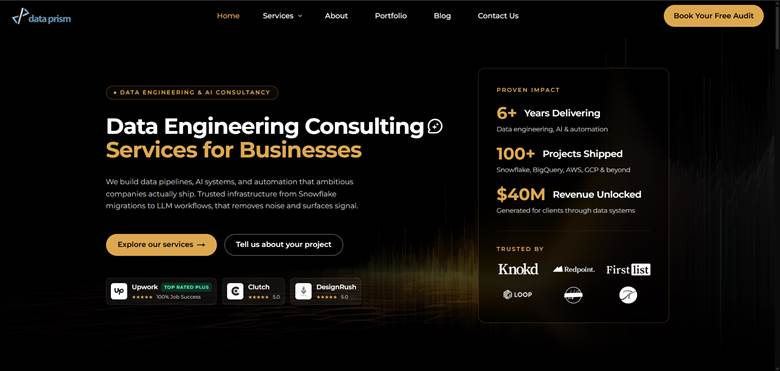
Data Prism is a data engineering and AI consultancy based in Atlanta, Georgia. The firm does the kind of data and automation work large enterprises take for granted. Startups and mid-sized businesses rarely have the same foundation.
The team covers AI consulting and strategy, workflow automation, and AI integration into existing CRM and ERP systems. Workflow automation here means document processing and approvals. The team also builds the data engineering that most automation projects sit on, from pipelines and warehousing through to migration.
Clients run from eCommerce brands and logistics providers to fintech startups and data-first SaaS platforms, across North America, Europe, and MENA. Past work includes a BigQuery data migration and a custom data-collection tool built for an investment research firm.
Data Prism fits founders and operations leads who want AI consulting, automation, and the data infrastructure underneath handled by one team instead of three vendors.
2. LeewayHertz
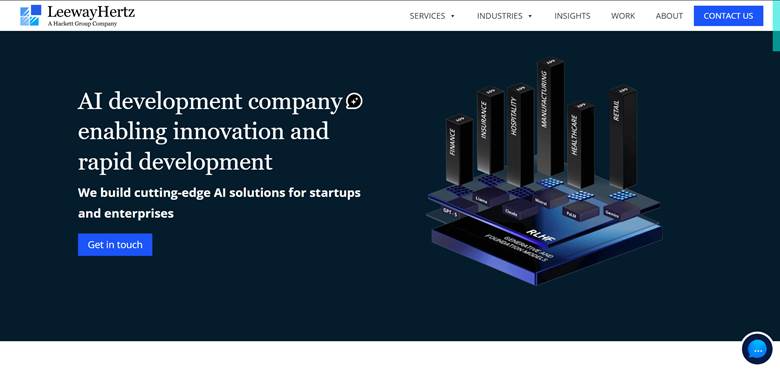
LeewayHertz brands itself as an AI development company and holds SOC 2 Type II and ISO/IEC 42001 certification. The firm has delivered more than 500 custom digital applications. One of them is an LLM-powered troubleshooting tool built for a Fortune 500 manufacturer. Its consultants work across natural language processing and predictive analytics.
LeewayHertz’s ZBrain platform ships more than 200 prebuilt data connectors. The platform also carries multi-agent orchestration tools the company calls Agent Crew, which turn business requirements into build-ready technical blueprints. Engagements run from AI strategy consulting through custom model development to full deployment and support. Clients range from startups to enterprise accounts.
LeewayHertz suits a mid-market or enterprise buyer looking for one vendor across strategy, build, and long-term platform ownership.
3. Markovate
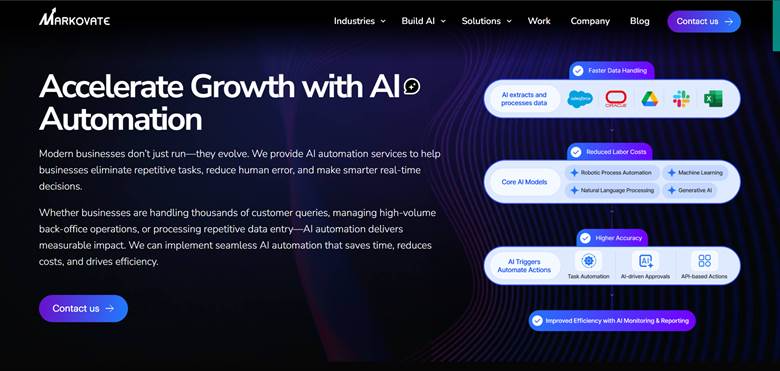
Markovate is a San Francisco company founded in 2015 by CEO Rajeev Sharma, previously an AI lead at AT&T and IBM. The firm has shipped over 300 solutions across construction, healthcare, manufacturing, insurance, and retail, and employs more than 50 certified engineers. Markovate calls the work AI automation services rather than AI consulting.
Markovate’s own case study reports a cut of more than 80% in manual review time for a construction blueprint-analysis tool built for civil engineers. The firm also reports a 30% lift in inventory turnover for a retail client using its predictive analytics. Markovate published both figures itself.
Markovate maps existing workflows first, then builds custom AI agents around the highest-value tasks. Automating a process end-to-end on day one comes later, if at all. Markovate works best inside a specific, document-heavy vertical, where deep domain experience counts for more than broad horizontal coverage.
4. Kanerika
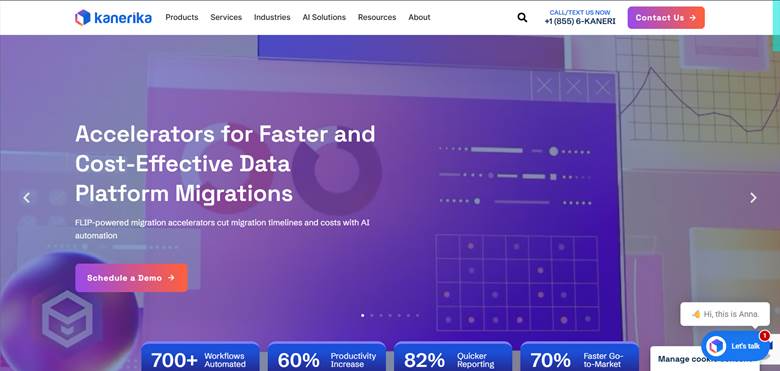
Kanerika is a global technology and data consultancy founded in 2015. More than 250 staff work across offices in the US, India, Argentina, and Singapore. The firm holds Microsoft Solutions Partner status for Data and AI, alongside ISO, SOC, GDPR, and CMMI accreditations. Sony, Volkswagen, Kroger, and HDFC appear among its named clients.
Kanerika’s FLIP platform handles low-code data-pipeline migration alongside intelligent automation work. Named agentic tools sit on top for specific tasks, including a data-insights agent called Karl and a customer-service agent called Ember.
Kanerika frames its AI consulting around a proprietary framework called the IMPACT methodology. The firm positions its engineering-led model against Big Four consultancies, which often subcontract the actual build to a different team.
Kanerika suits companies whose automation problem starts upstream. The trouble is usually fragmented or poorly governed data, well before the AI layer gets involved.
5. HatchWorks AI
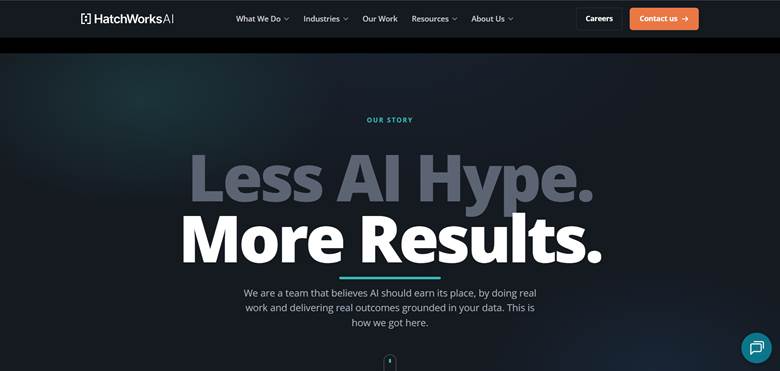
HatchWorks AI was founded in 2016 and is based in Atlanta. The firm built its practice around a proprietary methodology called Generative-Driven Development, and holds partnerships with Anthropic, Google, Databricks, and OpenAI. Clutch has named HatchWorks a top AI services company, by the firm’s own account.
Published Clutch data puts project minimums around $25,000. Typical client investment runs from $125,000 to more than $10 million, depending on scope. Clutch reviewers cite a velocity improvement close to 300% with almost no bugs on a telecom project. HatchWorks also modernized a legacy ATM marketing application for Diebold Nixdorf.
HatchWorks fits mid-market technology and healthcare companies looking for an embedded team they can watch work, not a black-box process handed back at the end.
6. Uvik
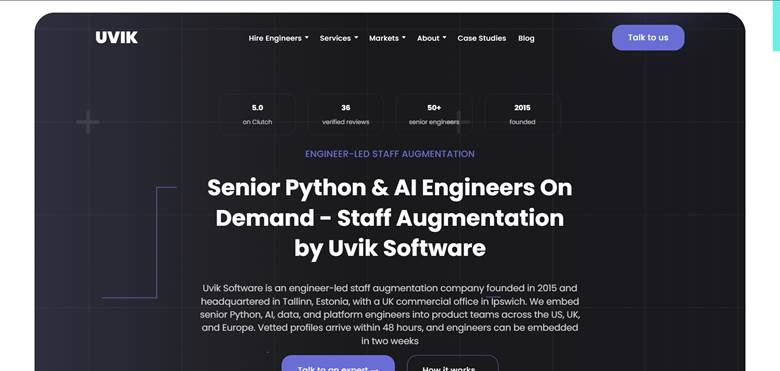
Uvik is an Estonia-headquartered firm founded in 2015, with an engineering hub in Tallinn and a commercial office in Ipswich, UK. The firm staffs senior Python and AI engineers hourly or on embedded teams. Published role-based rates run from $50 to $140 an hour. Every placement carries a 30-day replacement guarantee.
The stack centers on LangGraph and CrewAI for multi-agent orchestration, plus LangChain for retrieval pipelines. Uvik belongs to Anthropic’s Claude Partner Network and holds Databricks Bronze partner status. Clients sit in telecom, fintech, and SaaS across Europe and North America, and Uvik holds five stars across more than 35 verified Clutch reviews.
Uvik suits engineering leaders who want to pick the senior engineer and keep them under direct control.
7. EffectiveSoft
EffectiveSoft was founded in 2003 and is headquartered in San Diego, with regional offices across the US, Europe, and Costa Rica. The firm has built software for more than 20 years and now offers AI automation services alongside its core development work.
Research and Markets listed EffectiveSoft in its “Agentic AI in Digital Engineering Market 2025-2029” report. Clutch has recognized the firm as a Top AI Agent Company and a Top AI Consulting Company.
EffectiveSoft builds automation to meet GDPR, HIPAA, and PCI DSS requirements. Which ones apply depends on the client’s industry. The firm treats AI automation as one line item inside a larger custom-software build. The work covers workflow orchestration, decision engines, and enterprise system integrations.
EffectiveSoft works best when the automation belongs inside a bigger engineering program already underway.
8. Unico Connect
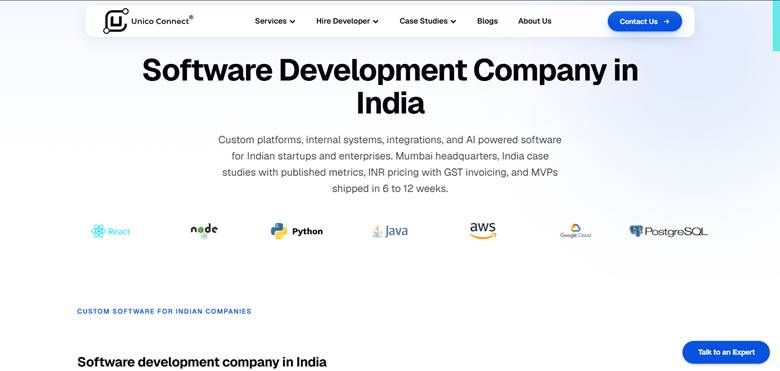
Unico Connect is an AI-native software development company founded in 2014 and headquartered in Mumbai, with a US presence for client-facing work. The team has shipped more than 250 production software products across at least 13 countries. Unico Connect rates above 4.8 across more than 50 Clutch reviews.
Recent work includes an AI agent built for a logistics company, handling voice orders in Hindi and English over WhatsApp. The team has also built document-intelligence and ticket-classification systems for turning unstructured input into structured data. Engagements start around $15,000. A three-week AI Adoption Discovery program is the entry point for new clients.
Unico Connect fits a team looking for workflow, conversational, document, or agentic automation built and owned end-to-end by one accountable group.
9. ScienceSoft
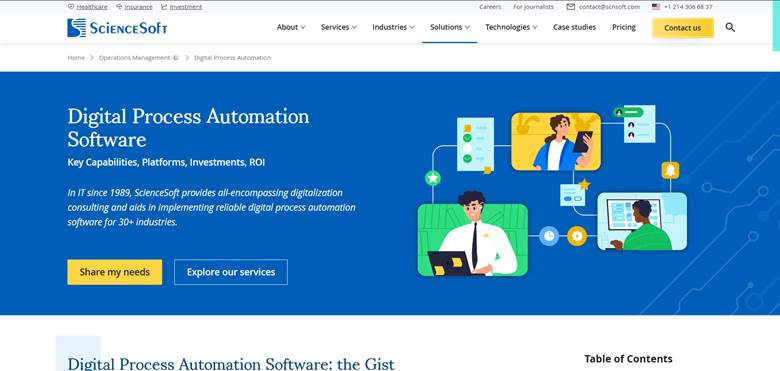
ScienceSoft is a global technology consulting and software development company founded in 1989 and headquartered in McKinney, Texas. Delivery teams operate across the US, the Gulf region, and Europe.
ScienceSoft has one of the broader enterprise automation practices on this list, built over more than three decades. The practice covers robotic process automation, business process management, and the ERP and CRM customization large automation programs eventually touch.
ScienceSoft publishes case studies across manufacturing, retail, healthcare, and financial services, though client names on the case-study pages are often anonymized. One industry comparison puts blended rates for a firm of this scale between $50 and $100 an hour. Enterprise programs start in the low six figures.
ScienceSoft suits a buyer automating many processes across a whole operation rather than one isolated workflow.
10. Axe Automation
Axe Automation is a US automation agency based between Cheyenne, Wyoming, and Marina del Rey, California. The agency audits how a business runs on tools like Monday.com, then layers in automations built with Make, Zapier, and n8n.
Axe Automation reports more than 150 active clients and tens of millions of dollars in collective client savings. Make.com named the agency a 2025 Partner of the Year for North America.
One published case study describes cutting a client’s onboarding speed-to-launch from 14 days to five after moving the business onto Monday.com.
Two things are worth checking before signing. Axe Automation doesn’t publish pricing, so cost only surfaces on a sales call. Clutch reviews are also mixed, and at least one client reports delays and a solution falling short, alongside several strongly positive reviews.
Axe Automation fits founders running on spreadsheets and manual processes who want the underlying operations fixed before anything gets automated on top.
Who Actually Needs an AI Automation Company
When Building In-House Makes More Sense
Is Hiring an AI Automation Company Worth the Cost?
Book a Free 30-Minute Meeting
Discover how our services can support your goals — no strings attached. Schedule your free 30-minute consultation today and let's explore the possibilities.
Book a Free Call