

Pricing Guide on How Much Does an AI Automation Agency Cost

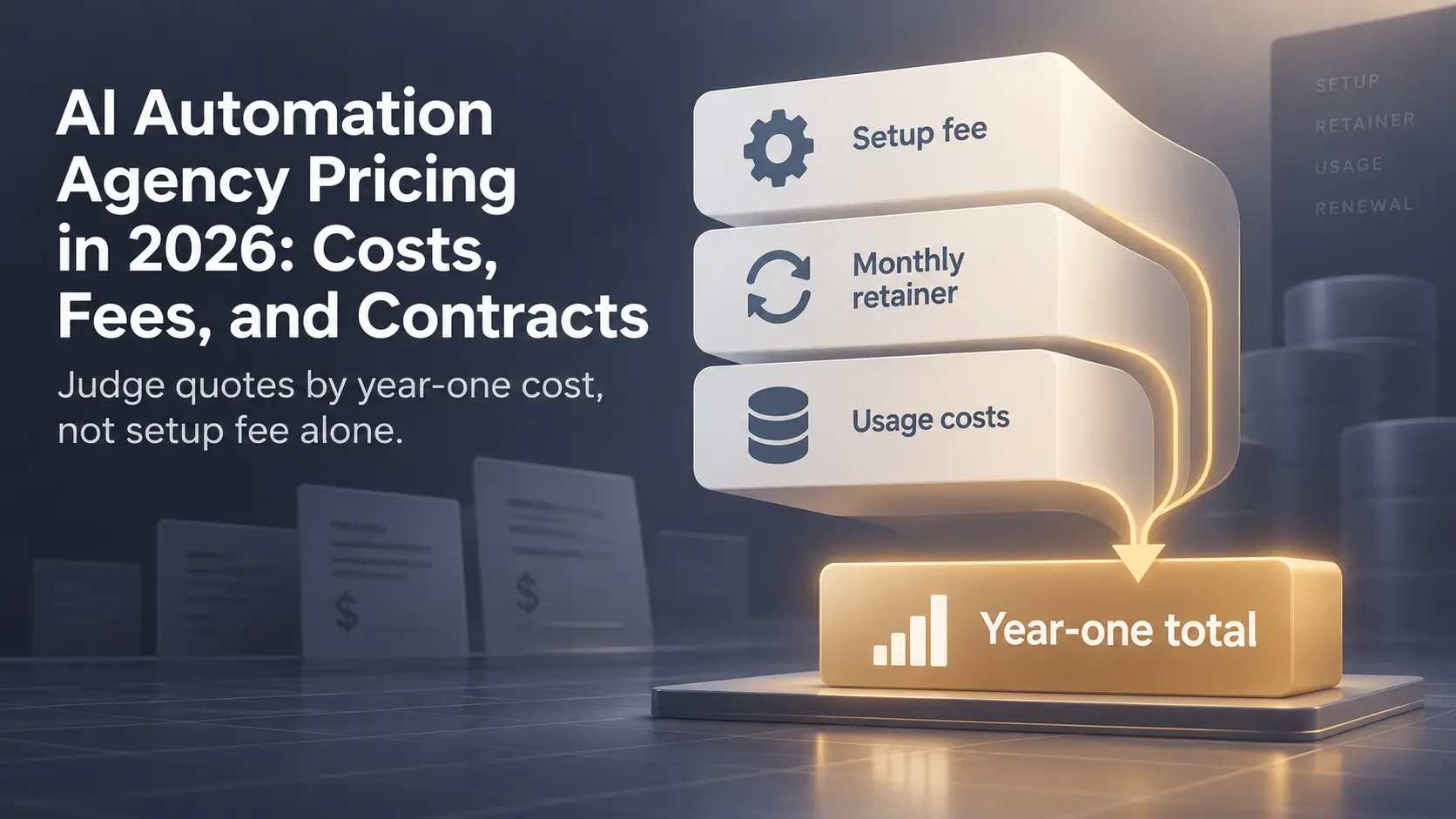
Cover reading AI Automation Agency Pricing in 2026, with setup fee, retainer, and usage costs flowing into a year-one total.
Written byPrincipal Data/AI Architect
Technically reviewed byUsama GoharAI Automation Engineer
Published
Reading time
22 min

Summarize with AI

Introduction

Many AI automation agencies keep their prices off their websites. A buyer often books a sales call before learning whether a build costs $1,500 or $100,000, the full spread in Taskip’s 2026 pricing guide. This guide puts real AI automation agency pricing from published rate cards in one place.

Published prices still have to pass a renewal test. In mid-October, Denver City Council rejected a five-year, $3.9 million extension for its “Sunny” chatbot. Nine of the 12 members present voted no.

Citibot, the company behind Sunny, sells software rather than agency services. The vote still applies to agency pricing, because an agency retainer must also justify its renewal cost. Before the vote, council members argued Sunny often gave inaccurate information.

Agency quotes face the same renewal test, even though a quote often leads with the setup fee. A year of retainer and usage fees can cost more. Buyers read a quote more easily after learning what an automation agency does. This article explains typical prices and pricing models, high-ticket offers, and safer contract terms.

What is AI Automation Agency Pricing?

AI automation agency pricing is what an outside firm charges to build and run automated workflows or AI agents for a business. The bill usually splits into a setup fee, a monthly retainer, and usage costs. The retainer covers monitoring and fixes. Usage costs pay for software and AI model calls.

The same three-part bill applies to workflows, chatbots, voice agents, and custom AI agents. Agencies differ mainly in what each line includes. So, the year-one total shows the real price better than the setup fee.

How Much Does an AI Automation Agency Cost in 2026?

AI automation agency pricing in 2026 runs from $150 a month for a packaged agent to $100,000 or more for an enterprise setup. The table groups published prices by project type. Each range comes from an agency rate card or a 2026 pricing guide.

Project Type

Typical Price Range

Timeline

Single Automation

$1,200 setup plus $250 a month (Alpenglow)

One to three weeks for packaged builds

Multi-Workflow System

$5,000 fixed for four n8n workflows (Goodspeed)

Set during scoping

AI Agent (Chat or Voice)

$700 to $1,500 setup, then $150 to $375 a month

One to two weeks (AtEase receptionist)

Custom AI Build

$5,000 setup (AtEase) to $15,000 pilot (AgixTech)

4 to 12 weeks (Data Prism)

Ongoing Retainer

$250 to $1,500 a month for small businesses

Monthly, after launch

No source in the table publishes a timeline for multi-workflow builds. So, the audit should set one in writing.

Company size moves the price too. For a small business, Taskip’s 2026 pricing guide puts typical agency setup at $1,500 to $5,000 and the retainer at $500 to $1,500 a month. Both numbers climb with company size. The table sets out the guide’s market bands for each size.

Business Size

Typical Setup Fee (Taskip Guide)

Typical Monthly Retainer (Taskip Guide)

Small Business

$1,500 to $5,000

$500 to $1,500

Mid-Market

$5,000 to $20,000

$1,500 to $4,000

Enterprise

$20,000 to $100,000+

$3,000 to $8,000+

No source ties build timelines to company size. Packaged builds on the AtEase and Alpenglow rate cards go live in one to three weeks. Data Prism’s guide to agent integration gives a typical 4 to 12 weeks for a single workflow.

Typical AI Automation Services Pricing by Solution Type

Beyond company size, the type of build moves the price. AtEase’s pricing tiers put the packaged receptionist at $1,500 setup and custom agents at $5,000. Custom agents also take longer. Price follows build time, and even a focused AI agent may take a few weeks.

AtEase bills its receptionist, a voice agent, at $250 a month after setup. For speed-to-lead follow-up, AtEase charges $150 a month on the same $1,500 setup.

Evolv AI Agents undercuts both setups at $700 for its after-hours answer line. The monthly fee runs higher, at $375. So, these packaged builds put the AI agent price at $150 to $375 a month after setup.

Hourly Rates by Who Does the Work

Taskip’s summary of 2026 rate guides gives four hourly bands, from $25 offshore to $500 at enterprise consulting firms. Agency pricing per hour sits in the upper two bands. Still, the bill is the rate times the hours quoted.

In Taskip’s bands, a boutique agency’s hourly rate runs $125 to $250. Enterprise consulting firms sit in the top band, at $250 to $500 an hour. So, the same hours can cost up to four times as much at an enterprise firm as at a boutique agency.

Hourly rate bands for 2026: offshore from $25, freelancers $40 to $150, boutique agencies $125 to $250, enterprise to $500.

Why a Freelancer Gig and an Agency Quote Differ

A freelancer usually bills only for the build. Agencies such as Alpenglow add a monthly fee for monitoring and fixes after launch. Without a retainer, the same work falls to the buyer’s staff. So, compare year-one totals before picking a freelancer or an agency.

AI Automation Agency Pricing Models Explained

AI automation agency pricing models differ mainly on who pays when a build runs over. Agency quotes usually follow one of six models, and the hybrid model joins two of them. Usage-based fees are not a seventh model, because they can sit on top of any of the six.

The table compares the six AI automation agency pricing models by structure, fit, and trade-offs.

Model

How It Works

Best For

Pros

Cons

Project-Based (Fixed Fee)

One price for a defined build

One-time builds with clear scope

Budget known upfront

No support after launch

Monthly Retainer

Recurring fee for ongoing work

Live systems needing care

Steady monitoring and fixes

Scope creep without a written list

Setup Fee Plus Retainer (Hybrid)

Build fee, then a monthly fee

Most small and mid-size buyers

Splits build and run risk

Two bills to compare

Productized Packages

Fixed scope at a fixed price

Common, repeatable workflows

Fast and predictable

Little room for custom needs

Hourly or Consulting

Rate times hours worked

Audits and strategy work

Pay only for time used

Total cost stays open

Performance or Value-Based

Fee tied to a measured result

Proven cases with a baseline

Agency shares the risk

Hard to measure fairly

Table: AI automation agency pricing models compared, 2026.

Project-Based Pricing (Fixed Fee)

A fixed fee buys one defined build with an end date. Under a fixed fee, the agency absorbs an overrun. Goodspeed, a London agency, publishes a fixed $5,000 price for four n8n workflows in production.

The weak spot comes after launch. A fixed fee covers the build, so fixes need a separate support line in the contract.

Monthly Retainer

A monthly retainer pays for ongoing build work plus maintenance on live systems. The fee recurs, so the buyer pays whether or not anything breaks. The retainer section below lists what a typical retainer covers.

Setup Fee Plus Retainer (Hybrid)

The hybrid model is the most common structure among the agencies reviewed here. Alpenglow, AtEase, and Evolv all pair a setup fee with a monthly fee.

Hybrid pricing splits the risk. The agency covers fixes under a setup plus retainer, while the buyer pays for new scope.

Productized Packages

Productized packages sell a fixed scope at a fixed price. AtEase’s packaged receptionist is one example, at $1,500 setup and $250 a month. Goodspeed’s four-workflow offer is another.

Packages work when the buyer’s process matches the package closely. Each change outside the scope becomes new billed work.

Hourly and Consulting

Hourly billing suits audits and strategy work, where the scope is still unknown. Each extra hour lands on the buyer’s bill. AgixTech, for example, publishes $150 to $350 an hour for discovery. The hourly bands above show how far rates spread by provider type.

Performance and Value-Based Pricing: When an Outcome Deal is Fair

Performance-based pricing puts the risk back on the agency when results miss. Still, Alpenglow, AtEase, Evolv, and Goodspeed publish no outcome fee on their rate cards. So, any performance-based pricing offer needs a close read.

An outcome deal is fair only when both sides measure results alike. Measuring starts with a recorded baseline, because a fee on “savings” needs a before number to compare against. Clean attribution then stops a seasonal sales bump from counting as agency work. Without a fee cap, one strong month can eat the savings.

Usage-Based Fees on Top of Any Model

Usage-based fees move the risk to the buyer as volume grows. Any of the six models above can carry them. Evolv’s answer line, for example, adds $0.20 a minute on top of the monthly fee.

Monthly Retainer Pricing: What You Get

AI automation agency monthly retainer pricing pays for keeping live automations working and growing. Published small-business retainers run from $250 a month at Alpenglow to $1,500 at the top of Taskip’s band. A retainer can cover six kinds of work.

  • Maintenance when a connected app or API changes
  • Fixes for broken runs and failed steps
  • New automations or changes within agreed hours
  • Monitoring with error alerts
  • Monthly reporting on runs, errors, and hours saved
  • Support hours for staff questions

Quotes differ on how many of the six each tier includes. The tier table shows one example structure. Data Prism prices each tier after a free automation audit, so the table lists scope rather than prices.

Tier

What’s Included

Best For

Starter

Monitoring, fixes, and maintenance for one or two workflows

One live workflow

Growth

Starter, plus monthly reporting and set change hours

Several workflows across teams

Scale

Growth, plus new automations and priority support hours

Daily processes across many systems

What the Setup Fee and Monthly Retainer Pay for

The setup fee buys a defined project with an end date. The monthly retainer is harder to judge, because some AI automation services pricing pages show a monthly number with no list of work. Alpenglow’s page itemizes the work, so the table sets each line item beside a buyer question and Alpenglow’s terms.

Line Item

Question to Ask

Alpenglow’s Terms

Hosting and Platform Management

Does the fee cover hosting?

Included

Monitoring and Error Alerts

Does the agency watch for errors?

Included

Fixes When an Integration or API Breaks

Does maintenance cover API breaks?

Included

Change Hours

How many hours are included?

Up to one hour a month

Data Prism’s automation services cover the same two stages: the build and the ongoing support.

The build itself covers connecting systems and planning for exceptions. For example, the LoveyPrints build sends unmatched files to a human review folder. Data Prism’s case study puts the cut in manual effort at up to 92%.

Why Two Retainers at the Same Price Differ

Two agencies can charge the same retainer and sell different deals. Alpenglow’s Build and Run plan costs $250 a month, and so does AtEase’s AI receptionist. Alpenglow bills per automated workflow and leaves usage fees to the client. AtEase includes an undefined “normal AI usage” and passes unusually high usage through at cost.

So, compare what each fee includes before comparing pricing per month.

When a Retainer Makes Sense vs a One-Time Project

A retainer makes sense when a workflow runs daily across several connected apps. Each connection can break when a vendor updates an API.

A one-time project fits a stable, simple workflow instead. The buyer then needs an in-house owner able to handle small fixes after handoff.

Decision diagram sending daily multi-app workflows to a monthly retainer and stable, simple workflows to a one-time project.

What Affects the Price of AI Automation?

One task can draw very different quotes. Data cleanup and integration complexity drive the gap, while model choice and compliance shape the monthly bill. The seven factors below move a quote up or down.

Number of Workflows and Integrations

Each workflow and each connected app adds build and test time. Goodspeed’s fixed $5,000 covers four workflows, so a fifth workflow means a new quote. Legacy systems add connection work too.

Complexity: Rules vs AI Decisions

Integration complexity is harder to check before a call. More decision paths mean more logic to build and test. A rules-based step follows fixed logic, while an AI step needs testing against messy real inputs. No published source puts a number on the cost of extra decision paths or legacy connections.

AI Usage and API Costs

Model choice sets the token bill after launch. The hypothetical 2,000-email load in the worked example below costs about $0.60 a month in tokens on Claude Haiku 5.5 and about $24 on Opus 5.5. So, a quote should name the model each step runs on.

Bar chart of monthly token cost for 2,000 emails: $0.60 on Claude Haiku 5.5, $12 on Sonnet 5.5, and $24 on Opus 5.5.

Data Quality and Cleanup

Data quality is the one driver a buyer can check before any agency call. Agencies clean messy records before building, so a data engineering line in a quote often points to dirty inputs. For messy data, AgixTech claims a RAG (retrieval-augmented generation) pipeline adds 20 to 30% to the cost.

Custom vs Template Builds

A template build reuses a workflow the agency has shipped before, so the price drops. AtEase charges $1,500 setup for its packaged receptionist and $5,000 for custom agents. Custom agents also take longer, at three to six weeks against one to two.

Support Level

Support level shapes the retainer more than the build. Alpenglow’s plan includes up to one change hour a month, so extra hours add cost. A quote should state response times and the number of included hours.

What Compliance Adds to the Bill

Healthcare and legal workflows face the most rules. Compliance rules narrow which services and discounts a workflow can use. Anthropic’s business associate agreement (BAA) lists the Batch API as “Not covered under BAA.” Read literally, the list means a workflow handling patient data gives up Anthropic’s 50% batch discount.

Paperwork adds cost too. Colorado’s SB26-189 regulates automated decision-making technology. Under the law, deployers must explain an adverse consequential decision within 30 days.

Hidden and Ongoing Costs to Budget For

Four ongoing costs often sit outside an agency quote. Tool subscriptions and AI API usage arrive as vendor bills. Maintenance after tool updates and staff training arrive as hours.

Where Hidden Costs Sit: Agency Fees vs AI Usage

Agency fees pay for people and accountability, while usage costs pay for software, tokens, and call minutes. Quotes often list only the fees, so usage becomes the hidden cost. G2’s vendor-run 2026 survey found 46% of 1,000-plus B2B software buyers reported higher-than-expected AI agent operating costs. The vendors below can bill the client directly.

Cost Line

Published Price or Plan

Zapier Professional

$19.99 a month billed yearly, 750 tasks a month

n8n Cloud Starter

2,500 executions a month, billed yearly

Claude Sonnet 5.5

$2 in and $10 out per 1M tokens

Claude Haiku 5.5

$0.10 in and $0.50 out per 1M tokens, prompts up to 100K

Claude Opus 5.5

$4 in and $20 out per 1M tokens

Twilio US Voice

$0.0085 to $0.0140 a minute local, $1.15 a month per number

Token costs stay small on routine work. A hypothetical inbox gets 2,000 emails a month, at 1,500 input and 300 output tokens per email. At Claude Sonnet 5.5’s published rates, the monthly token bill comes to about $12. Still, retries and agent loops can multiply token use, so ask the agency who caps API costs.

Platform subscriptions are another usage cost, and their price depends on the tool behind the build. A busy workflow can outgrow an entry plan’s limit.

Maintenance When Tools Update

Connected apps change their APIs and plans over time. Alpenglow’s retainer lists fixes for broken integrations as included work. Without a retainer, the same fixes become hourly work or staff time.

Training Time for Staff

Staff need time to learn a new workflow and review its output. The Federal Reserve Banks’ March 2026 Small Business Credit Survey found 37% of planned AI adopters named time to implement or train employees as a challenge. So, budget training hours alongside the agency fee.

High-Ticket AI Agency Service Offerings in 2026

High-ticket AI agency service offerings in 2026 replace a hire, drive revenue, or rework a core process. A single workflow saves hours. A high-ticket offer changes how a department runs, so buyers weigh the price against a salary or a revenue target rather than a software plan.

AI Voice and Chat Agent Systems

A voice or chat agent system handles inbound calls and messages for a business. Complex cases go to staff. Clinics, home services firms, and law offices buy these systems to cover the front desk after hours.

The premium comes from replacing reception hours. Packaged receptionists such as AtEase’s start at $1,500 setup. Full systems add CRM links, call routing, and custom chatbot development on the client’s own data. For custom builds, this comparison lists AI chatbot development company rates and minimum project sizes from Clutch.

End-to-End Operations Automation

End-to-end operations automation links every step of a process, from intake to delivery. Ecommerce stores, manufacturers, and logistics firms buy this kind of work when order volume outgrows staff.

The premium comes from scope. The build touches every system in the chain, so integration and testing grow with each handoff. Data Prism’s page for Australian movers Movers4Melbourne reports routine job processing cut from about 30 minutes to two. Sound process automation maps the current process before any build.

AI-Powered Lead Generation and Sales Systems

A lead generation system finds and scores prospects, then routes the strongest ones to sales. B2B firms, brokerages, and investment teams buy these systems.

The premium comes from a direct tie to revenue. A Retell AI vendor case study credits Target Dial’s voice agent with cutting ISpeedToLead’s average lead response from 100 minutes to under five. Data Prism’s startup research build for Redpoint Ventures reports an 80% drop in manual prospecting.

Custom AI Applications and Internal Tools

A custom AI application is software built around a client’s own data and rules, such as an internal search tool or a document assistant. Mid-size firms buy one when off-the-shelf tools miss a core workflow.

The premium pays for engineering time and ongoing hosting. AgixTech, for example, publishes $5,000 to $15,000 for a pilot before any full build.

AI Transformation Roadmap and Consulting

A transformation roadmap ranks a company’s processes by automation value and sets the build order. Leadership teams buy a roadmap before committing a larger budget.

The premium comes from senior time. A roadmap also shapes every later build, because each build follows the ranking.

Example AI Automation Pricing Packages

The three packages below are an example structure, not a published price list. Data Prism scopes and prices every package during a free automation audit. So, the price column points to the audit instead of listing a number.

Package

What’s Included

Price

Best For

Workflow Starter

One automated workflow, testing, and handoff

Quoted after a free audit

A single repetitive task

Operations Suite

Several linked workflows plus a monthly retainer

Quoted after a free audit

Daily processes across systems

AI Agent System

Custom chat or voice agent with CRM links and support

Quoted after a free audit

Front-desk or lead-handling volume

Each package starts from logged hours rather than a menu price. The audit maps the workflow and the systems involved before any quote arrives.

A free audit and pricing estimate takes one call to book.

Is It Worth the Price? Calculating Your ROI

An automation is worth the price when monthly savings pay back the setup fee within a timeframe the buyer accepts. The simple test sets the year-one cost against hours saved and revenue gained. Hours saved times an hourly wage gives the monthly saving.

The table compares two cases from the hypothetical worked example below. Only the minutes saved per email change between the two columns.

Line

Two Minutes Saved per Email

One Minute Saved per Email

Year-One Cost

$4,440 to $7,200

$4,440 to $7,200

Net Monthly Gain

$620 to $850

$60 to $290

Payback Period

1.4 to 1.9 months

4.1 to 20 months

Data Prism’s ROI guide walks through the full formula for a small business.

Year-One AI Automation Cost: A Worked Example With Payback

A setup fee and retainer show only part of the year-one bill. One hypothetical support-inbox workflow on a real rate card shows how far the payback period can swing. In this hypothetical, payback runs from under two months to 20 months.

Alpenglow’s published rate card sets every agency price in the example. The workflow triages a hypothetical 2,000 support emails a month.

Claude Sonnet 5.5 handles the hypothetical load for about $12 a month in tokens. The $12 fits inside Alpenglow’s $20 to $250 usage estimate, which also covers platform fees. So, the year-one table below uses both ends of the estimate.

Stacked bars showing a $1,200 setup fee growing to $4,440 or $7,200 in year one once retainer and usage costs are added.

The workflow saves a hypothetical two minutes per email, which adds up to 66.67 hours a month. Each saved hour is valued at $22.40, the Bureau of Labor Statistics mean wage for US customer service representatives (May 2025, wages only).

A hypothetical quarter of the savings stays with staff for human-in-the-loop review, where people check the workflow’s output. The year-one return on investment (ROI) table below subtracts the review cost from the savings.

Line

Low Usage

High Usage

Basis

Setup (Audit Credited)

$1,200

$1,200

Published price

Retainer x 12

$3,000

$3,000

$250 a month

Usage x 12

$240

$3,000

Alpenglow’s estimate: $20 or $250 a month

Year-One Total

$4,440

$7,200

Agency share matches Alpenglow’s $4,200

Manual Cost Replaced Per Month

$1,493.33

$1,493.33

Hypothetical 4,000 minutes at $22.40 an hour

Staff Review Kept Per Month

$373.33

$373.33

Hypothetical quarter

Net Monthly Gain

$850

$620

Hypothetical $1,120 savings minus $270 or $500 running cost

Payback Period

1.4 months

1.9 months

$1,200 setup over hypothetical net gain

At a hypothetical one minute per email, the net monthly saving falls from $1,120 to $560. Net gain then drops to a hypothetical $290 at low usage and $60 at high usage. Payback stretches to 4.1 months and 20 months.

Alpenglow’s prices never moved between the two-minute and one-minute cases. So, a buyer learns more about payback by timing real emails before signing than by comparing agency prices.

Agency, In-House Hire, or DIY?

DIY wins for simple linear tasks, while an agency fits daily processes across several systems with a named owner. An hourly freelancer suits a one-off build with clear scope. An in-house hire needs steady volume plus a builder on staff. Across all four, the biggest difference is who handles maintenance once the workflow goes live.

Option

Upfront

Monthly

Who Handles Maintenance

DIY on Zapier

Staff time only

$19.99 for Professional at 750 tasks, billed yearly

Your own team

Freelancer

$40 to $150 an hour (Taskip guide)

Hourly, only when rehired

Your team after handoff

Agency

$1,500 to $5,000 small-business setup (Taskip guide)

$500 to $1,500 (Taskip guide)

The agency, under the retainer

In-House Hire

Recruiting and onboarding time

Salary plus tools

The new employee

Data Prism’s no-code builds sit between DIY and a full agency retainer. Data Prism puts typical minimum viable product (MVP) development at 1 to 3 weeks, so a team can test one workflow before committing to a retainer.

Who Needs an AI Automation Agency

A business needs an AI automation agency when a high-volume process runs every day across several systems. Each handoff between apps can break, so the agency watches for failures. The process also needs a named owner to approve changes, or the client pays a retainer to maintain a workflow nobody checks.

Data Prism linked four systems for Kaemark, a US manufacturer, with plain workflow automation and no AI model. Kaemark’s case study puts the drop in manual data entry at 50 to 80%.

When an Agency is Overkill

An agency is overkill for rare tasks and simple linear flows. At a few runs a month, an AI service rarely costs less than doing the task by hand. Processes still changing weekly fit poorly too, since each change becomes billed work.

Poor data quality is a reason to hold off on an agency, because cleanup adds to what AI services cost. A team can check data quality first with Data Prism’s free readiness scorecard, which weights data foundation at 25% of the score.

For Agency Owners: How to Price Your AI Automation Services

Agency owners face the same numbers from the other side of the table. Pricing well starts with charging for results and ongoing care rather than for hours alone.

Value-Based vs Time-Based Pricing

Time-based pricing caps agency income at billable hours. Value-based pricing ties the fee to a result instead, such as hours saved or leads booked.

Value pricing needs a measured baseline before work starts. Buyers apply the same rule to outcome deals, so a recorded baseline makes the pitch easier to accept.

Why Retainers Create Stable Revenue

A retainer turns one project into monthly income. Live automations need fixes as connected apps change, so the retainer pays for real work rather than idle availability. The agency business model guide shows how retainers fit into a wider revenue mix.

How to Package High-Ticket Offers

High-ticket AI agency service offerings in 2026 sell an outcome, not a tool. A strong package names one process and one measurable result. The support level and retainer belong in the same offer.

A build can become a template once the same process repeats across clients. Templates then sell as productized packages at a fixed price.

Common Underpricing Mistakes

Underpricing usually starts with a single price for build and ops. The agency then absorbs every post-launch fix for free.

A fixed quote after a thin discovery call is the second mistake, because the real scope surfaces mid-build. Budget pressure adds to the risk. In a self-reported May 2025 teardown, practitioner Nadia Privalikhina found about half her leads had budgets under $2,000.

Questions to Ask Before Signing with an Agency

Five questions clear up the biggest unknowns in an agency quote. Ask each one in writing before signing.

  • What does the setup fee include, and what counts as extra?
  • Who owns the automations, accounts, and documentation?
  • What happens when something breaks, and how fast does the agency respond?
  • Are tool subscriptions and AI usage billed separately?
  • Is there a contract minimum or a notice period?

Written answers to all five make quotes from different agencies easier to compare.

How to Compare Quotes Line by Line

A year-one sheet with every quote works as a simple pricing calculator. Each column adds setup, usage, and change hours to a year of retainer. Evolv’s $700 setup undercuts Alpenglow’s $1,200. Still, Evolv’s $375 monthly answer-line fee puts year-one agency charges at $5,200 against Alpenglow’s $4,200, before per-minute charges.

A shortlist of two or three agencies should quote the same audit scope. Matching scopes keep line items comparable, so hidden costs stand out.

Hourly rates help narrow the shortlist before any quote arrives. For process automation firms, BPA company costs compared side by side show each firm’s published Clutch rate and build cost by scope.

Warning Signs in an Agency Quote

Most warning signs come from what a quote leaves out. A higher price can cost less than a missing usage line or an unprotected deposit. Four signs deserve a question before signing.

  • No usage line appears, so API costs surface after launch.
  • The CRM or automation platform account sits in the agency’s name.
  • A large deposit has no acceptance criteria.
  • A fixed price arrives before any scope work.

Contract Terms Worth Insisting on

Contract terms decide who pays for a stalled project. A stalled build can leave the buyer paying a second team to finish the work. Four clauses keep a failed build from becoming a second budget.

  • Each payment follows a milestone with written acceptance criteria.
  • The client keeps workflows and documentation on exit, as Alpenglow’s terms allow.
  • A monthly usage cap with alerts limits surprise bills.
  • The minimum term stays short, so a failed pilot doesn’t lock in months of retainer.

Final Verdict on AI Automation Agency Pricing

An agency earns its fee when an AI service runs a daily process across several systems. The buyer also needs a named owner for the workflow. Rare tasks and messy data flip the math, so DIY or data cleanup comes first.

In the hypothetical worked example, usage costs and 12 months of retainer took the year-one total to as much as six times the $1,200 setup. AI automation agency pricing makes sense only as a year-one total set against a realistic payback period.

Every quote above still needs an independent budget to check against. Data Prism’s free cost estimator is built for software, information technology, and app-development projects. The estimator asks for a work email address, then shows a phase-by-phase budget to hold against each agency quote.

The fastest route to a real number is a scoped price for one real workflow. Data Prism’s free automation audit maps the workflow and the hours at stake, then returns a custom pricing estimate before any contract. Book a free audit and pricing estimate to get a quote built on logged hours instead of a guess.

Book a Free 30-Minute Meeting

Discover how our services can support your goals — no strings attached. Schedule your free 30-minute consultation today and let's explore the possibilities.

Book a Free Call

Frequently Asked Questions

AI automation agency monthly retainer pricing for small businesses runs $250 to $1,500 a month in published rate cards. Alpenglow charges $250 a month for its Build and Run plan. Taskip’s 2026 pricing guide puts mid-market retainers at $1,500 to $4,000 and enterprise retainers at $3,000 to $8,000 or more. Usage costs for tools and AI models often sit on top.

A retainer is better for a daily workflow across several connected apps, because each connection can break when a vendor updates an API. A one-time project suits a stable, simple workflow with an in-house owner. Many agencies pair both, with a setup fee for the build and a retainer after launch.

High prices usually reflect custom work. Messy data, legacy systems, and compliance rules add build and test time. Custom agents cost more than packaged ones, as AtEase’s $5,000 custom setup against $1,500 for its packaged receptionist shows. High-ticket offers also price against a salary or a revenue target rather than a software plan.

Often, no. Alpenglow estimates usage at $20 to $250 a month, paid straight to vendors. AtEase includes normal AI usage but never defines normal. Unusually high AtEase usage passes through at cost. A quote should state who pays for tool subscriptions and AI tokens before signing.

A high-ticket AI service is an offer priced against the value of a hire or a revenue gain rather than a single task. Common examples include voice and chat agent systems, end-to-end operations automation, and lead generation systems. Custom AI applications and transformation roadmaps also qualify.

Most AI automation agencies price their services with a setup fee for the build and a monthly retainer for monitoring and fixes. Some sell fixed-price packages for common workflows, and a few bill hourly for audits. Usage costs for software and AI models usually sit on top. Comparing quotes on the year-one total shows the real price.

Book Consultation