

AI Automation Agency Business Model: Pricing and Profit

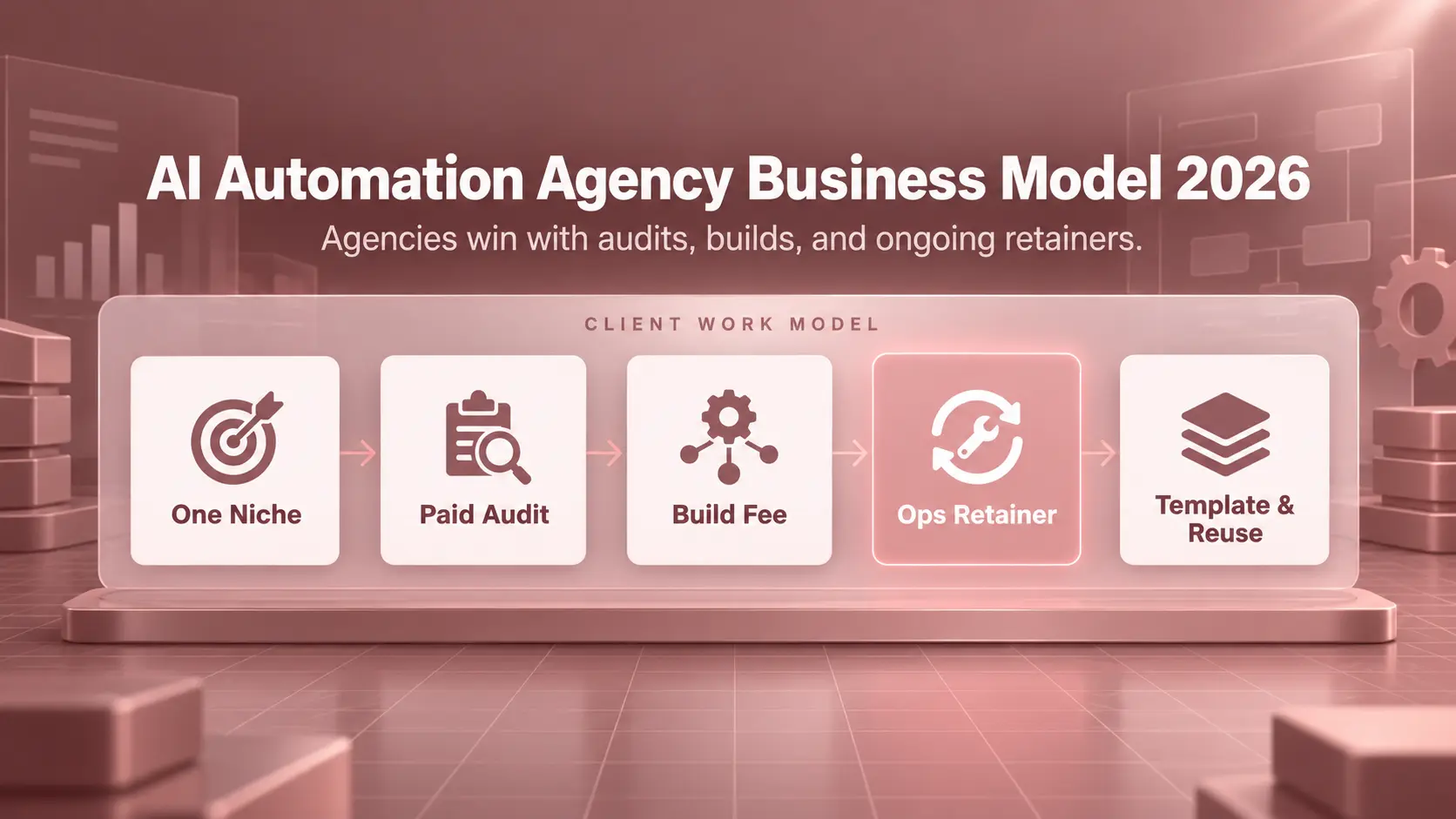
Cover reading AI Automation Agency Business Model 2026, with steps from One Niche and Paid Audit to Ops Retainer and Reuse.
Written byPrincipal Data/AI Architect
Technically reviewed byUsama GoharAI Automation Engineer
Published
Reading time
20 min

Summarize with AI

Introduction

The AI agency business model is how an agency earns money by selling AI-powered solutions to other businesses. For an AI automation agency, revenue usually starts with a paid audit. A build fee for each automation follows, then a monthly retainer to monitor and fix live systems.

An AI agency business differs from SaaS and from freelancing. A SaaS company sells one product to many users, so each client adapts to the software. A freelancer sells hours or fixed gigs, so income stops when the work stops. An agency builds custom work for each client, then earns recurring fees for keeping the work running.

Shortcut sellers have moved into the space too. Air AI sold licenses to resell its AI for up to $100,000, and the FTC sued in August 2025 over buyer losses of about $19 million. On March 24, 2026, the FTC filed a proposed settlement banning Air AI and its owners from selling business opportunities.

The AI agency business model works only when clients pay for the work itself. This article covers the main business models, the steps to start an agency, the best niches, and sourced income data for 2026. A separate guide explains what an AI automation agency does for its clients.

Types of AI Automation Agency Business Models

AI automation agencies make money through six common business models, from one-off builds to blends of several. Each model trades predictable income against setup risk in a different way. The table compares how each one earns, its pros and cons, and the founder it suits.

Model

How You Earn

Pros

Cons

Best For

Project-Based

One setup fee per scoped build

Clear scope and fast payment

Post-launch support goes unpaid

Clear, one-time workflows

Monthly Retainer

Recurring fee to build and maintain

Steady, predictable revenue

Scope creep without a written list

Live systems needing care

Productized Service

Fixed package at a fixed price

Easy to sell and repeat

Hard to fit unusual clients

A first repeatable offer

Consulting or Done-With-You

Fee for scoping, advice, and a roadmap

Low delivery cost

Client may build in-house afterward

Founders with deep process skill

White-Label

Builds delivered under another agency’s brand

Steady work without selling

Lower margin and no direct client

Builders who avoid sales

Hybrid

Services plus the agency’s own templates

Each stage priced on its own

More to explain on the first call

Most new agencies

Project-Based (One-Time Builds)

A project-based model charges one setup fee for each scoped automation. The agency gets paid when the build is done. The weak spot comes after launch, because fixes and changes fall outside the original fee. Project work suits workflows with a clear end state, such as moving web leads into a new CRM.

Monthly Retainer (Build and Maintain)

A monthly retainer pays the agency to keep live automations running and to add small changes. Connected apps change their APIs and settings, so live systems need regular fixes. The retainer turns this ongoing work into recurring income. A written list of included work stops the retainer from absorbing every new request.

The pricing guide shows typical retainer tiers and what each tier covers.

Productized Service (Fixed Package, Fixed Price)

A productized service sells one fixed package at one fixed price, such as a lead follow-up workflow for real estate brokers. The agency builds the package once and reuses most of it for each client. Sales get easier, since the buyer sees the price and scope upfront. The trade-off is fit, because clients with unusual processes need custom work.

Example package pricing shows how agencies structure fixed-scope offers in 2026.

Consulting or Done-With-You

A paid audit can also grow into done-with-you AI consulting, where the agency advises and the client’s team does the build. Consulting earns a fee for scoping, process mapping, and a roadmap. Delivery costs stay low, since the agency writes no production code. The risk is losing the build, because the client may take the roadmap in-house.

White-Label (Delivering for Other Agencies)

Growth can come from direct clients or through other agencies. An agency can resell a platform under its own brand or build under another agency’s brand. Each direction trades margin for reach.

HighLevel’s SaaS Mode lets an agency resell HighLevel as its own software on the $497-a-month Agency Pro plan, the only plan with usage markup (help docs, September 2026). n8n requires a commercial agreement and the vendor’s branding for embeds inside an agency’s product, while Make and Zapier only run referral programs.

In the reverse channel, builders such as Amplify Automation advertise white-label builds in Retell’s partner directory. The builder accepts a lower margin and no direct client. One partner leaving can also cut the builder’s pipeline.

Hybrid (Services Plus Your Own Templates)

The hybrid model mixes client services with assets the agency owns, such as niche templates. Each stage gets its own price. The client pays for scoping, then a build fee per automation. A month-to-month ops retainer follows launch, covering monitoring, fixes, and human review, with AI usage passed through or capped. Over time, repeat builds become templates the agency sells again at a lower delivery cost.

AI Agency vs Freelancer vs Productized Service vs SaaS Reseller

A freelancer bills for time or fixed gigs, while an agency sells a scoped outcome plus ongoing care. The agency wins on recurring revenue, and the freelancer wins on simplicity. The table compares how the four models earn and what limits each.

Model

How the Model Earns

What Limits Growth

Best For

Freelancer

Gigs minus Upwork’s 0% to 15% fee (October 2026)

Your own hours

Testing demand

Agency

Paid audit, build fee, separate retainer

Sales and delivery capacity

Founders who can sell

Productized Service

One fixed-scope offer, plus a monthly fee

Fit of a single offer

A first repeatable offer

SaaS Reseller

Platform fee per client plus marked-up usage

Vendor sets base prices

Many similar small clients

The rows read as stages on one path. Freelancing first is the safer start. The AI agency business model fits once a build repeats across clients.

Why the AI Agency Business Model Matters in 2026

The money in 2026 sits in AI client work. On August 10, 2026, Upwork’s Q2 2026 results showed AI-related gross services volume (GSV) up more than 22%, while total GSV fell 4%. AI Strategy & Consulting GSV grew over 50%. Resale licenses skip the client work.

Bar chart of Upwork Q2 2026 volume change: total marketplace down 4%, AI work up over 22%, AI consulting up over 50%.

How the AI Automation Agency Business Model Works in 2026

The model runs as one loop. One offer goes to one niche, and a paid audit leads to a build. A separate retainer keeps the build running. Six parts make the loop work in 2026, from the offer to the team behind it.

The Offer

The offer has to beat free or bundled AI. Zapier’s free plan includes basic agents and two chatbots. HubSpot offers its Customer Agent in Professional and Enterprise editions, billed per resolution (both checked October 2026). So, the stronger pitch is AI agents working across a client’s tools, tied to one measurable result.

Client Acquisition

Most new agencies win clients through one niche, a working demo, and referrals from a first proof client. A niche keeps outreach focused, because the same demo speaks to every prospect on the list. Freelance marketplaces add a second channel for founders still building a track record.

Delivery

Agencies can build on visual no-code automation tools, then call OpenAI or Anthropic APIs for the AI steps. Delivery doesn’t end at go-live. Small firms using AI struggle most with accuracy, at 46%, in the Federal Reserve Banks’ March 2026 Small Business Credit Survey report. Tool fit followed, at 43%. Planned adopters named time to implement or train employees, at 37%. Staff also need time to drop old habits, so support continues after launch.

Retention

Retention comes from the retainer. A monthly impact report ties each renewal to hours saved or leads handled. A client seeing the number every month has a clear reason to renew.

Tools and Running Costs

Running costs sit mostly in software and AI usage. Zapier Free costs $0, and n8n Starter runs $20 a month billed annually (pricing pages checked October 2026). AI usage grows with each client’s volume, so retainers should pass usage through or cap it.

Team Structure: Solo to Small Team

Most agencies start with one founder who sells and builds. The first hire usually takes over delivery, so the founder can keep selling. A small team then splits into sales, builders, and one person watching live systems. Each hire should follow retainer revenue rather than a one-off project spike.

AI Automation Agency Example: System AI for The Srama Group

System AI is a UK agency serving mainly real estate firms. Its founder estimates n8n runs about 70% of the business. System AI built a WhatsApp assistant for Australian buyers agency The Srama Group (n8n case study, checked October 2026). The assistant turns voice and text into Zoho CRM and Google Sheets records.

The results are self-reported and unaudited. Tasks that took four to five minutes now take 10 to 20 seconds. Onboarding-to-sale time dropped from 62 to 44 days. Time saved came to about one day a week.

System AI’s own site (checked October 2026) sells a fixed-price build and an optional retainer after a free 30-minute audit. This pricing setup makes System AI one of the clearer AI automation agency examples.

Data Prism Example: Lovey Prints Order Fulfillment

Data Prism’s own portfolio adds an e-commerce case. Lovey Prints turns customer photos into personalized art, including custom portraits. Orders once needed several manual handoffs.

Staff watched Shopify for orders and downloaded each photo. Staff then sorted files for artists and matched finished artwork to customers by hand. The case page (checked October 2026) says fulfillment “took several days.”

Data Prism built a Python pipeline joining Shopify, Google Drive, and email for order fulfillment. New orders were checked every five minutes and finished artwork every 10. Order IDs in file names kept customers matched. Unmatched files went to manual review.

Data Prism’s portfolio page reports manual effort cut by “up to 92%.” For a founder, a measured result like this one turns a first project into a case study and supports a retainer pitch.

How to Start an AI Automation Agency: Step-by-Step

Sales comes before tools for anyone learning how to start an AI automation agency. A demo alone proves little. So, the eight steps below run from skills and a niche to a retainer, and each step builds on the one before.

Eight steps to start an AI automation agency, from learning skills and picking a niche to winning clients and scaling.

Step 1: Learn the Core Skills and Tools

Anyone asking how to start an AI agency needs one automation platform learned well before anything else. Start on a free plan. Data Prism’s guide to automation tools compares Zapier, Make, n8n, and others. Next, learn to call an AI model through an API and to write a prompt returning structured fields.

Step 2: Pick a Niche

Pick one buyer type and one task the buyer repeats weekly. Message-heavy and document-heavy tasks fit best. Writing or marketing tops the Federal Reserve report’s list of small-firm AI uses, at 83%. The niches section below compares nine options by deal size and competition.

Step 3: Build a Clear Offer Around One or Two Problems

Founders working out how to create an AI agency often list every service they can build. A clear offer names one or two problems and one outcome instead, such as a reply to every new lead within five minutes. The offer should open with a paid audit. The audit maps each step’s volume, data, and owner, then ends in a fixed scope and a price.

Data Prism’s free readiness scorecard shows how 12 scored questions can pre-screen prospects before the audit.

Step 4: Set Your Pricing

Price the build and the ongoing care separately. A build fee covers the scoped automation, while a monthly retainer covers monitoring and fixes. A single price for both leaves the agency absorbing every post-launch fix. The pricing guide shows published setup fees and retainer ranges for 2026.

Step 5: Create Two or Three Case Studies or Demo Builds

Trust is hard for a new agency to win, since buyers have no past results to check. Two or three demo builds or proof clients earn the trust. Each build should end with one tracked number, like the Lovey Prints figure above. Data Prism’s low-code page warns a focused prototype “may take several weeks,” so plan the demos early.

Step 6: Build a Website That Converts

A simple website puts the demos and tracked numbers in front of the next buyer. One page for the niche offer, a case study, and a booking link cover the basics. The Claude Design guide covers building a first site, from brand setup to publishing.

Step 7: Get Your First Clients

First clients usually come from direct outreach inside the niche. Send each prospect the demo and its tracked number rather than a list of services. Freelance marketplaces such as Upwork add a second channel while the agency builds a track record. Each signed deal should start with the paid audit from Step 3.

Step 8: Deliver, Retain, and Scale

A person should review output wherever an error costs money. In February 2024, a British Columbia small-claims tribunal held Air Canada liable for its chatbot’s wrong bereavement-fare advice. The ruling binds no other court, but the case still shows why customer-facing answers need testing.

Training comes right after launch, and a monthly impact report then ties renewals to the savings. Data Prism’s Lost & Found Marketing page describes ROI reporting pulled from 15+ platforms through an automated workflow.

Once a build works, support moves to the retainer, and the build becomes a niche template. Templates sell as productized services. Reuse is how to make an AI automation agency grow past one client.

Best Niches for an AI Automation Agency in 2026

Data Prism’s guide for service businesses maps weekly tasks by industry. Agency founders need a narrower filter. The best niches pair frequent paperwork or messages with owners who can pay for a measurable result.

How to Choose a Niche

A good niche passes five checks. First, the work repeats every week, so one build keeps saving time. Second, buyers can afford a build fee and a monthly retainer. Third, the return shows up in a number the client already tracks.

The last two checks cover the sale itself. Fourth, owners or office managers make the buying decision directly, which shortens the sales cycle. Finally, competition stays thin enough for a new agency to stand out with one clear offer.

Niche

Top Automations

Typical Deal Size

Competition

Real Estate

Listing data entry, CRM notes from voice messages, lead follow-up

Medium

High

Clinics and Healthcare

Intake forms, patient calls, reminders

Medium to large

Medium

Law Firms

Client intake, document drafting, billing reminders

Medium to large

Medium

Home Services

Quotes, job admin, review requests

Small to medium

Medium

Ecommerce

Order routing, file handoffs, support replies

Small to medium

High

Accounting and Bookkeeping

Document collection, engagement letters

Medium

Low

Recruitment

Candidate intake, interview scheduling, status updates

Medium

Medium

Coaches and Consultants

Discovery call booking, onboarding, invoicing

Small

High

Property Management

Maintenance requests, tenant messages, rent reminders

Medium

Low

No public dataset tracks deal size or competition by niche. So, the last two columns are relative editorial ratings, based on how much each build touches and how many agencies target the niche today.

Chart placing nine AI automation agency niches by deal size and competition, with the three most profitable picks marked.

Real Estate

Real estate agents spend hours on listing entry and CRM notes. System AI’s WhatsApp assistant for The Srama Group, covered above, turns voice notes into CRM records. Lead follow-up is the other common build, since a slow reply can lose a buyer. Competition is high, because many new agencies start here.

Clinics and Healthcare

Private practices lose front-desk time to intake forms and phone calls. Builds here pay well, because each one frees paid staff hours. Health data adds HIPAA duties, so every vendor handling patient data needs a signed business associate agreement. The compliance work keeps out agencies without experience.

Law Firms

Small law practices lose billable hours to intake and document drafting. AI can draft an engagement letter from intake answers, while a lawyer approves the final version. Confidentiality rules make data handling part of every sale, so deals run larger than in most service niches.

Home Services

Trades and movers hit a ceiling on job volume when office work piles up. Quotes, dispatch, and review requests are the usual builds. Movers4Melbourne’s system, for example, cut routine job processing from about 30 minutes to two. Budgets are smaller, so productized packages fit best.

Ecommerce

Small online stores outgrow their staff as order volume rises. Order routing, file handoffs, and support replies are the common builds, as the Lovey Prints project above shows. App-store tools already cover simple cases, so agencies win on custom flows across several systems.

Accounting and Bookkeeping

Accounting firms chase the same client documents every tax season. Document collection and engagement letters repeat on a fixed calendar. The output is easy to check, which makes AI extraction safer here. Few agencies target the niche yet, so competition stays low.

Recruitment

Small recruitment agencies handle a flood of candidate messages for every open role. Intake, interview scheduling, and status updates are the main builds. Each placement carries a fee, so time saved on admin turns into capacity for more placements. Hiring decisions still belong to people, which keeps AI on the admin steps.

Coaches and Consultants

Solo coaches and consultants lose paid session time to booking and invoicing. A booked discovery call can trigger the intake form and the first invoice. Budgets are small, and many owners try DIY tools first. Fixed-price packages suit this niche best.

Property Management

Property managers field maintenance requests and tenant messages around the clock. AI can sort each request by urgency and route the request to the right contractor. Rent reminders run on plain rules. Few agencies focus on small portfolio managers, so competition stays low.

Which AI Automations Stick and Which Ones Often Fail

Accuracy tops small-firm AI users’ problems in the Federal Reserve report, at 46%. So builds stick best on frequent tasks with checkable output, like notes, bookkeeping, and document work. Builds fail when wrong answers reach customers unchecked, like Air Canada’s chatbot advice in Step 8.

Lead handling can still stick. A Retell AI vendor case study (checked October 2026) credits Target Dial’s voice agent with cutting ISpeedToLead’s average lead response from 100 minutes to under five.

Wrong answers can end projects. The Markup and THE CITY caught New York City’s MyCity chatbot in 2024 telling businesses they could take workers’ tips. Mayor Zohran Mamdani called the bot functionally unusable in January 2026, and the city pulled the bot in February. A roundup of seven agentic workflows covers limits like these too.

The Three Most Profitable AI Automation Agency Niches in 2026

No dataset ranks AI automation agency niches by profit, so the picks below rest on three bars. Repeat work, measured cases, and sticky automation types. Real estate and home services clear all three bars. Accounting and bookkeeping clear two bars, though no published case exists yet.

Real estate has the most proof, including System AI’s clients. For Cupid Real Estate, Data Prism’s page on agent data (checked October 2026) reports manual research down 75%.

Accounting and bookkeeping firms chase the same client documents every season. Document work sits on the safer side of the split above. Home services have measured proof. Data Prism’s page for Australian movers Movers4Melbourne (checked October 2026) reports routine job processing cut from about 30 minutes to two.

How Much Do AI Automation Agencies Make in 2026?

No public source shows typical AI automation agency income. Upwork’s July 2026 marketplace data comes closest. Freelancers doing AI work there earn 34% more per hour than other freelancers.

The Bureau of Labor Statistics put May 2025 median pay at $48.97 an hour for management analysts and $50.89 for computer systems analysts. Hourly pay still says little about AI automation agency income. The table maps revenue by stage instead.

Stage

Where Revenue Comes From

What Limits Income

Solo Builder

Freelance gigs and small builds

Hours you can bill

Proof-Client Agency

Paid audits and first fixed-price builds

Selling time and trust

Retainer Agency

Monthly ops retainers on live systems

Delivery capacity

Productized Agency

Niche templates sold repeatedly

Fit of the core offer

Revenue Math for a Retainer Agency (Illustration)

In a hypothetical example, five clients on a $1,500 monthly retainer bring in $7,500 a month. Tool subscriptions and AI usage at $200 per client cost $1,000. The agency keeps $6,500 before the founder’s time, taxes, and sales costs.

Waterfall chart where five $1,500 retainers make $7,500, tools and AI usage cost $1,000, and the agency keeps $6,500 a month.

One lost client cuts the same agency’s monthly revenue by a fifth. So, an income plan needs real retainer prices and real usage bills. A churn estimate belongs in the plan too, before any income target.

The “$10,000 a month” promise in ads describes revenue, not profit. In September 2024, the FTC’s “Operation AI Comply” sweep alleged Ecommerce Empire Builders made the same claim in ads.

Courses on making money with AI automation deserve the same test. Before buying any AI automation agency course, ask what share of buyers earned the claim. Ask for 10 past buyers as references too. Honest sellers can show both. The FTC’s Business Opportunity Rule (in force since 2012) requires covered sellers to disclose both.

Is an AI Automation Agency Profitable in 2026?

An AI automation agency can be profitable in 2026, though no dataset tracks margins at AI automation agencies. The closest data is AgencyAnalytics’ June 2026 vendor survey of 494 marketing agency professionals, where 68% of agency leaders reported operating margins above 20%. AI agency profit turns on where usage costs land.

AI usage is a pass-through cost. OpenAI’s flagship models run from $0.10 per million input tokens to $50.00 per million output tokens at standard rates. Retell AI charges $0.07 to $0.31 a minute for voice agents (both pricing pages checked October 2026). A flat fee absorbing usage loses margin as volume grows.

Value-based pricing needs a measured baseline instead. One example is the 80% drop in manual prospecting on Data Prism’s startup research page for Redpoint Ventures (checked October 2026).

AI Automation Agency for Small Businesses: Profitability in 2026

Small-business clients can pay, though rarely through one-off custom builds. In a self-reported May 2025 teardown, practitioner Nadia Privalikhina found about half her leads had budgets under $2,000. She called the one-off project model broken.

Small-firm demand also has a ceiling. The Federal Reserve report found 46% of small employer firms use AI. Yet 56% of the 33% with no plans call AI “not applicable to my business.” An AI agency for small business clients can profit more from repeatable templates and monthly retainers.

Is AI Automation Oversaturated, a Scam, or Still Worth Entering?

AI automation is crowded at the cheap end, where free chatbots make generic bots a commodity. Integrated work is still open. Paid work has moved to systems needing tuning, such as custom chatbot development on client data.

Demand still rises in the latest Census data. From October 5 to 18, 2026, 24.6% of US businesses reported using AI in a business function in the prior two weeks. Over the next six months, 28.6% expect to. Yet the Federal Reserve report found just 7% of small-firm AI users fully integrated.

The scam label fits “business in a box” sellers. In March 2025, the FTC alleged Click Profit sold AI-run stores as “passive income.” Amazon blocked, suspended, or terminated about 95% of them, the complaint alleged.

Common Mistakes New AI Agency Owners Make

Early mistakes sit in the offer. Serving every industry leaves no build to reuse. Selling a tool instead of an outcome gets harder as simple work gets cheaper. Upwork’s July 2026 marketplace data shows genAI and creative production contract starts up 90% year over year while per-contract earnings fell 13%.

Automating a broken process is the next mistake, because the automation repeats the broken steps faster. Sound process automation maps the current process and its gaps before any build.

Pricing mistakes follow. One is a single price for build and ops. Another is a fixed price quoted after a thin discovery call. Three more mistakes complete the list. Leading with lead-gen, skipping case studies, and dropping the retainer.

Who Should Start an AI Agency Business, and Who Shouldn’t

An AI agency business suits a founder with a known niche and a working demo. The founder also needs months of runway for selling. Builders who prefer the keyboard have better routes. One route suits nobody.

Builders who avoid sales can freelance or take white-label work. Reselling HighLevel’s SaaS Mode is a third option. The route to avoid is any license or business-in-a-box offer sold with income promises, the kind of pitch the FTC alleged in the Air AI case.

Verdict: Is an AI Automation Agency Worth Starting in 2026?

An AI automation agency is worth starting for a founder with a narrow niche and client proof. Weekly selling time matters too. Shortcut buyers should pass, since no AI agency business model runs without sales calls. The AI automation agency business model pays when ongoing care is priced as its own product.

Everything above assumes the founder can build the first automations alone. Founders who need help with the build can book a free 30-minute call with a senior engineer through Data Prism’s automation services team.

Book a Free 30-Minute Meeting

Discover how our services can support your goals — no strings attached. Schedule your free 30-minute consultation today and let's explore the possibilities.

Book a Free Call

Frequently Asked Questions

Yes, for agencies with recurring retainers and capped AI usage costs. No dataset tracks AI automation agency margins directly. The closest figure comes from AgencyAnalytics’ June 2026 survey, where 68% of marketing agency leaders reported operating margins above 20%. Demand also keeps growing, with Upwork’s Q1 2026 results showing AI integration and automation work up more than 50% year over year.

Learn one tool on a free plan. Build a working demo. Then take paid freelance work for proof, and pitch agency retainers once clients vouch for the results.

No. Visual tools such as n8n, Make, and Zapier handle simple workflows without code. Code matters once clients need custom integrations or self-hosted setups like n8n’s Community Edition.

Tools cost little. Zapier Free costs $0, and n8n Starter runs $20 a month billed annually (pricing pages checked October 2026). The higher cost is unpaid selling time before the first client signs.

No public data shows typical AI automation agency income. Revenue depends mostly on the number of retainer clients. A solo builder bills hours, while a retainer agency earns recurring fees. Ads promising $10,000 a month usually describe revenue before tool costs, AI usage, and taxes.

No dataset ranks AI agency niches by profit. Real estate and home services have the most measured proof, including published client results. Accounting and bookkeeping firms come close behind. Document collection repeats every season in these firms, and the output is easy to check.

Yes, for founders with a narrow niche and time to sell. Generic chatbots have become a commodity, but integrated workflows across a client’s tools still draw paid work. Census data from October 2026 shows 24.6% of US businesses using AI in a business function. The Federal Reserve’s 2026 survey found only 7% of small-firm AI users fully integrated.

A hybrid model suits most new agencies. The client first pays for an audit to scope the work. A build fee then covers each automation. After launch, a separate monthly retainer pays for monitoring and fixes. Productized offers come later, once the same build repeats across several clients.

Book Consultation