

Introduction
A customer sends a support request at 2 a.m. Even though no one is online, the AI answers the customer's question, updates the account, and closes the support ticket. By the time the team starts work, the issue is already resolved.
This is an agentic workflow. The AI completes the entire task on its own, and many businesses already use these workflows in their daily operations.
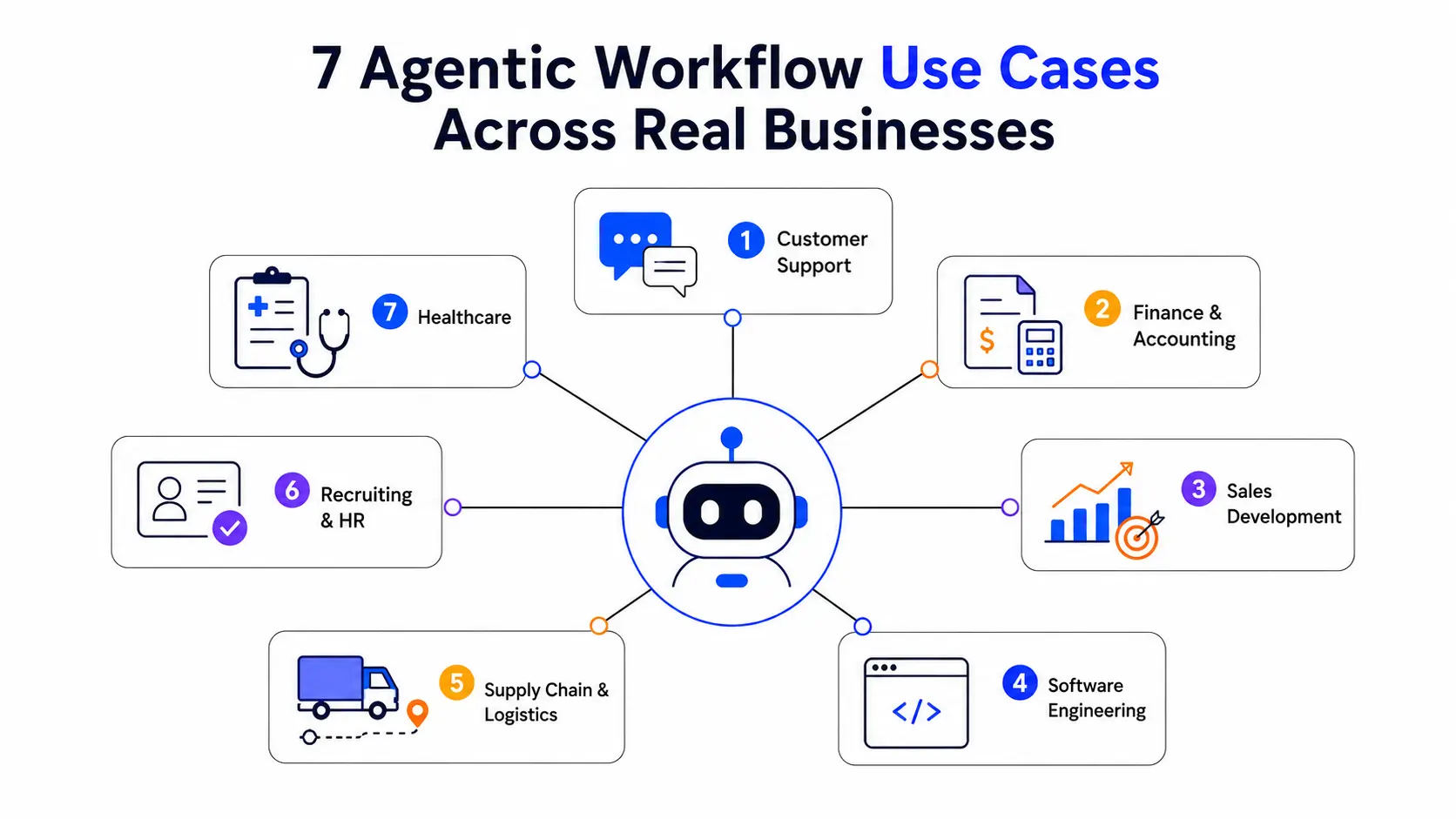
This guide covers seven examples from customer support, finance, sales, software development, supply chains, hiring, and healthcare. For each one, you'll see how it works, the numbers companies report, and where a person still signs off.
What is an Agentic Workflow?
An agentic workflow is a process where you give the AI a goal, and it figures out how to complete it. The AI decides what steps to take, chooses the right tools, and completes the task. You do not need to tell it every step.
Traditional automation works differently. It follows a fixed set of rules and does the same thing every time. This works well until something changes, such as a new invoice format, a different way of asking a question, or updates in your data. When this happens, the workflow often fails and needs a person to fix it.
An agentic workflow is more flexible. If an invoice looks different, it can still find the information it needs. If a customer asks a question in a new way, it can understand the request, look up the right information, and respond. The goal is to complete the task, even when the details change.
Most agentic workflows combine three parts:
- An AI model to plan and decide.
- Memory for past information and context.
- Tools such as your CRM, database, or email.
Several AI agents can also work together, each handling a different step, and complete an entire business process from start to finish.
How Agentic AI Differs From Rule-Based Workflows
|
|
Traditional automation |
Agentic workflow |
|
Handling change |
Breaks when inputs drift from the rules |
Adapts, re-maps, and keeps going |
|
Decision-making |
Follows a pre-set path |
Reasons toward a goal and picks the next step |
|
Work across systems |
Needs a rule, wired for each handoff |
Coordinates tools and hands off on its own |
|
When something breaks |
Stops and waits for a human |
Diagnoses the cause and often self-corrects |
|
Human role |
Operator (running and fixing the process) |
Overseer (setting goals and approving exceptions) |
|
Best-fit work |
Simple, stable, and repetitive tasks |
High-volume work with variation and judgment |
How AI Agents Reason, Decide, and Work Together
One AI agent can complete a single task. Multiple AI agents can work together to complete larger tasks.
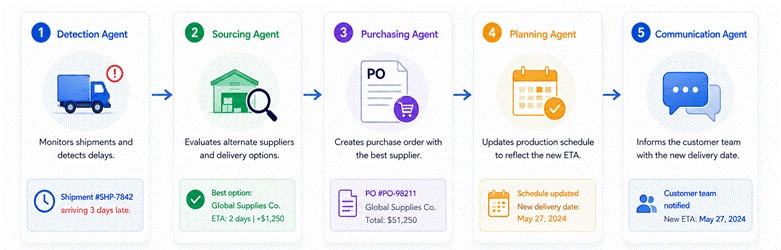
For example, imagine a business use case where a shipment will arrive three days later than expected. One agent detects the delay. Another agent looks for a different supplier or a faster delivery option. A third agent creates a purchase order. A fourth updates the production schedule. A fifth tells the customer support team about the new delivery date. All of this can happen in just a few minutes.
Each agent has a specific job. It completes its task, shares the results with the next agent, and helps achieve the final goal.
AI agents also have limits. If they are unsure or the decision is important, they ask a person for approval. They can collect information, make recommendations, and complete routine tasks on their own, but people make the final decision on important or irreversible actions.
The Seven Use Cases in Production Today
1. Customer Support: Resolve Tickets from Start to Finish
Many companies first use AI agents for customer support. Support teams answer many customer questions every day, and most of the information they need already exists in the company's systems.
An AI agent reads the customer's question, checks their account and previous conversations, and finds the right answer. It replies to the customer and updates or closes the support ticket. If the problem is unusual or too complex, the agent passes it to a human.
Salesforce says its AI agent handles about 85% of customer questions without human help. It has also cut response times for most customers. Fisher & Paykel lifted customer self-service from 40% to 70% after adding AI.
According to a 2026 research, Salesforce found that 66% of customer service teams now use agentic AI (up from 39% the year before). Many teams also reported higher customer satisfaction.
AI handles the routine work. People focus on the cases needing judgment or care. For many businesses, customer support is a good place to start.
2. Finance and Accounting: Close the Books Faster
Invoice processing, reconciliation, and month-end close are ideal agent territory. Finance teams spend 41% of their time gathering and processing data, and half of them still need six or more business days to close the month. The work is high-volume, the rules are already written down, and doing it by hand is painful.
An accounts payable AI agent collects invoices from emails and online portals. It compares each invoice with the purchase order and delivery receipt, sends it for approval if needed, and records it in the accounting system. If it finds a real problem, it alerts a person.
This allows the AI to process most routine invoices automatically, so finance teams only need to review the small number of invoices that have issues.
One documented deployment at a financial services firm handling over $200M in annual transactions compressed the month-end close from 10 working days to 2. The reconciliation team went from 60-hour weeks during close to standard hours. The team cleared the invoice backlog within three weeks.
You keep a human on the exceptions. The agent clears the easy 90% and hands anything outside its tolerance to an accountant with the reasoning attached. That human-in-the-loop split is what makes the pattern work in regulated finance, so start your AI automation project with the approval rules and the audit trail.
3. Sales Development: Prospecting Around the Clock
Sales teams spend a lot of time on repetitive tasks instead of selling. They research potential customers, build lead lists, update the CRM, and send follow-up emails.
An AI agent can handle these tasks with ease. It researches potential customers, identifies the most promising leads, drafts email sequences, and replies to initial customer messages. This gives sales teams more time to focus on selling and building relationships.
By early 2026, 41% of enterprise teams were running sales development agents in production. These have the fastest payback of any function, around 3.4 months.
AI agents can send many more emails than people, but sending more emails does not always produce better results. If you target the wrong people or your emails are marked as spam, your campaign is likely to fail.
The best approach is to combine AI with human expertise. The AI handles repetitive tasks, such as researching leads and sending outreach emails. People choose the right prospects, respond to objections, and build customer relationships.
4. Software Engineering: Ship More Code
Coding AI agents can do more than suggest code. A developer gives the agent a task, such as fixing a bug or adding a feature. The agent plans the work, updates the necessary files, and creates a pull request for the developer to review.
GitHub Copilot reached 140,000 organizations in 2026, almost triple the year before. Microsoft studied its own engineers and found the ones using Copilot merged 24% more pull requests than they otherwise would have. The lift held for four months. Engineers using AI coding assistants report saving nine hours a week.
AI-generated code still needs to be reviewed. It can contain bugs, security problems, or other mistakes. Always review and test the code before using it. Treat the AI's work as a first draft, and let a developer approve it before it is added to your project.
5. Supply Chain and Logistics: Reroute in Real Time
Supply chains generate more variables than any planning team can track. Agents watch those signals around the clock and act the moment something moves. Cross-border freight platform Nuvocargo launched its system in 2026. Around a dozen AI agents manage more than 70% of load touchpoints across a US, Mexico, and Canada network.
AI agents can automate many supply chain tasks. They schedule appointments, negotiate prices, process documents, and check invoices. This helps companies reduce delays, lower excess inventory, and improve on-time deliveries.
AI agents should only work within clear limits. If they face a situation they are not allowed to handle, they ask a person for approval. As the agents prove they can perform tasks reliably, companies can gradually give them more responsibility.
6. Recruiting and HR: Shortlists in Minutes
Hiring includes many repetitive tasks that AI agents can automate. They can read job descriptions, screen resumes, contact candidates, and identify the best matches.
For example, an AI agent can collect the job requirements from an email or meeting, review new applications as they arrive, and rank the best candidates. Recruiters receive a shortlist in minutes instead of spending hours reviewing every application.
Staffing group Adecco uses this to accelerate hiring, pre-screen candidates, and unify candidate data across regions. This frees recruiters for the conversations that actually matter. The pattern generalizes to any HR team drowning in applications. The agent handles the sorting, and a recruiter only reviews the shortlist.
7. Healthcare: Less Paperwork, Same Oversight
AI agents can reduce paperwork in industries with strict regulations, such as healthcare. For example, an AI agent can create clinical notes while a doctor speaks with a patient. This saves time and reduces paperwork.
People still make the important decisions. The AI handles administrative tasks, but doctors review the notes and make all decisions about patient care. This approach works well in industries where accuracy, safety, and compliance are essential.
What Businesses Gain
AI agents provide the same benefits across many industries. They can work 24/7 without increasing the size of your team. They reduce delays between systems and complete routine tasks in minutes instead of hours.
This allows employees to spend less time on repetitive data entry and more time on work that requires human judgment. AI agents follow the same rules every time, so they also reduce mistakes and create more accurate records.
Payback is real when the scoping is right:
|
Workflow type |
Typical payback |
Why |
|
Sales prospecting |
3 to 4 months |
Narrow scope, quick volume gains |
|
Cross-function median |
About 5 months |
Support, finance, and engineering cluster here |
|
Regulated processes |
8+ months |
Humans stay closer to the loop, so gains take longer to show |
The Limitations you Should Plan For
None of this is risk-free. The same failures come up in project after project, and most of them trace back to scoping rather than the model.
|
Risk |
What goes wrong |
Mitigation |
|
Reliability |
An agent acting on a wrong conclusion is worse than a chatbot giving a wrong answer |
Keep humans on consequential and irreversible decisions |
|
Governance |
Agents deployed without formal oversight; rollbacks are common |
Define oversight, audit logs, and rollback before launch |
|
Data quality |
The agent is only as good as the data it can reach and trust |
Deduplicate and reconcile source data first; most demos skip this work |
|
Cost |
Token spend adds up at scale |
Set usage budgets and monitor per-workflow cost |
|
Scope creep |
Pilots trying to automate everything at once get stalled |
Prove one workflow before expanding |
How to Implement Agentic Workflows Well?
The most successful AI agent projects follow a few simple practices.
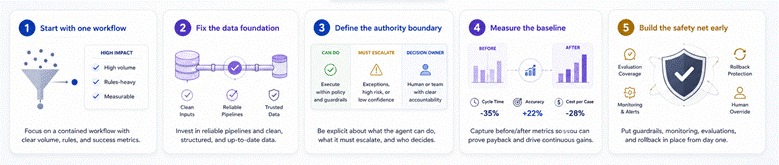
Start with one repetitive task, follow clear rules, and have results you can measure. Make sure your data is accurate and easy for the AI to access before you deploy the agent.
Decide in advance what the AI can do on its own and when it must ask a person for approval. Measure your current performance so you can compare the results after the AI is deployed. Finally, test the AI regularly to catch problems early and reduce the need for future fixes.
Ready to Pick Your First Workflow?
The fastest way to fail is automating everything at once. Payback comes from proving one measurable process, then expanding upon it. Want a second pair of eyes on which process to start with and where to draw the authority boundary?
An AI strategy and consulting engagement helps you find the best processes to automate with AI agents. Bring us your most repetitive and time-consuming workflow, and we'll assess how an agentic workflow can handle it and how to deploy it successfully.
Book a Free 30-Minute Meeting
Discover how our services can support your goals — no strings attached. Schedule your free 30-minute consultation today and let's explore the possibilities.
Book a Free Call