

Introduction
When an AI gives the wrong answer, most teams try to fix the prompt. They add clearer instructions, more examples, or stricter rules. Sometimes this helps. But often, the real problem is that the AI lacks the information it needs to give the right answer.
This gap explains why context engineering became the defining AI skill of the past year. In June 2025, Andrej Karpathy backed the term, calling it “the delicate art and science of filling the context window” with the right information for each step. Shopify CEO Tobi Lütke had made the same case a week earlier, and after that the label “context engineering” stuck.
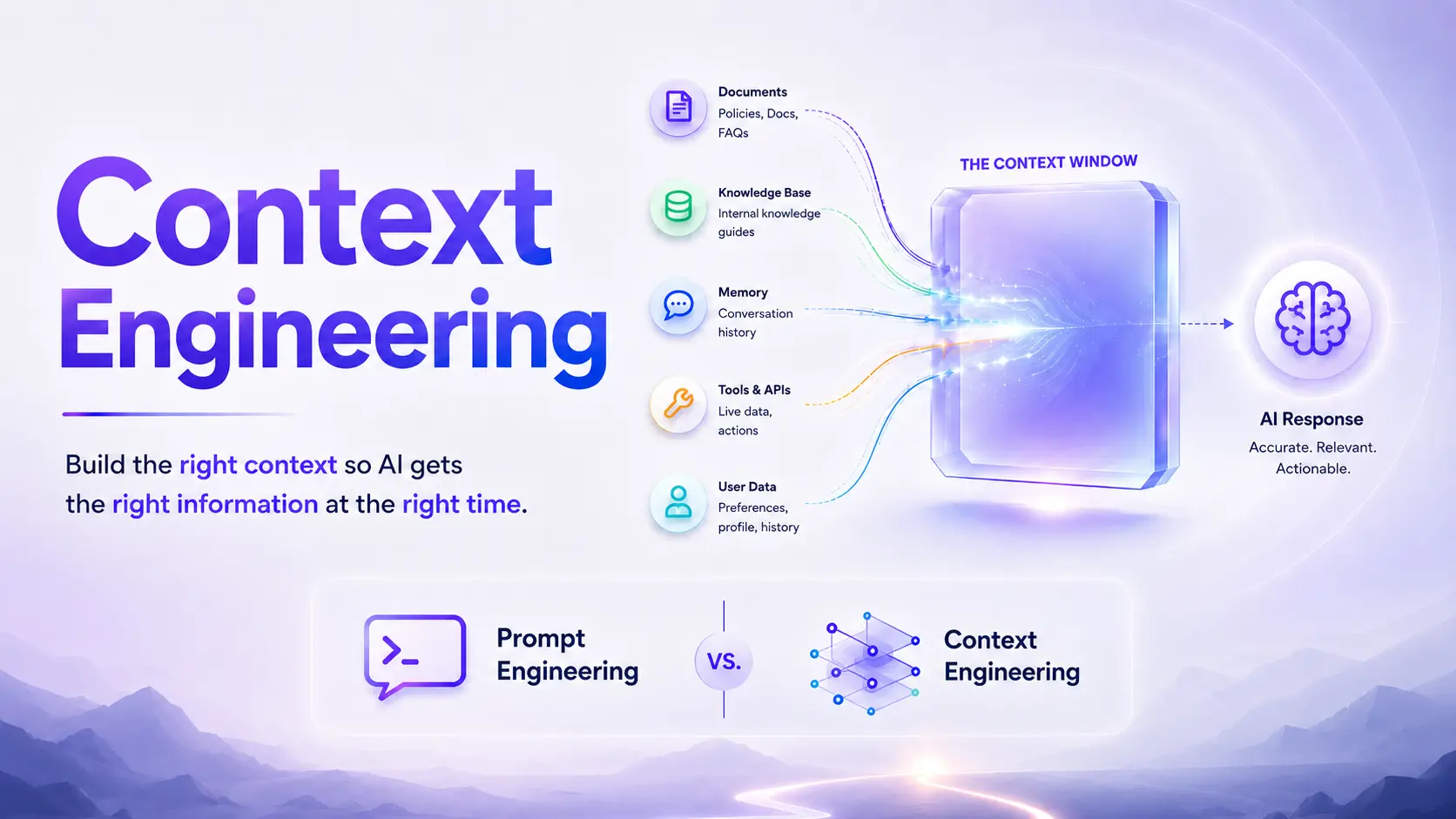
Are context engineering and prompt engineering the same thing? No. Prompt engineering optimizes the instruction you send to a model. Context engineering optimizes everything the model sees before it responds. It includes instructions, retrieved documents, memory, tool outputs, and user data. So, in essence, prompt engineering is one part of context engineering.
In this guide, you’ll learn the context engineering definition in plain terms, how it differs from prompt engineering, the seven components that make it work, and a step-by-step way to apply it to an AI agent.
What is Context Engineering?
Context engineering is the practice of selecting, structuring, and managing all the information an AI model receives at inference time so it completes a task reliably. Anthropic’s engineering team calls context a “critical but finite resource” and treats context engineering as the natural progression of prompt engineering.
Context is everything the AI can see before it replies. The AI can only use this information. Good AI apps therefore focus on providing the right information at the right time, instead of relying on clever wording.
What is Prompt Engineering?
Prompt engineering is the practice of writing and structuring instructions so a model produces the output you want. It covers wording, role descriptions, few-shot examples, output formats, and reasoning cues. OpenAI’s prompt engineering guide documents these techniques in detail, and they still work.
Good prompts matter, but they can’t create missing information. If the AI doesn’t have your refund policy in its context or training, it can’t quote or explain it, no matter how you ask.

Where Prompt Engineering Hits its Limit?
Two problems pushed the industry beyond prompts. The first is missing knowledge. Models don’t know your internal data, and a prompt can’t add what it doesn’t have. The second is degraded attention over long inputs.
Stanford researchers found that models often miss relevant information placed in the middle of long contexts. A technical report reached a similar conclusion, documenting performance drops as input length grew, even on simple tasks.
Both problems get worse in agents because they work step by step. They look at the information they have, decide what to do next, use a tool if needed, and then add the tool’s result to its context.
After many steps, the agent ends up with a lot of information in its context. It then has to figure out which parts matter and ignore the rest.
A better prompt won’t fix this problem. The agent needs the right information in its window, free of distracting details. Context engineering is the discipline of getting it there.
Context Engineering vs Prompt Engineering: Side-by-Side Comparison
Let’s view the two side by side, and the differences will be quite clear.
|
Aspect |
Prompt Engineering |
Context Engineering |
|---|---|---|
|
Scope |
One instruction or template |
The entire context window |
|
What you optimize |
Wording, examples, and output format |
Information selection, structure, and flow |
|
When it happens |
While writing the prompt |
Before and during every model call |
|
Problem it solves |
Unclear instructions |
Missing, stale, or excessive information |
|
Typical tools |
Prompt templates, few-shot examples |
RAG pipelines, memory stores, tool orchestration |
|
Relationship |
One component of the larger discipline |
The umbrella discipline that contains prompting |
Prompt Engineering and Context Engineering Work Together
Prompt engineering and context engineering are complementary, not competing, approaches. Every AI system still needs clear prompts to define the task, set expectations, and guide the model's behaviour. A well-written prompt helps the model understand what it should do and how the response should be structured.
Context engineering, however, determines what the model knows before it starts generating an answer. Rather than relying on increasingly detailed prompts, it ensures the AI has access to the right documents, tools, memory, and permissions at the right moment. This allows the model to base its responses on relevant information instead of guessing or relying only on its training.
As AI applications become more complex, context engineering often has a greater influence on performance than prompt engineering alone. Once the prompt clearly defines the task, improving the quality and timing of the information the model receives usually leads to more accurate, reliable, and consistent results.
Why Context is the Foundation of AI Agents?
Deloitte’s Tech Trends 2026 research found that only 11% of organizations use AI agents in production while 38% are still testing them. One common reason is that the AI agent does not have the information it needs. If it cannot access order data, company policies, or its own previous actions, it cannot make reliable decisions, even if the model itself is capable.
Agentic context engineering pushes the idea further by letting the context improve over time. ACE (Agentic Context Engineering) treats context as an evolving playbook that accumulates working strategies from experience.
The model is available to everyone; your data is not. Competitors can rent the same model, but they cannot access your company’s knowledge, past conversations, or connected tools.
Choosing the model matters, but the context is what makes an agent useful. Serious AI agent development, therefore, starts with the context layer, not the model choice.
The 7 Components of Context Engineering
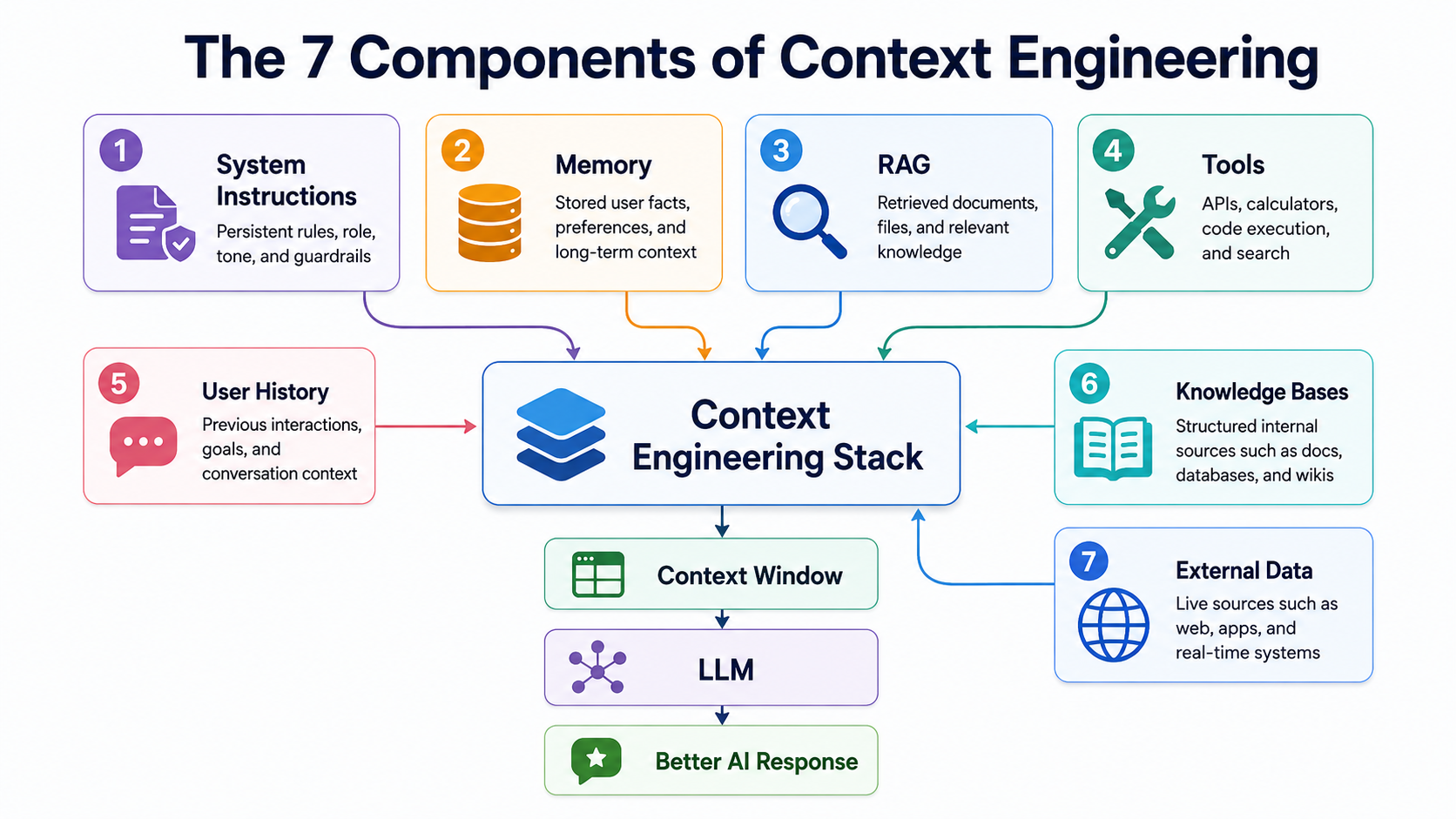
AI systems built with context engineering draw on seven building blocks. Each one appears in our refund example.
1. System Instructions
These are the fixed instructions that tell the AI how to behave. They define the AI’s role, tone, limits, and when it should ask a human for help. For example, a refund agent should know what refunds it can approve and when it must transfer the customer to a human.
Keep these instructions the same over time. Do not include changing information, such as customer details or order data. Put this data elsewhere in the context instead.
2. Conversation Memory
Short-term memory stores information from the current conversation. Long-term memory stores information across multiple conversations.
For example, if a customer already gave the refund agent their order number, the agent remembers it and does not ask for it again. This memory keeps the conversation smooth and spares the customer from repeated questions that can frustrate people.
3. Retrieval (RAG)
Instead of relying on what the AI already knows, the system looks up the right documents when the user asks a question.
For example, a refund agent finds the exact refund policy for the customer’s region before it answers. The agent then answers from your company’s policy instead of guessing.
4. Tools and Outputs
Tools let the AI access other systems, such as APIs and databases. The AI can use these tools to get information or perform actions.
For example, the AI can query the order system and see that the refund went out two days ago. No prompt can substitute for that lookup. Connecting the AI to these systems takes careful work. Many companies therefore use AI integration services to build these connections.
5. User History and Preferences
The AI also uses customer information, such as their profile, previous orders, loyalty status, and communication preferences.
This history helps the AI respond appropriately. For example, a returning customer who has already received three refunds may need a different response than someone who is requesting a refund for the first time.
6. Knowledge Bases
The AI also uses your company’s internal information, such as FAQs, product catalogs, guides, and policy documents.
When the AI needs an answer, it searches these documents for the right information. If the documents are accurate and up to date, the AI gives better answers. If they are outdated or incorrect, the AI’s answers will also be less reliable.
7. External Data Sources
The AI also needs real-time information from external services, such as shipping companies and payment providers.
For example, it can check the latest shipping status or confirm whether a payment has been completed. Without this information, the AI can only rely on your company’s database, which may not show the most recent updates.

How Context Flows Through an AI Application
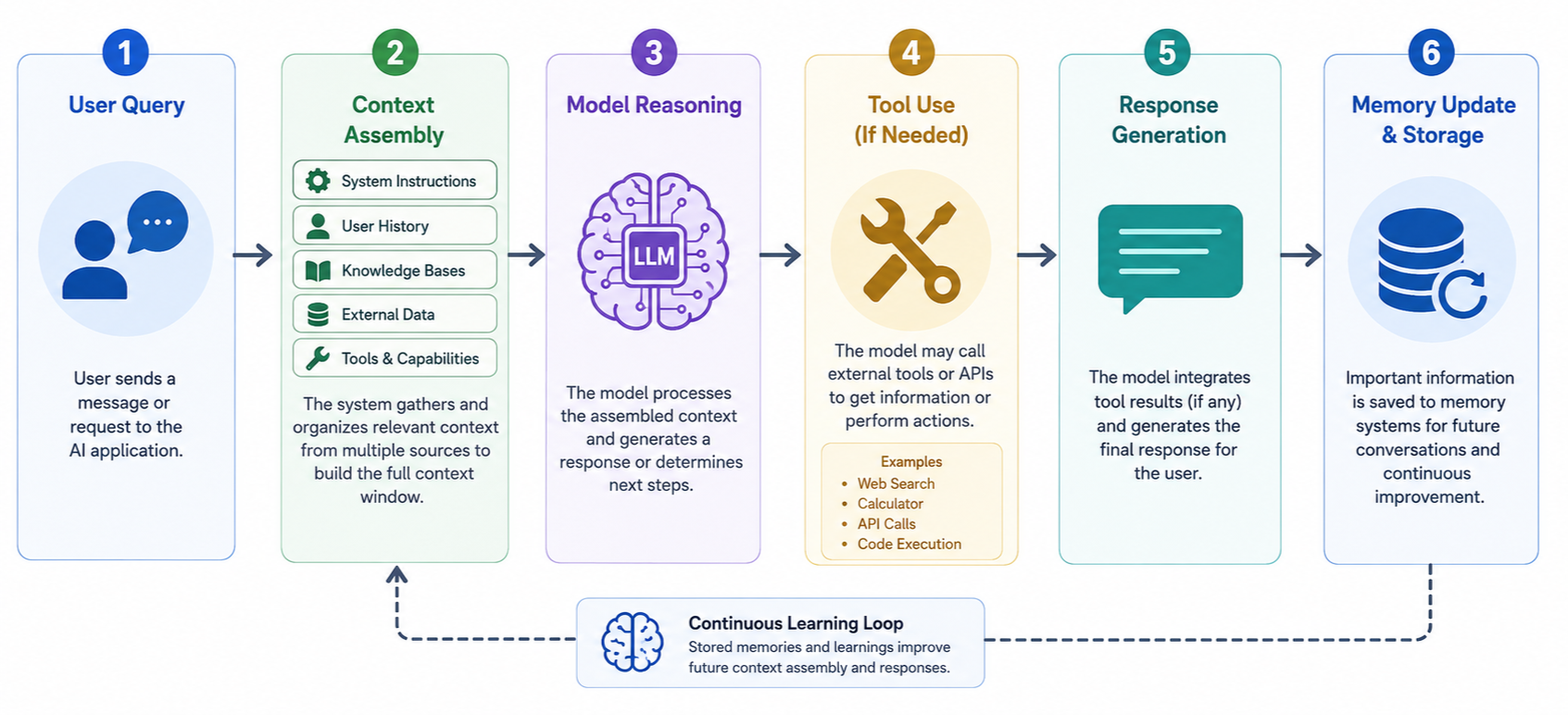
Context flows through several stages before an AI generates a response. Each stage helps the model gather, filter, and use the information it needs to complete the task accurately.
- A user sends a query (“Where’s my refund?”).
- The context assembly layer gathers system instructions, conversation memory, the user’s profile, and retrieved policy documents.
- The model reads the assembled window and decides on an action.
- The agent calls a tool, such as the order database.
- The tool result enters the window, and the model reasons again with fresh data.
- The agent responds, and the memory store saves what it learned for next time.
Stages 2 through 5 can repeat several times in an agentic workflow. Every loop is a fresh chance to add the right information or drown the model in the wrong information.
One Refund Request, Two Ways to Build It
To understand the difference, compare how prompt engineering and context engineering handle the same refund request.
The Prompt-Engineering-Only Build:
You write a careful prompt with role, tone, format, and examples of good replies. The customer asks where their refund is. The model produces a polite, well-structured guess. It doesn’t know the order, the policy, or the refund status, so it invents a plausible timeline. The wording is excellent. The answer is wrong.
The Context-Engineered Build:
Same model, same question. This time the system retrieves the refund policy, pulls the order record through a tool call, and loads the customer’s history. The model sees the refund went out two days ago and the policy promises 5 to 7 business days. It answers with the actual date and the actual window. The prompt is almost unchanged. The context is not.
One thing to keep in mind is that the second approach takes more engineering work. You still need to write prompts, but you also have to build retrieval, manage permissions, handle memory, and deal with errors. The benefit is that you get answers you can confidently show to customers.
Where Enterprises Apply Context Engineering?
Context engineering helps AI work with real business data, systems, and rules. Organisations can use AI to handle complex tasks more accurately and reliably across different departments.
Customer Support:
Assistants connected to CRM records, order systems, and company policies can resolve customer issues instead of simply directing users to a human agent. This integration is what separates a demo chatbot from a production-grade AI chatbot.
Software development:
Coding agents, such as Anthropic’s Claude Code, load files just in time using paths and search, rather than dumping a whole repository into the window. This allows them to stay accurate on large codebases.
Healthcare:
Clinical assistants use patient records and the latest medical guidelines to help healthcare professionals make informed decisions. Here, missing context is a safety risk, so accurate retrieval and strict access controls are especially important.
Finance:
Analysis agents combine filings, market feeds, and internal risk policies. The ACE study’s 8.6-point gain came from finance benchmarks, where grounded context matters most.
Operations:
Agents support tickets, match records, and send approvals between ERP and CRM systems. It handles these tasks as part of larger automated workflows, reducing manual work and speeding up everyday operations.
How to Correctly Implement Context Engineering?
- Map the task and its information needs: List every fact a competent person working on a project would need to complete the job. The list is your context requirement.
- Audit your sources: Find where each fact lives, then rate it for freshness, structure, and access. Ungoverned sources become ungrounded answers that you can’t rely on.
- Set up search first: Make sure the AI can find the right documents when it needs them. This helps it give accurate answers from the start.
- Add memory deliberately: Store decisions, preferences, and outcomes rather than full transcripts, and summarize older turns to protect the window.
- Connect tools with limits: Only give the agent access to the systems it needs. Apply scoped permissions so it can complete the task without exposing sensitive data.
- Measure, then prune: Evaluate accuracy on a fixed set of real queries, and remove any context that doesn’t move the score. More context is not better context.
Common Mistakes to Avoid
- Adding too much information: Putting entire documents into the AI's context "just in case" makes it harder for the AI to find the important information. As a result, the quality of its answers can get worse.
- Don't stop at search: Keep updating it as your documents change. If the search system uses old or outdated documents, the AI will give worse answers, even if everything else seems to be working correctly.
- Avoid oversized prompts: Keep instructions, data, and examples separate. This makes it easier to find and fix problems when something goes wrong.
- Control what the AI can access; Do not give it access to all your data. Only allow it to use the information it needs for the current task. This reduces the risk of exposing sensitive information.
- Test your AI regularly: Use a set of real user questions to check its answers. Without testing, you cannot tell whether the changes you made improved the AI or made its answers worse.
Does Context Engineering Replace Prompt Engineering?
No. Prompt engineering hasn't died. Instead, it has become one part of a larger process. Anthropic frames context engineering as the natural next stage, and a clear system prompt remains the first component of any well-built context.
Prompt engineering tunes the instruction while context engineering runs everything around it. Both belong in your toolkit, in their order of priority.
Getting Context Engineering Right
If your AI Agent produces fluent but unreliable answers, resist the urge to rewrite the prompt a twelfth time. Audit the context instead. Most systems we've reviewed had a working model and a broken information pipeline around it. Book a free consultation, and we'll pinpoint where your context is failing and what to fix first.
Book a Free 30-Minute Meeting
Discover how our services can support your goals — no strings attached. Schedule your free 30-minute consultation today and let's explore the possibilities.
Book a Free Call