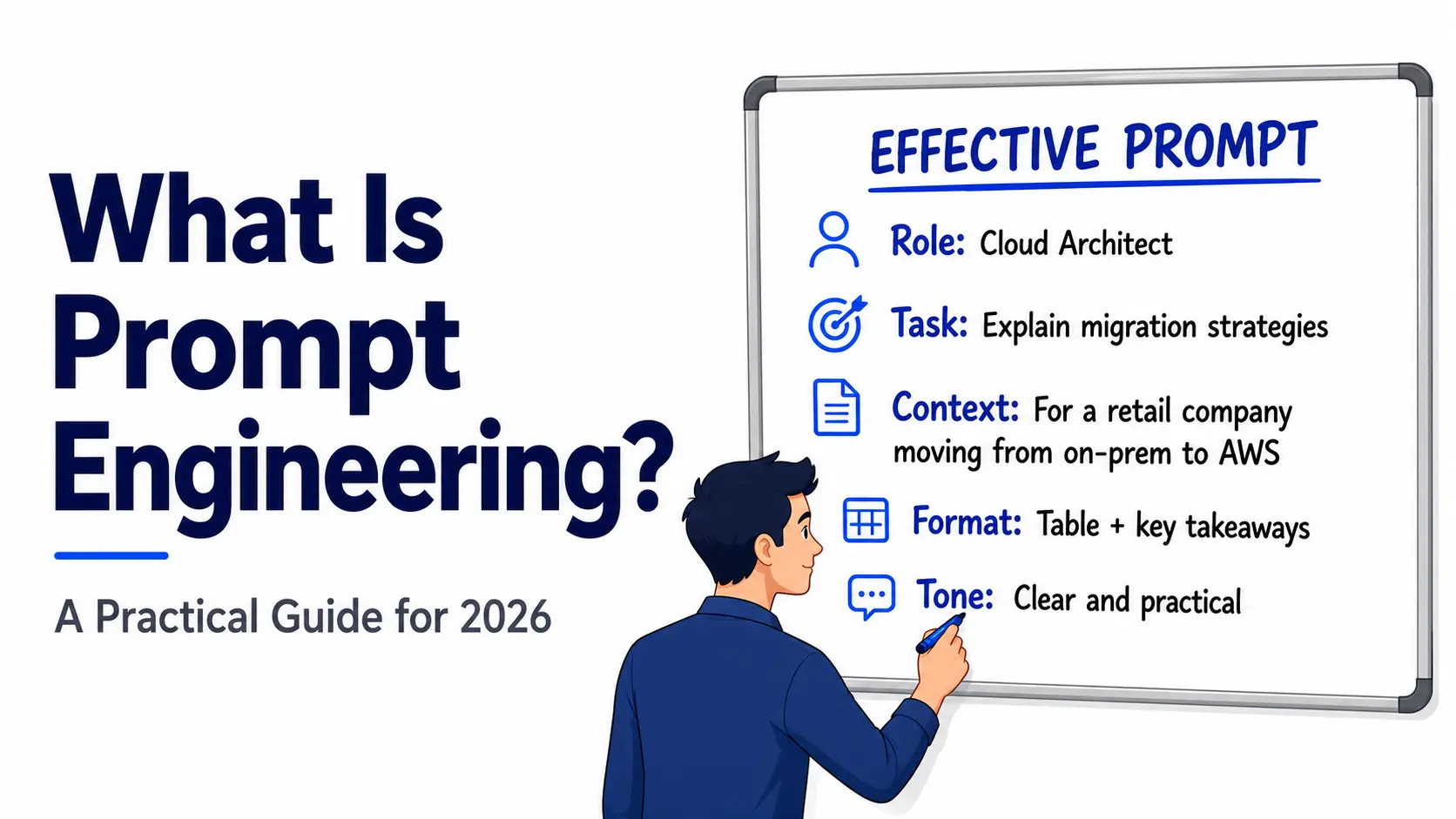


What Is Prompt Engineering? A Practical Guide For 2026

Usman AshrafJul 24, 2026
Illustration of a person writing an effective AI prompt on a whiteboard beside the title "What Is Prompt Engineering?"

Introduction

You ask ChatGPT or Claude a question and get a vague, generic answer. A colleague asks the same model a more specific question and gets a response they can use immediately. Your colleague didn't pay for a better model. They wrote a better prompt.

This guide explains what prompt engineering is, how AI models interpret instructions, the techniques that produce better results, and where prompt engineering is heading in 2026.

What is Prompt Engineering?

Prompt engineering is the practice of designing, testing, and refining the instructions you give an AI model to produce accurate, useful outputs. A prompt includes everything you send to the model: the task, context, examples, constraints, and the expected output format. Prompt engineering treats those instructions as a deliberate design process rather than a simple one-time request.

The Stanford AI Index 2026 reports that organizational AI adoption reached 88% in 2025. More teams now use AI in their daily work. As a result, the quality of their prompts has a big impact on how accurate, consistent, and useful the AI's responses are.

Why Does Prompt Engineering Matter?

Large language models generate responses based on probabilities rather than fixed rules. The same prompt can produce different outputs, especially when the instructions are vague. When key details are missing, the model fills the gaps with assumptions, which can reduce accuracy. A well-designed prompt reduces this variability by providing clear objectives, context, and constraints.

Research demonstrates the impact of prompt design. Google's chain-of-thought study found that providing eight worked reasoning examples increased PaLM's accuracy on the GSM8K math benchmark to 58%, more than doubling its performance with standard prompting. The model remained the same. Only the prompt changed.

Better prompts help companies save money and get more reliable results. Clear instructions help the AI avoid unnecessary words, reduce incorrect answers, and produce responses that need fewer edits.

Companies that use AI in real work do not create prompts from scratch every time. They save their prompts, test them, update them when needed, and keep improving them over time.

How do AI Models Interpret Your Prompts?

A language model does not interpret prompts the way people do. It breaks text into tokens, processes those tokens as input, and predicts the most likely next token based on patterns learned during training. Your prompt provides the context that guides those predictions.

Three practical principles dictate this process:

  • The model responds to what you write. If the prompt is ambiguous, the model may make incorrect assumptions or produce inconsistent results.
  • Instruction placement matters. Clear objectives near the beginning of a prompt and important constraints near the end are generally more effective than burying key details in the middle of a long prompt.
  • Every model has a context window. A model can consider only a limited amount of text at one time. Information outside this limit isn't available when the model generates a response.

Prompt engineering guidance from both Anthropic and OpenAI emphasizes the same principle: write clear, direct, and well-structured instructions instead of relying on clever wording or complex phrasing.
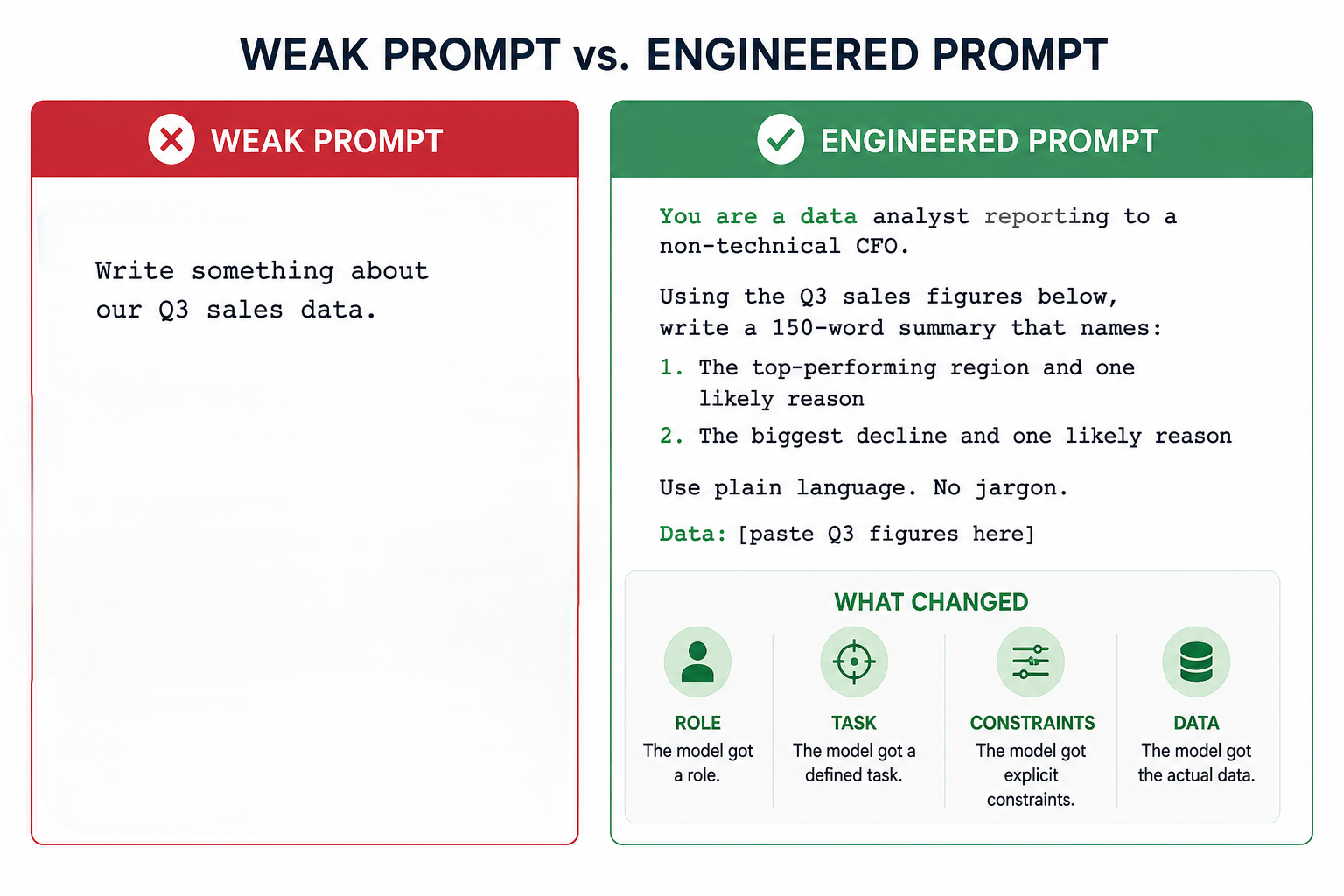
Comparison of a weak prompt and an engineered AI prompt showing how role, task, constraints, and data improve results.

Basic Prompting vs Advanced Prompt Engineering

The table below shows where casual prompting ends and prompt engineering begins.

Aspect

Basic prompting

Advanced prompt engineering

Instruction

A single question or request

A clearly defined task with a role, context, and constraints

Context

Little or no context provided

Relevant data, background, and audience included

Examples

No examples

One or more worked examples (few-shot prompting)

Output format

Model chooses the format

Format is specified, such as length, tone, JSON, or a table

Iteration

Accept the first response

Test, evaluate, and refine across representative cases

Reliability

Output quality varies

Outputs are consistent enough for production workflows

What Does an AI Prompt Engineer Do?

An AI prompt engineer designs, tests, and maintains the prompts used in AI applications and workflows. Typical responsibilities include writing system prompts for chatbots and AI agents, building evaluation datasets to measure output quality, optimizing prompts for cost and latency, and documenting effective prompting patterns for reuse across teams.

The ever-increasing demand for these skills has driven competitive salaries. Glassdoor estimates the average U.S. salary for an AI prompt engineer at $140,324 per year in 2026, with typical salaries ranging from approximately $116,000 to $172,000. However, the role is evolving, and many organizations now include prompt engineering within broader AI engineer positions, where prompt design is one of several responsibilities.

Successful prompt engineers combine strong writing skills with technical knowledge. They understand how language models behave, use Python to automate testing and evaluation, measure output quality with reliable benchmarks, and apply domain expertise to identify inaccurate or misleading model responses.

Prompt Engineering Techniques That Actually Work

Researchers cataloged 58 distinct text-based prompting techniques in The Prompt Report, a 2024 survey of the field. You don't need 58. These five cover most real work.

1. Zero-shot prompting

You give the model a direct instruction with no examples. It works because modern models are trained to follow instructions. Use it for simple, well-defined tasks, like summarizing, translating, or classifying.
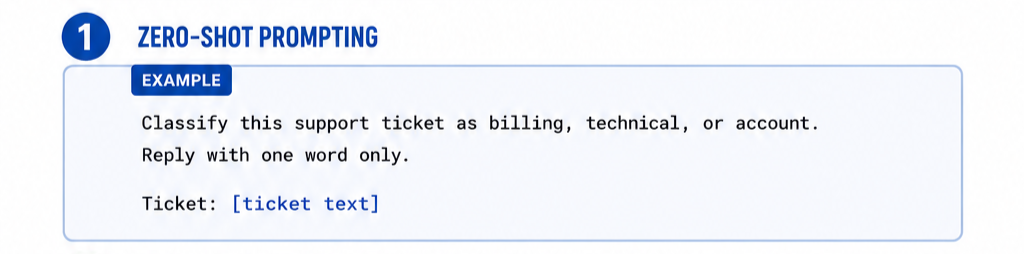
Zero-shot prompting example showing an AI classifying a support ticket into billing, technical, or account using one instruction.

2. Few-shot prompting

You include two to five worked examples before the real task. The model copies the pattern (format, tone, and logic) it sees. Use it when the output format matters or the task is unusual enough that instructions alone fall short.
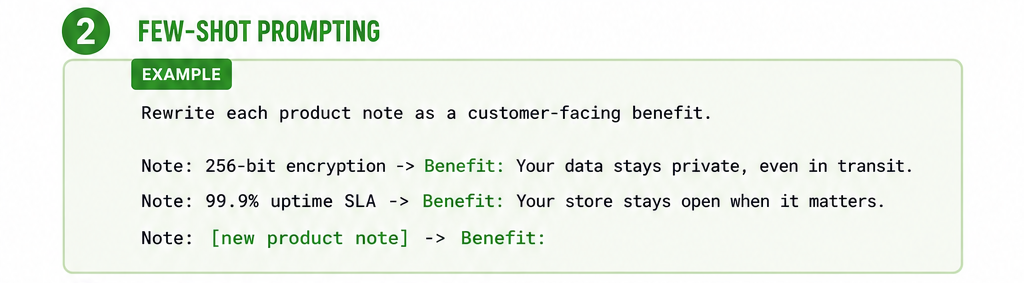
Few-shot prompting example showing product notes rewritten as customer benefits using example pairs before a new input.

3. Chain-of-thought prompting

You ask the AI to think through the problem before answering. This often helps with tasks that involve several steps, such as math, logic, or planning.

However, many newer AI models already think through problems internally before they respond. Asking these models to show every step usually makes the response longer without making it more accurate.

Try both approaches and compare the results. Use the one that gives the best answers for your task.
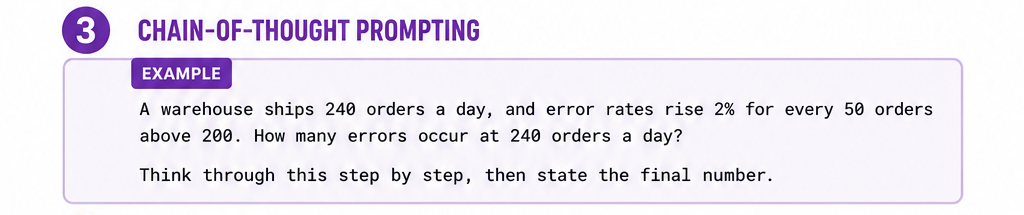
Chain-of-thought prompting example asking an AI to solve a warehouse error-rate problem by reasoning step by step.

4. Role prompting

You assign the model a persona. For example, "You are a senior SQL developer reviewing a junior's query." The role narrows the tone, the vocabulary, and the assumptions the model makes. It works best when combined with a concrete task (and is not very useful on its own). After all, a role without a task is still a vague prompt wearing a costume.
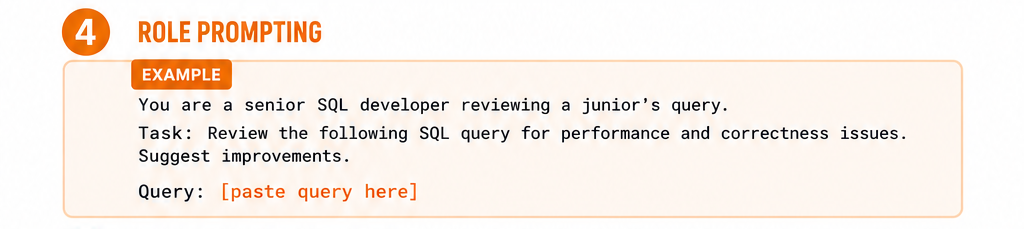
Role prompting example assigning the AI as a senior SQL developer to review and improve a junior developer's SQL query.

5. Structured prompting

Divide your prompt into clear sections. For example, create separate sections for instructions, background information, input data, and the desired output.

This helps the AI understand what each section is for. It can tell the difference between your instructions and your data, which leads to more accurate and consistent answers. Teams building AI chatbots use this pattern to keep user input from overriding system rules.
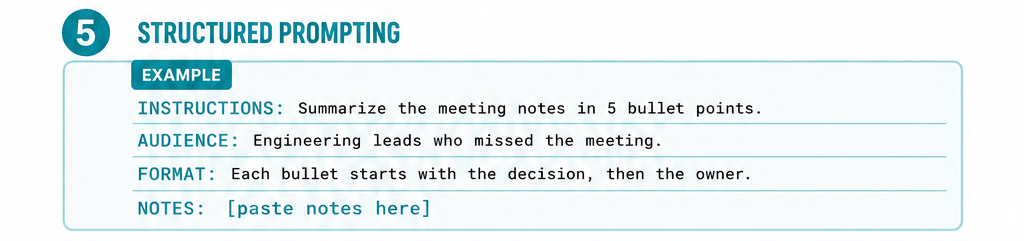
Structured prompting example organizing instructions, audience, format, and notes for summarizing meeting notes.

A Step-by-Step Prompt Engineering Framework

Techniques are individual building blocks and you need to combine them to get the best possible results. This framework shows exactly how you can combine them into a repeatable prompt engineering process.

  1. Define the expected output first. Specify the format, length, audience, and success criteria before writing the prompt.
  2. Provide the model with a role and relevant context. State who the response is for, what information to use, and what to ignore.
  3. Write clear instructions. Put the primary task in the first sentence, followed by any constraints or formatting requirements.
  4. Include examples when needed. Add one or two examples if the expected structure or style is not obvious.
  5. Test the prompt with multiple inputs. Evaluate it against five to ten representative cases instead of a single example. Record where the prompt produces incorrect or inconsistent outputs.
  6. Modify one variable at a time. Change the wording, examples, or instruction order individually, then retest to measure the impact of each change.
  7. Version successful prompts. Save effective prompts as reusable templates with placeholders, and manage revisions using version control or a documented change history.

Prompt Engineering Best Practices

Run every production prompt through this checklist:

  1. Put the primary task in the first sentence.
  2. Specify the output format, length, audience, and tone.
  3. Provide the data and context for the model.
  4. Include an example when the expected format is not obvious.
  5. Define what the response should include and exclude.
  6. Break complex tasks into smaller prompts when appropriate.
  7. Test prompts with representative, edge-case, and adversarial inputs.
  8. Version successful prompts and document the changes that improve performance.

Common prompt engineering mistakes (and how to fix them)

The most common prompt engineering mistake is to use vague instructions. A prompt like "Make this better" gives the model little direction. Instead, specify the objective, such as shortening the text, changing the tone, or writing for an executive audience.
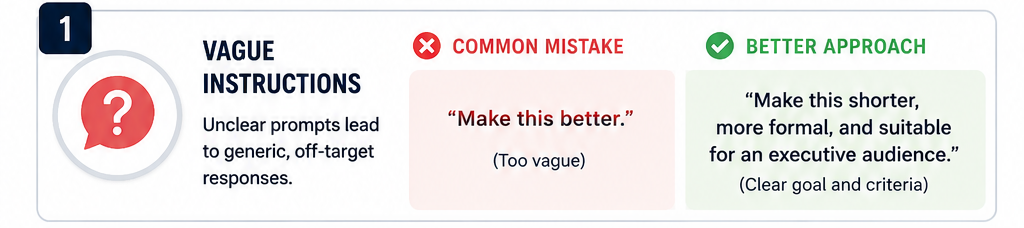
Comparison showing vague prompting versus a specific prompt with clear goals and criteria for better AI responses.

Cramming several tasks into one prompt causes similar troubles. Ask the model to research, draft, and format in a single pass, and each job gets a fraction of its attention. Split the workflow into smaller prompts and feed the output of one step into the next.
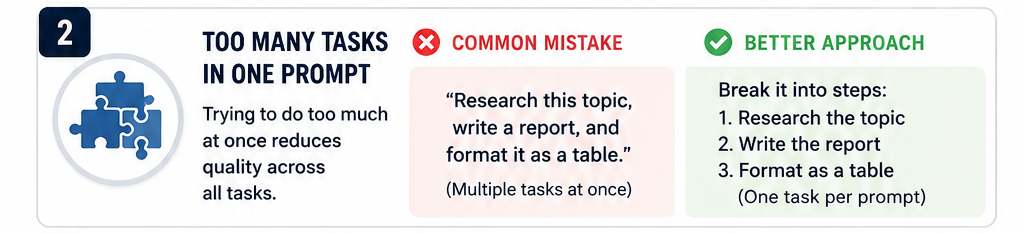
Comparison showing why combining multiple tasks in one prompt reduces quality and how breaking them into steps improves results.

Failing to specify the output format also leads to inconsistent responses. Define the expected structure, length, tone, or format instead of relying on the model's default behavior.
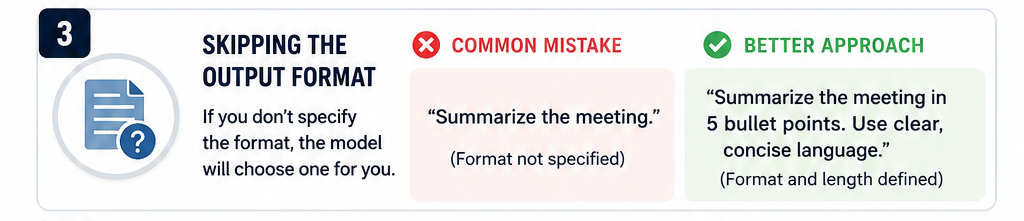
Comparison showing the importance of specifying output format instead of leaving the AI to choose one automatically.

Accepting the first response from an AI model is another very common mistake. The initial output is a draft and you need to refine the prompt or ask the model to improve the response against specific criteria.
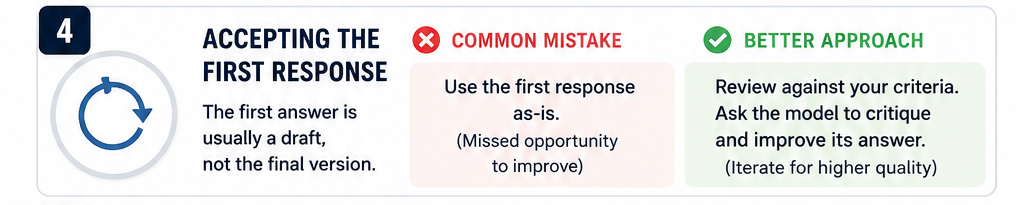
Comparison showing why reviewing and refining an AI response produces better results than accepting the first draft.

Prompt performance also varies across AI models. A prompt optimized for GPT may produce different results on Claude or Gemini. Re-test prompts whenever you switch models, and adjust them as needed.

Comparison showing why prompts should be tested and adjusted across different AI models instead of reused unchanged.

Finally, evaluate prompts with representative test cases. Testing against multiple real-world and edge-case inputs helps verify the results and allows you to improve output quality by adjusting the prompt.

Comparison showing why prompt testing with multiple examples is more reliable than judging results from a single response.

Where is Prompt Engineering Heading In 2026?

These three trends are shaping how teams build AI applications in 2026.

Reasoning models require different prompting strategies. Modern reasoning models perform much of the intermediate planning internally. Prompts should define the objective, constraints, and success criteria instead of prescribing every reasoning step. Unnecessary instructions can increase token usage and may reduce output quality.

AI agents rely on complete prompt systems. AI agents combine system prompts, tool definitions, memory, and user instructions to complete tasks. Weak instructions in any part of the system can affect the entire workflow. As a result, AI agent development teams design and evaluate these components together rather than treating prompts as standalone assets.

Context engineering is becoming a core discipline. Effective AI systems depend on providing the right information, tools, and conversation history at each stage of a workflow. Enterprise teams now maintain version-controlled prompt libraries, automate prompt evaluations, and review prompt changes using the same processes they apply to source code. Prompt writing remains important, but structured engineering practices are becoming more and more important (to support it).

Start Engineering Your Prompts

Prompt engineering is one of the most effective ways to improve AI output. You do not need to retrain a model or replace your AI platform. Clear instructions, structured prompts, and consistent testing often deliver better results. Start with the framework in this guide, follow the best practices checklist, and version successful prompts so they can be reused and improved over time.

If you're moving from experimentation to production AI, whether for chatbots, AI agents, or automated workflows, DataPrism can help. Our AI consulting team designs, tests, and deploys production-ready AI systems for organizations across industries. Book a free consultation to discuss your use case and explore the right approach for your business.

Book a Free 30-Minute Meeting

Discover how our services can support your goals — no strings attached. Schedule your free 30-minute consultation today and let's explore the possibilities.

Book a Free Call

Frequently Asked Questions

Yes, though its shape has changed. Models tolerate sloppier prompts than they did in 2023, and reasoning models plan their own steps. The skill now lives inside system prompts, agents, and AI product design rather than one-off chat messages. Clear instructions still beat vague ones on every model.

No. The core skill is writing precise instructions in plain language, and anyone who writes well can start today. Coding becomes useful once you test prompts at scale, call models through APIs, or build agents, which is why most professional prompt engineers pick up Python along the way.

You can learn the five core prompt engineering techniques on a weekend and see better outputs immediately. Reaching a professional level, where you build evaluation sets and production-grade prompts, usually takes a few months of hands-on work on real projects.

Prompt engineering changes the input while fine-tuning changes the model itself. Prompting is faster, cheaper, and covers most use cases. Fine-tuning suits narrow, repeated tasks where you have thousands of labeled examples and prompting alone falls short.

Glassdoor reports an average of $140,324 per year for AI prompt engineers in the US as of 2026. The salary ranges roughly between $116,000 and $172,000. Compensation at frontier AI labs runs far higher, and many roles now carry the broader title of AI engineer.

Book Consultation