

Claude Opus 5 Compared: Features, Pricing & Benchmarks

Usman AshrafAug 4, 2026
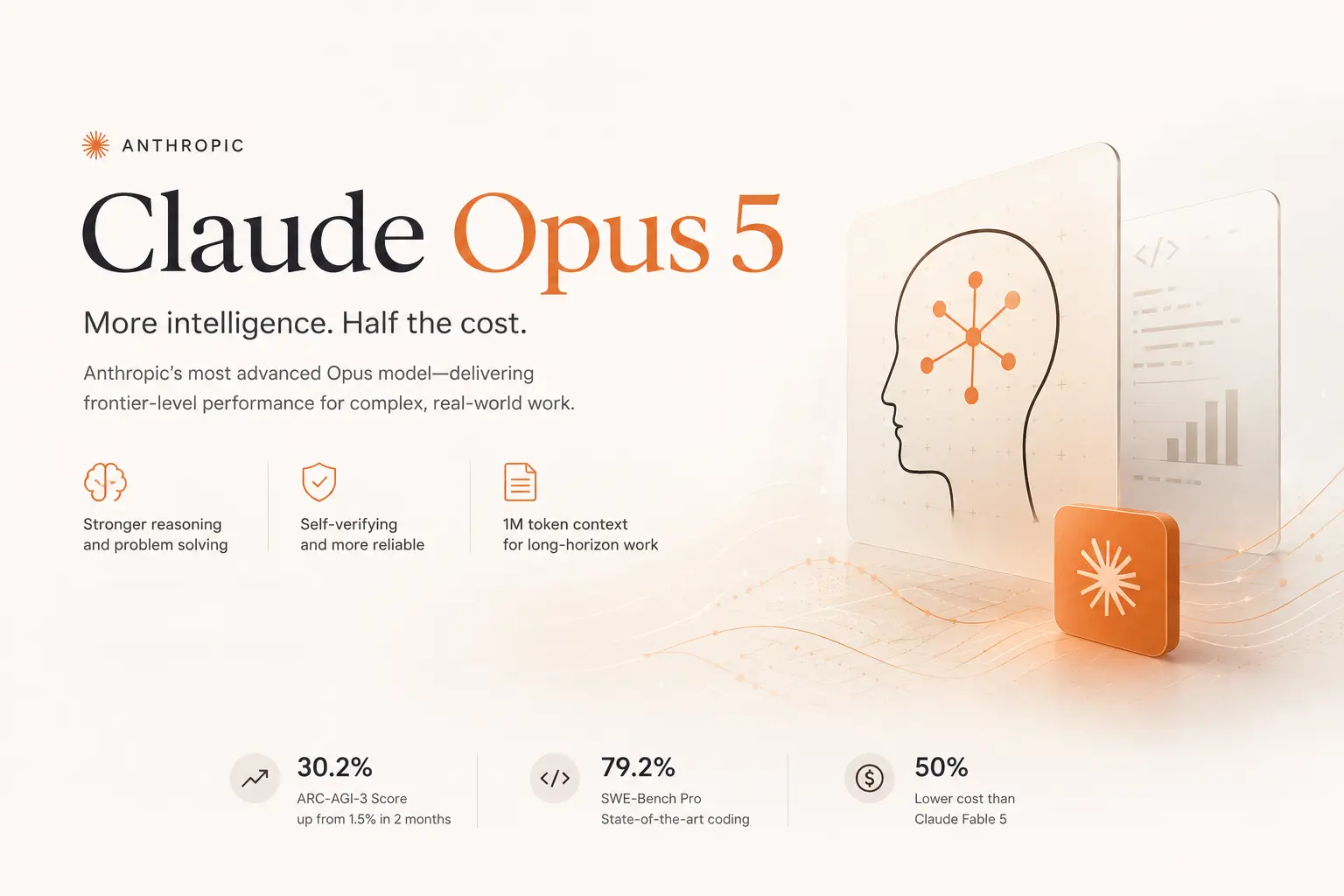
Claude Opus 5 hero graphic highlighting stronger reasoning, self-verification, 1M-token context, coding scores, and lower cost.

Introduction

Most teams pick a frontier model from a launch-day chart, wire it into one workflow, and discover a month later that the bill and the failure rate look nothing like the announcement. The chart wasn’t wrong. It just measured a task set that isn’t yours.

Claude Opus 5 makes this trap easier to fall into, because its headline reads backwards. Anthropic says Opus 5 matches Claude Fable 5’s top-tier intelligence in many domains at half the price, and Opus 5 outscores Fable 5 on two of Anthropic’s own evaluations. Once the cheaper model beats the expensive one, the buying question stops being “which is smartest” and becomes “which one finishes my work at a cost I can defend.”

This guide covers what Claude Opus 5 is and what changed. It compares the model with Claude Fable 5, GPT-5.6 Sol, and Grok 4.5 on benchmarks, production cost, and limits. The goal is to leave you with enough information to decide whether it belongs in your stack or not.

What is Claude Opus 5?

Claude Opus 5 is Anthropic's Opus-tier frontier model, released on July 24, 2026. It's designed primarily for agentic coding and enterprise knowledge work. It holds 1M tokens of context (returns up to 128,000), thinks by default, and can be called through the API model ID claude-opus-5

Anthropic's lineup runs Haiku, Sonnet, and Opus, with the Mythos class on top. Mythos ships as Claude Fable 5 for general customers and Claude Mythos 5 for approved Project Glasswing partners. Opus 5 sits a tier below both on paper. Published evaluations complicate the ranking, because Opus 5 outscores Fable 5 on agentic coding and knowledge work while trailing Mythos 5 on cybersecurity tasks.

Anthropic calls the release a step change over Claude Opus 4.8. The biggest gains claimed are in deep reasoning, long-horizon agentic tasks, and test-time compute scaling. Amazon's engineering team frames the same release in cost terms: frontier capability at Opus-tier economics.

Claude Opus 5 Features and Capabilities

Opus 5 is built to handle longer, more complex tasks with fewer mistakes. It works more independently, checks its own work, and stays reliable even on large projects. 

Agentic Persistence

Opus 5 keeps working until the task succeeds. Older models stop at the first answer that looks right.

Anthropic gives two examples. The model couldn't open a machine-part drawing, so it wrote its own code to read the image and pull out the shapes. In a separate case, it found a bug in an open-source tool, traced the cause, and fixed that instead of the visible symptom.

You see this as fewer half-finished pull requests, and fewer placeholders left behind when it edits several files at once.

Effort That Converts Into Quality

The effort parameter runs low, medium, high, xhigh, and max, with high as the default. Anthropic says Opus 5 converts extra effort into better results more reliably than any earlier Opus model, so the parameter works as a cost-quality dial. You drop a level where quality holds to save money. You reserve the top end for work you can't afford to redo. 

Self-Verification

Opus 5 checks its own work without being asked. Teams migrating from older models trip over this. Prompts like "include a final verification step" or "use a subagent to verify" now trigger over-verification and burn tokens. Delete them.

Long-Context Reliability

The 1M-token window is both default and ceiling, with no smaller variant to configure. Instruction following and tool calling hold up at 800,000 tokens instead of degrading after the first few hundred thousand.

Vision and Document Work

Opus 5 reads charts, scanned documents, and diagrams, and reproduces UI and frontend visuals. So, you can hand it tools to crop, analyze, and check its own reading rather than asking for a single-pass answer on a dense image, and accuracy climbs.

Multi-Agent Coordination

Opus 5 delegates to subagents more often. Similarly, it runs writer-verifier patterns with fewer agents overwriting each other's work. Anyone building a fleet of agents gets a real gain here. Run one prompt at a time, and the only difference you'll see is longer default responses.
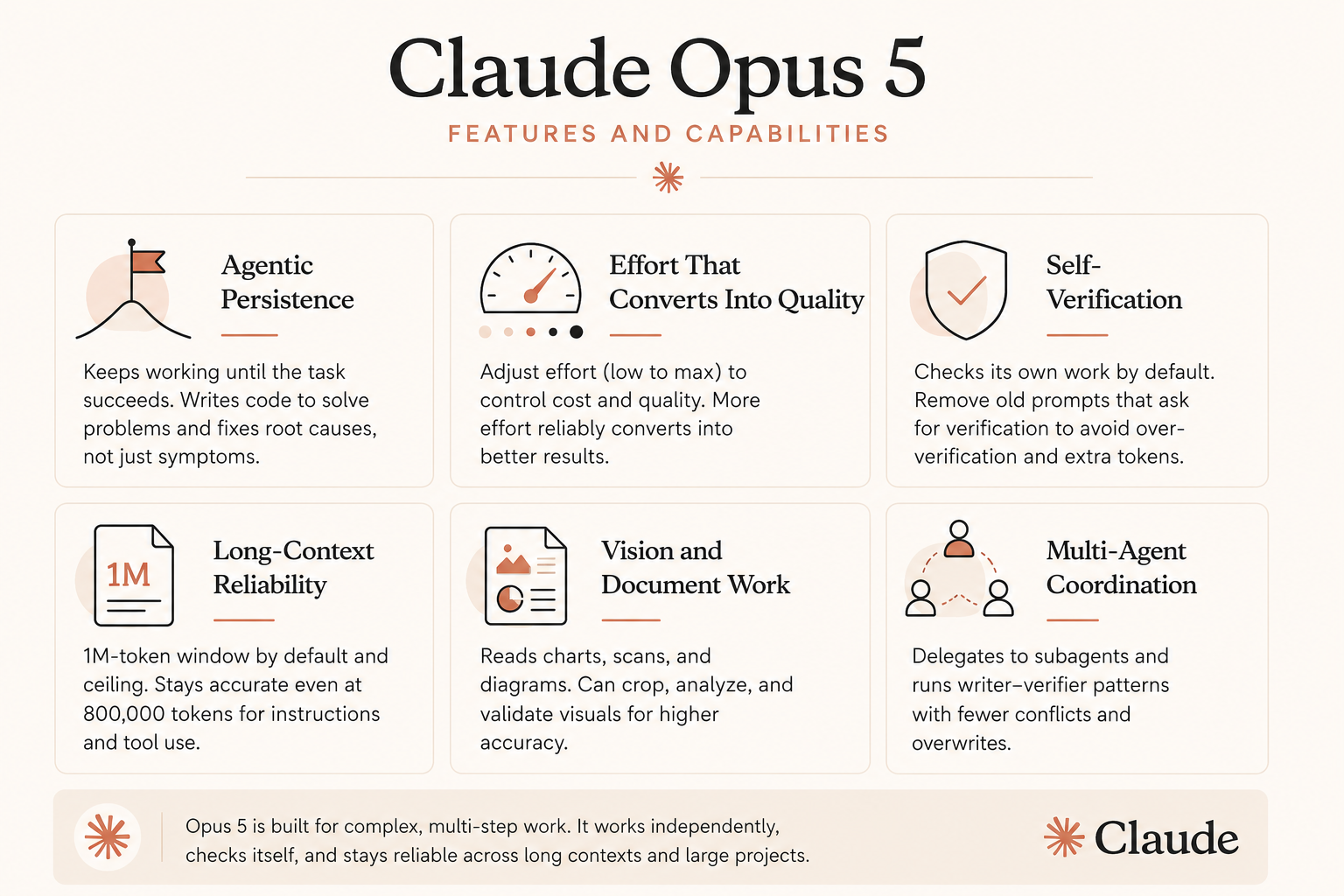
Claude Opus 5 feature infographic covering agentic persistence, self-verification, long context, vision, and multi-agent work.

Claude Opus 5 Benchmarks

The generational jump from Opus 4.8 is the clearest signal in the numbers. And we must remember that Opus 4.8 was only two months old when Opus 5 shipped.

Benchmark

Claude Opus 5

Claude Opus 4.8

SWE-bench Verified

96.0%

88.6%

SWE-Bench Pro

79.2%

69.2%

Frontier-Bench v0.1

43.3%

18.7%

ARC-AGI-3

30.2%

1.5%

GDPval-AA v2 (Elo)

1,861

1,593


ARC-AGI-3 is the row worth staring at. Opus 5 went from 1.5% to 30.2% on a benchmark built to resist memorization. This points to novel problem-solving rather than pattern recall. On Frontier-Bench v0.1 (a test of terminal-based agentic coding), Opus 5 more than doubled the score in the same two months.

Opus 5 also posts 70.6% on OSWorld 2.0 for computer use, 90.8% on BrowseComp, and 26.0% on AutomationBench for tool use. Anthropic reports its lowest misaligned-behavior audit score to date at 2.3, where lower is better. You can see all of them lined up in a side-by-side benchmark breakdown.

Labs run these evaluations on their own infrastructure, with their own prompting and effort settings. The results are then published, and every number above and below comes with that asterisk. Treat them all as a shortlisting tool, never as procurement evidence.

Claude Opus 5 vs Fable 5, GPT-5.6, and Grok 4.5

Model

Price per 1M (in/out)

Context

SWE-Bench Pro

GDPval-AA v2

Best fit

Claude Opus 5

$5 / $25

1M

79.2%

1,861

Long agent runs, document-heavy work

Claude Fable 5

$10 / $50

1M

80.3%

1,747

Hardest reasoning, highest ceiling

GPT-5.6 Sol

$5 / $30

1.05M

64.6%

1,736

Terminal and Codex-style coding

Grok 4.5

$2 / $6

500K

64.7%

Not published

High-volume, cost-capped agent loops

Claude Opus 5 Pricing

Claude Opus 5 lists at $5 per million input tokens and $25 per million output tokens (same as Opus 4.8). Fast mode doubles both rates, to $10 and $50, in exchange for faster output. It's a research preview, available on the Claude API only.

Effort level swings reasoning-token volume by a wide margin, and every retry multiplies the bill. Both will move your estimate more than the rate card does. Measure them on your own workload before you forecast.

Migration is one line. Change the model ID to claude-opus-5, then revisit the two behavior changes above. If you're already integrating AI into existing systems, this is mechanical work
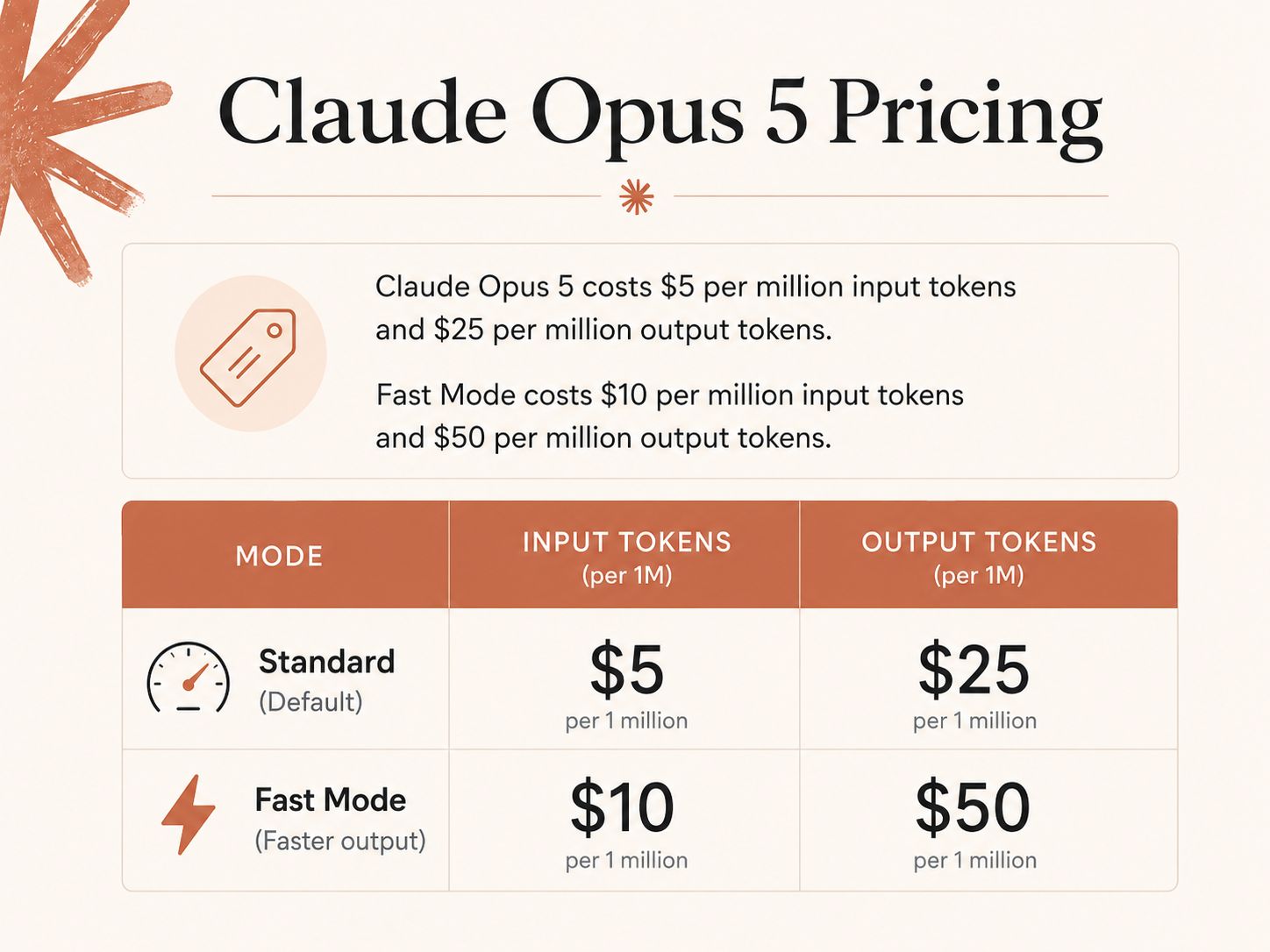
Claude Opus 5 pricing chart comparing standard and Fast Mode input and output token costs per million tokens.

Pros and Cons of Claude Opus 5

What works well:

  • You pay half Fable 5's price for frontier-level results, on the same 1M-token context window.
  • Bedrock includes zero data retention by default, which Fable 5 and Mythos 5 can't offer.
  • Effort levels give you a cost-quality dial instead of a binary model choice.
  • Opus 5 gains most on unfamiliar problems. This is where templated coding benchmarks tell you least about production value.
  • Self-verification means you write less scaffolding.

What to watch:

  • Default responses and deliverables run longer than on Opus 4.8, so you pay more per call.
  • Disabling thinking at xhigh or max effort returns a 400 error, a breaking change from Opus 4.8.
  • Prompts you carried over from older models trigger over-verification and waste tokens.
  • Grok 4.5 and the Gemini Flash tier remain far cheaper per token for high-volume work.
  • Every score here is lab-reported (Anthropic's included).

Limitations, and When Another Model Fits Better

Opus 5 is not the correct answer for every workload. Treating it as a default is how AI budgets get out of hand. There are many scenarios when it will be better to use other options. For example, choose something else when:

  • You're classifying, extracting, or routing at high volume. Haiku, GPT-5.6 Luna, or Gemini Flash-Lite handle that work at a fraction of the cost.
  • Your business case turns on token cost, and errors are cheap to catch. Grok 4.5 wins on rate card and token efficiency, as long as you price in its measured hallucination rate.
  • You're doing terminal-heavy coding inside an existing Codex workflow. GPT-5.6 Sol leads Terminal-Bench 2.1 and DeepSWE.
  • Your integration must run with thinking disabled. Opus 5 gets less predictable in that configuration.

You route most traffic to a cheaper tier and reserve Opus 5 for the steps where a wrong answer is expensive. Working out which steps qualify takes up most of an AI strategy and consulting engagement.

Conclusion

The model at the top of the chart is rarely the one that finishes your work at a cost you can defend. Opus 5 holds frontier-level quality at half of Fable 5's price, verifies its own output, and stays coherent across a million tokens of context. You feel all three on long agent runs and document-heavy enterprise work. However, cheaper tiers still win on high-volume classification and cost-capped loops. A pilot project that ignores will most probably die at the budget review.

You'll need a private evaluation on your own tasks. Similarly, a clear read on your retention and residency constraints, and honest arithmetic on cost per finished task are necessary.

You can run all of that yourself. If you'd rather not, book a free consultation and bring one workflow you want to automate. We'll tell you which model fits and what it costs before you write any code. The pipelines, retrieval, and agent infrastructure are a separate conversation.

Book a Free 30-Minute Meeting

Discover how our services can support your goals — no strings attached. Schedule your free 30-minute consultation today and let's explore the possibilities.

Book a Free Call

Frequently Asked Questions

Claude Opus 5 handles agentic coding, long-running automation, document-heavy analysis, and enterprise knowledge work. Common deployments include code review and refactoring, contract and compliance review, multi-sheet financial modeling, and customer-facing agents that coordinate several tools across a single task.

List pricing is $5 per million input tokens and $25 per million output tokens. It is the same as Claude Opus 4.8 and half the rate of Claude Fable 5. Fast mode (of Opus 5) will cost $10 (for input) and $50 (for output). Prompt caching, batch processing, and effort level all move real spend more than the rate card suggests.

It depends on the task. Opus 5 leads GPT-5.6 Sol on SWE-Bench Pro, ARC-AGI-3, OSWorld 2.0, and AutomationBench. Sol leads on Terminal-Bench 2.1 and DeepSWE. Opus 5 suits open-ended problems while Sol can be better for well-defined terminal coding.

Fable 5 is Anthropic’s most capable widely released model at $10 and $50 per million tokens. Opus 5 costs half as much, beats Fable 5 on some agentic work benchmarks.

Book Consultation