

4 Best AI Automation Companies for E-commerce Stores

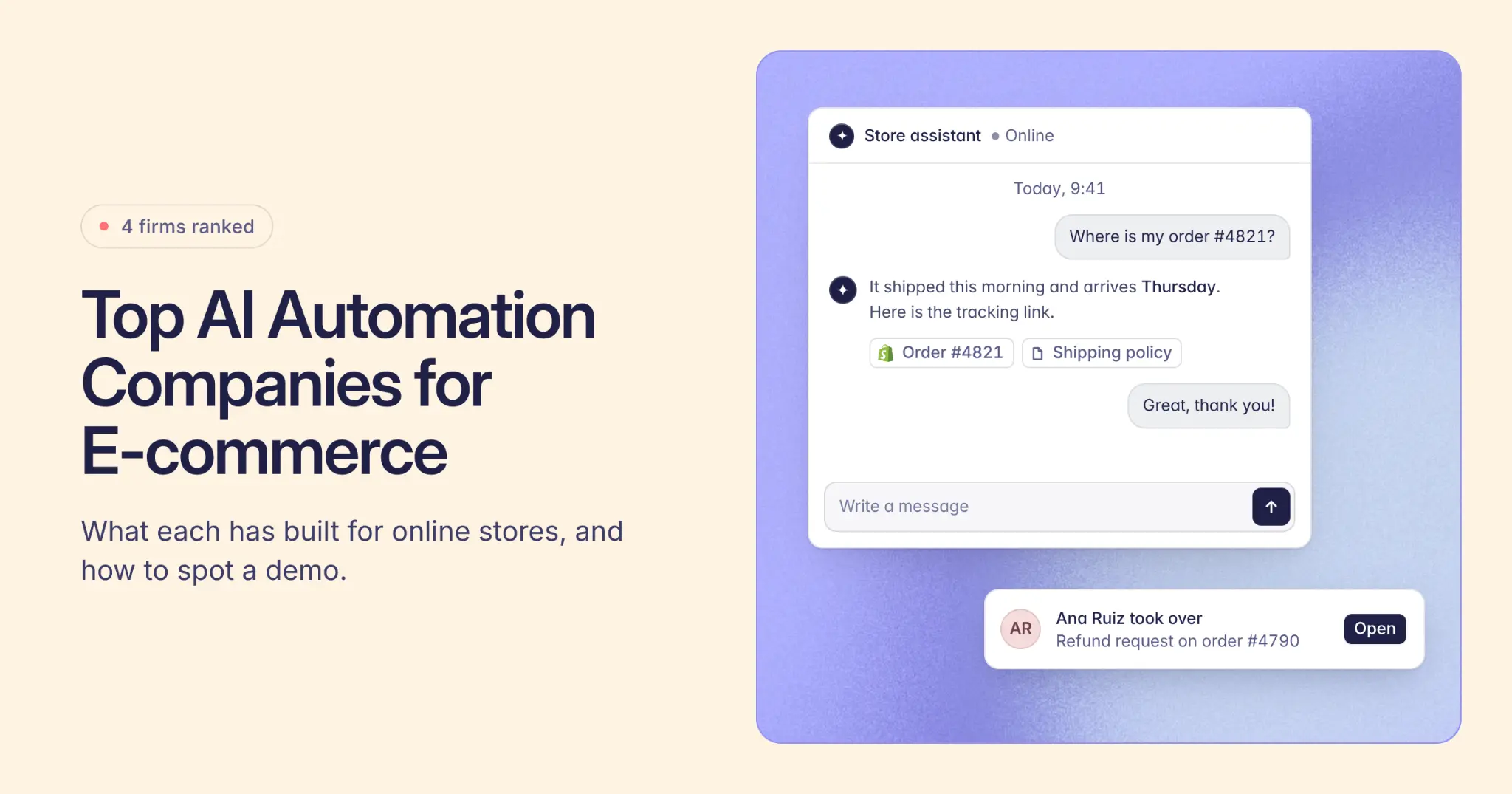
Cream cover reading Top AI Automation Companies for E-commerce beside a store chat assistant answering an order question.
Written byPrincipal Data/AI Architect
Technically reviewed byMuhammad Taha Senior AI Architect
Published
Reading time
12 min

Summarize with AI

Introduction

Chewy started testing a new AI assistant with a small group of app shoppers in 2026. On the September 9, 2026, earnings call, CEO Sumit Singh said the Kai assistant resolved “approximately 30% of chats” through self-service. Less than 10% or 15% of Chewy’s traffic was exposed to Kai, which had been live for less than a month.

Early numbers from a rollout this small prove little about a working system. Stores without in-house engineers need outside help to build one, and AI automation companies for e-commerce differ widely in what they have shipped. Some e-commerce AI automation services run in production for real stores. Others have little beyond a demo.

This article ranks four AI automation firms for e-commerce, then explains the ranking method, what each has built for stores, and how to spot a demo.

How These AI Automation Companies for E-commerce Were Shortlisted

Each firm cleared five checks to make the list. The checks were services offered, proven projects, industry focus, client reviews, and pricing transparency. Only service firms building for clients qualified, so software products stayed off the list. General AI agencies without retail proof were also left out.

Services offered meant AI automation work relevant to a store, with named tools and platforms. Proven projects meant at least one verified e-commerce or retail project with a named client and a published result. Industry focus kept the list on firms delivering AI automation with retail-specific proof.

Client reviews and pricing transparency came next. Reviews on third-party directories showed how past buyers rated delivery, and public rates or price ranges counted in a firm’s favor. The review ran on each firm’s own website in October 2026, and firms with case pages the review could not read were left out.

Rank order reflects fit for small and mid-size online stores first, then strength of evidence. Data Prism publishes this article and ranks first, so Data Prism’s profile states limits alongside strengths. Every result figure comes from the firm’s own case page, and none were independently audited, so read each one as the firm’s own claim.

What E-commerce AI Automation Means for an Online Store

E-commerce AI automation services connect a store’s existing systems. They let software handle routine work, while people handle the exceptions. A typical setup links the storefront, helpdesk, inventory, and shipping tools. The work splits into three levels, and each level gives the software a different amount of freedom.

The simplest level runs on fixed rules, such as sending an email once an order ships. The next level uses AI to draft replies or product copy for a person to approve. The third level is AI agents for e-commerce, which take actions directly, such as looking up an order or starting a return.

Order-status support is often the first project for this kind of work. Gorgias, a helpdesk vendor, says up to 30% of incoming support tickets are shipping status requests. AI chatbots can answer these questions with live tracking data from the order system. Refund disputes still go to a person. Stores hiring out the chatbot alone can compare these AI chatbot builders for e-commerce support.

Product content also sits at the drafting level. AI writes first drafts of product descriptions and fills attribute fields from supplier data. A merchandiser reviews each draft before publishing.

Cart recovery goes after another large, measurable leak. Baymard Institute puts average documented cart abandonment at 70.22%, based on 50 studies. Automated flows remind shoppers about items left behind. AI can also adjust the wording for each cart.

Inventory and order work happens behind the storefront. E-commerce AI workflow automation can flag low stock before a best seller runs out. The same automation can route orders between warehouses and hold suspicious orders for review.

Best E-commerce AI Automation Agencies, Ranked

The four firms below all build automation for online stores, but each serves a different kind of store. Each profile covers key services and a verified project. Each profile also states the firm’s limits and its best-fit store. The order follows the ranking criteria above.

1. Data Prism

Data Prism is an AI automation and data engineering firm working from Atlanta and Dubai. The firm builds e-commerce AI workflow automation around tools a store already uses, such as Shopify, Google Drive, and Google Sheets. Both published store projects route problem cases to a person or a failure log.

Data Prism homepage with an AI Automation and Data Engineering for Growing Businesses headline and Upwork and Clutch badges.

Data Prism’s main services are AI automation, AI agents, chatbots, data engineering, and system integration. For stores, chatbots handle product questions, order tracking, and return requests. Separate agents cover inventory monitoring and order workflows.

Lovey Prints is a Shopify store selling personalized artwork from customer photos. The store once needed several days to fulfill requests. Data Prism built a Python workflow for the store’s Shopify fulfillment.

The workflow checks new orders every five minutes. Customer photos go to the production folder in Google Drive. Resolution-upgrade orders go to a separate queue.

The store’s finished artwork is matched back to each order by order ID. Then proofs go to customers by email. Files unsafe to match go to a manual folder instead. Data Prism reports manual effort cut by “up to 92%.”

23 Brand Group, a multi-brand e-commerce seller, hired Data Prism for marketplace automation on Bol, Otto, Cdiscount, and Kaufland, four European marketplaces.

Google Sheets controls the browser automation for product-ranking tasks. Failed runs retry automatically and leave a failure record for review. Data Prism’s case page lists 72% less manual effort.

The firm suits small and mid-size online sellers on Shopify and European marketplaces, including multi-brand sellers listing on several marketplaces at once. Published work outside e-commerce covers logistics and real estate, so the approach carries across businesses with manual, document-heavy back offices.

Sensitive steps can require human approval before they run, and failed runs leave a record for review. The people who scope a project also build the project, so the plan doesn’t change hands between sales and delivery. The work connects to current tools, so a store keeps Shopify and its helpdesk instead of swapping them.

The limits are plain. Both e-commerce case studies are undated, and both describe rules-based automation, with no AI model in production on either store. Data Prism publishes no named US store client, and both effort figures are self-reported.

Data Prism is best for small and mid-size Shopify and marketplace sellers who want order and fulfillment work automated without replacing their tools.

2. Elogic Commerce

Elogic Commerce is an e-commerce development agency founded in 2009 and based in Tallinn, Estonia. The firm works only in e-commerce and builds ERP-connected B2B and B2B2C stores. Its AI work covers agents, chatbots, and AI search.

Elogic Commerce homepage with an Ecommerce Development Company for Complex B2B and B2B2C headline and a 5.0 Clutch rating.

The clearest proof is Cromwell, a wholesale industrial distributor. Cromwell runs Adobe Commerce Cloud with SAP S/4HANA and Akeneo PIM. For Cromwell, Elogic built intent-aware search and AI-assisted reordering for repeat buyers.

Elogic also built AI quote classification and routing. Complex and exception quotes still go to human sales engineers, each with an AI-generated context summary.

Elogic’s own case page, last updated October 2026, lists a 34% reduction in time-to-order for repeat buyers. The same page claims a 28% increase in search-driven conversions. Elogic also says 65% of manual quote-routing operations are now automated through AI classification and routing.

Read the numbers with care. Elogic published the figures on its own, with no baseline or measurement period. Cromwell is a B2B distributor, not a consumer store, so the results say little about a Shopify brand.

Elogic lists Shopify Plus and BigCommerce work, but no AI results for clients on either platform. A D2C store should ask Elogic for consumer-store results first when comparing e-commerce AI automation agency options.

Elogic suits B2B and wholesale sellers on Adobe Commerce who need ERP and PIM data connected.

3. Grid Dynamics

Grid Dynamics is an engineering services firm founded in 2006 and based in San Ramon, California. Its e-commerce work covers AI search, conversational AI, merchandising, and generative AI catalog management. Most of this work sits on Google Cloud. The firm also runs its own Merchandising Experience Platform, known as MXP.

Grid Dynamics homepage with an AI engineered for your enterprise headline beside stacked orange and glass cube shapes.

The named case is Galeries Lafayette, where the firm built AI search and merchandising on MXP with Vertex AI Search for Commerce. A Grid Dynamics press release dated April 20, 2026, reports a 7% total revenue increase and an 8% rise in average basket value. The release cites a 20% year-over-year increase in online sales.

The figures come from Grid Dynamics’ own release, with no baseline or measurement period stated. The release quotes a Galeries Lafayette executive, who refers to tests run over a summer. The release doesn’t say whether the numbers come from the summer tests or a full rollout, so treat them as directional.

Scale matters here too. Grid Dynamics works with enterprise retailers, not D2C brands, so its services are too large for a small Shopify store with a lean catalog.

Grid Dynamics fits large retailers with big catalogs already running on Google Cloud.

4. Provectus

Provectus is an AI and machine learning services firm based in San Francisco. The firm builds on AWS, including Amazon SageMaker and Amazon Bedrock. Retail is a small part of its published work. Two of its cases still fit online stores with search or forecasting problems.

Provectus homepage with a We run the AI systems our clients run the business on headline and a See our work button.

Houzz runs an online platform connecting homeowners with home-improvement professionals. The platform also includes a product marketplace. Provectus built semantic query understanding for the marketplace search.

The Provectus case page shows category accuracy rising from 52.94% to 78% and recall rising from 66.98% to 85%. The page also says the work went from idea to working prototype in two months. So, read the figures as prototype results.

The second case is Blue Bottle Coffee, a specialty coffee roaster with cafes in the US and Asia. Provectus built pastry demand forecasting for more than 100 cafes on Amazon SageMaker. Cafe managers can override the forecasts. The Blue Bottle case page, dated May 5, 2026, shows pastry ordering accuracy improving 8% in the first month.

Its published work has limits for an online store. The Provectus site has no online-store support or product-content case with a named client. Blue Bottle covers in-cafe ordering, not online sales. The 8% is a first-month figure. Every figure here is self-published by Provectus.

Provectus is best for stores running on AWS with a search or demand-forecasting problem.

Comparison of E-commerce AI Automation Agencies

The four agencies differ most in client type and in how far each published project went. Data Prism shows a small Shopify build, while Elogic Commerce and Grid Dynamics work with B2B and enterprise clients. The table below shows each company’s best-fit buyer and one verified project. The last two columns give the published result and the main limit.

Company

Best For

Verified Project

Published Result

Main Limit

Data Prism

Shopify stores automating order fulfillment

Lovey Prints Shopify fulfillment

Up to 92% less manual effort

Undated case, rules-based workflow

Elogic Commerce

B2B sellers on ERP-connected platforms

Cromwell product discovery and quotes

34% faster repeat orders

B2B only, no D2C case

Grid Dynamics

Enterprise retailers on Google Cloud

Galeries Lafayette search and merchandising

7% revenue increase

Enterprise focus, no published baseline

Provectus

AWS stores with search or forecasting needs

Houzz marketplace search

Recall up from 66.98% to 85%

Prototype stage, self-published figures

Which E-commerce AI Automation Agency Fits Your Store

The best e-commerce AI automation agency for your store depends on the platform, the size of the business, and the one workflow costing the most staff time. A firm built for enterprise retail can be a poor match for a small Shopify brand. Name the job first, then compare vendors.

Data Prism fits a Shopify or marketplace seller whose orders, fulfillment, or listings are still handled by hand. The work is mostly process automation around Shopify, marketplaces, and Google tools. Data Prism builds in exception handling.

Elogic Commerce fits a B2B or wholesale seller on Adobe Commerce, especially when ERP and PIM data drive quotes and reorders.

Grid Dynamics fits a large retailer with a big catalog on Google Cloud. Grid Dynamics builds AI search, merchandising, and catalog content tools on Vertex AI Search for Commerce. Its tools are sized for enterprise retail.

Provectus fits a store on AWS whose main problem is on-site search or demand forecasting. However, retail is a minor focus for Provectus.

Whichever firm wins the job, start with the single most costly workflow. One working automation teaches more about your data and tools than a broad plan on paper.

What to Check Before Hiring an E-commerce AI Automation Agency

A polished pitch says little about how an agency will handle your store. Trust comes from proof on stores like yours, and most of the proof surfaces once a buyer asks direct questions. Four checks matter most before signing with an e-commerce AI automation agency.

The first check is fit with the stack your store already runs. A sound partner builds around Shopify, your helpdesk, and your email tool instead of asking the team to swap them out. Ask which current tools the AI integration plan connects to, and which ones the agency wants to replace.

Data readiness comes next, because an assistant answers only as well as its data. Product details, order records, and store policies must be clean and current before launch. A bot reading an outdated returns page will repeat the old rule to every customer. Ask how much data engineering work the agency expects up front, and who owns the cleanup.

The third check covers approval points. Risky actions like refunds, price changes, and customer emails need a person’s approval until the system proves reliable. NRF’s Retail AI Trends survey of 56 US retail AI leaders, published December 17, 2025, found 86% of retailers already have AI governance policies. Ask which actions the agency routes to a person.

The last check is named proof. Ask for a named store project and its measured result, since an unnamed case study is hard to verify. Then ask what will drive the effort on your project. A clear answer covers the systems to connect, the data cleanup, the exception rules, and the approval steps.

How to Tell Working E-commerce AI Automation From a Demo

A working system handles real orders and failures, while a demo handles one clean example chosen in advance. Many AI pilots never reach live use.

Deloitte’s State of AI in the Enterprise 2026 survey of 3,235 leaders found only 25% had moved 40% or more of their AI pilots into production. For a store, the real measure is a system running on most of your traffic.

Three tests show the difference before signing.

  1. Check live data and volume. Ask to see the system on real orders from a live store, and ask what share of traffic the system handles today.
  2. Test the exceptions. Ask where an order goes when the system can’t match it, such as one with a missing product code. A sound setup sends the order to a manual queue and logs every action.
  3. Ask about approval and rollback. Refunds, price changes, and bulk catalog edits should need a person’s sign-off. Ask how fast a bad change can be reversed.

Final Verdict on AI Automation Companies for E-commerce

The right pick follows the platform and the workflow. Data Prism is the first pick for small and mid-size Shopify and marketplace sellers, while larger and B2B stores should weigh the other three against the fit guide above.

Larger retailers often need process work beyond the store itself, such as syncing orders into an ERP. A wider comparison of BPA companies for retail and other industries covers firms built for that scale.

Each option gets easier to judge with one workflow on the table. Book a consultation with Data Prism and bring one workflow, such as order status or fulfillment, to scope as a first pilot.

Book a Free 30-Minute Meeting

Discover how our services can support your goals — no strings attached. Schedule your free 30-minute consultation today and let's explore the possibilities.

Book a Free Call

Frequently Asked Questions

Data Prism is the best fit for small and mid-size Shopify and marketplace sellers. For other stores, Elogic suits B2B sellers and Grid Dynamics suits large retailers.

An e-commerce AI automation agency connects store systems and builds automated workflows, such as order chatbots, on top of them. The agency also sets the rules for when a person steps in.

Scope drives cost more than tools do, starting with the number of systems to connect. Data cleanup, exception rules, approval steps, and upkeep add to the total.

Plan for a few months for one workflow, from scoping to a pilot on live orders. Each extra system or approval rule adds time.

No. AI automation takes over repeat work like order status questions, while people still handle exceptions, refunds, and upset customers.

Book Consultation