

Data Integration vs ETL Differences and When ETL Is Enough

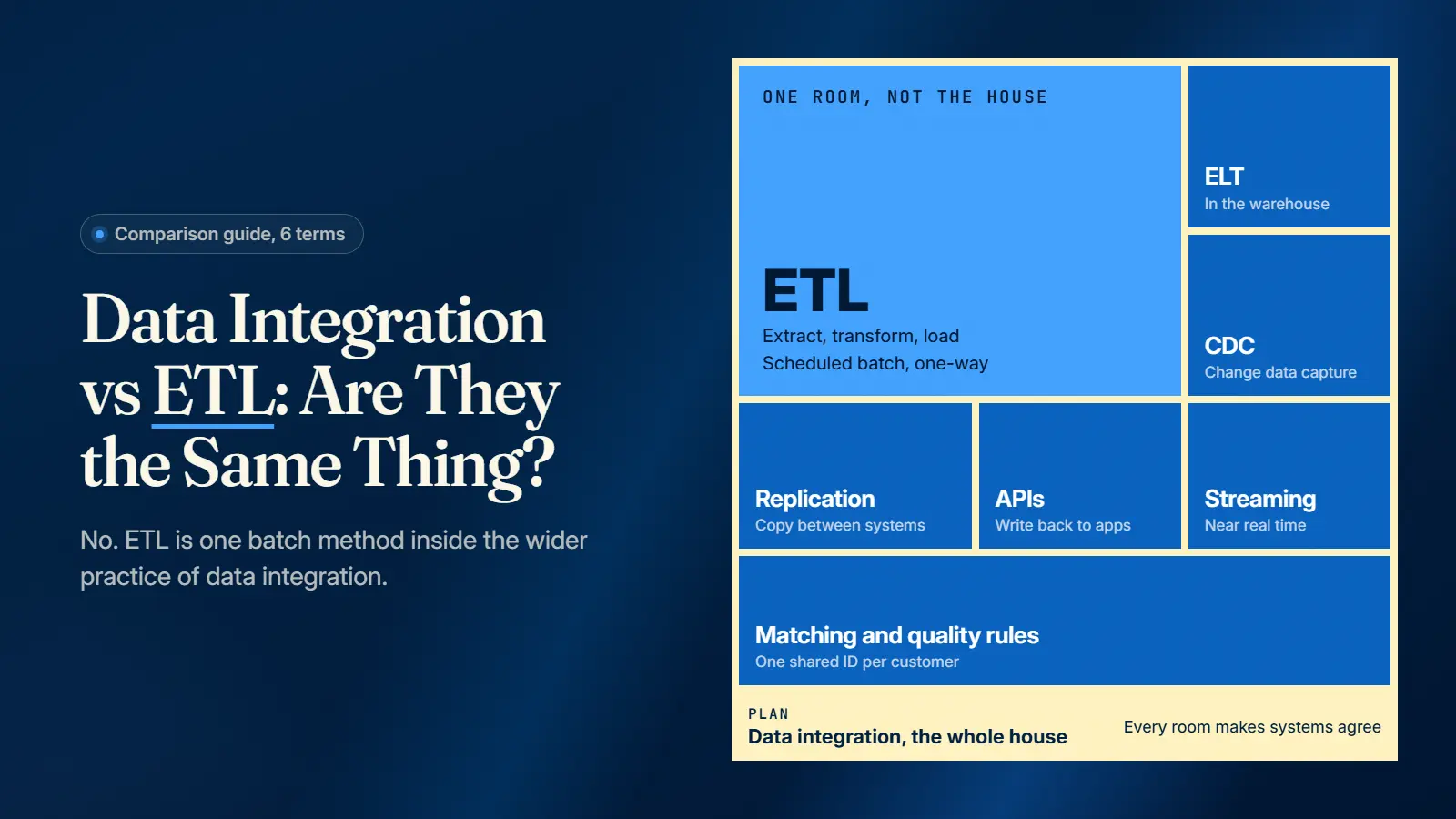
Cover reading Data Integration vs ETL, Are They the Same Thing, with ETL as one room in a data integration floor plan.
Written byPrincipal Data/AI Architect
Technically reviewed byMuhammad Taha Senior AI Architect
Published
Reading time
7 min

Summarize with AI

Introduction

On November 13, 2026, Workday placed every WD1 production tenant into maintenance. The trigger was an issue in its disaster recovery environment, which left inconsistent data in production. A Florida Atlantic University notice passed on Workday’s warning that scheduled jobs, integrations, and other automated processes could fail. Workday Production was available again the next morning.

The warning named integrations and scheduled jobs as separate items, though many teams call all of this work ETL. So, is data integration vs ETL only a question of wording? No. ETL is one method inside the wider practice of data integration.

This article explains what each term covers, the other terms people mix up with them, and when ETL alone is enough.

Data Integration vs ETL: The Short Answer

Data integration and ETL are not the same thing. Data integration covers every method a company uses to make its systems agree. ETL covers one of those methods, a batch process that reshapes data before loading it. The data integration guide covers the full discipline.

What Data Integration Covers

Data integration is the practice of combining data from separate systems so every team works from the same records. It includes moving data, matching records that describe the same customer or product, fixing quality problems, and sending results back to the apps people use. The goal is agreement between systems.

Movement is only one part of the work. A team can choose from ETL, ELT, data replication, change data capture, APIs, and data virtualization, and the integration techniques guide explains when each fits.

The need is widespread because most companies run many disconnected apps. Salesforce’s 2026 Connectivity Benchmark Report found that the number of apps in enterprises grew from 897 to 957 year over year, and only 27% of them are integrated together.

Integration also sets the rules that make records match. A customer stored as “ACME Inc.” in the CRM and “Acme” in billing needs one shared ID before a report can trust the total. This matching work belongs to data management, not to an ETL job.

Diagram of ACME Inc. in the CRM and Acme in billing joined to one shared customer ID, CUST-0042, by matching rules.

What ETL Covers

ETL stands for extract, transform, and load, and the three steps run in that order. The transform step happens in a staging area before anything reaches the target. As a result, an ETL job delivers only cleaned and reshaped data. Most ETL jobs run in batches on a schedule.

The usual target is a data warehouse built for reporting. ETL suits reports that need the same structure every day. ETL moves data one way, though, and doesn’t keep two operational systems in sync.

Data Integration vs ETL: Side-by-Side Table

Integration is the whole program. ETL is one batch method inside it. The table compares the two on eight points a buyer meets when scoping a project.

Point

Data Integration

ETL

Scope

Every method that makes systems agree

One extract, transform, and load process

Methods

ETL, ELT, CDC, replication, APIs, streaming

Batch extract, staging, and load

Timing

Batch, near real time, or on demand

Mostly scheduled batch

Direction

One-way, two-way, or back into apps

One-way into a target

Where Data Is Transformed

Before load, in the warehouse, or in flight

In a staging area before load

Data Types

Structured, semi-structured, and event data

Mostly structured rows and columns

Compliance

Governance across every flow

Masking sensitive fields before load

Main Cost Driver

Number of systems and owners

Pipeline build and upkeep

Every ETL job is a data integration task, but most integration programs need more than ETL.

Other Terms People Mix Up

Four more terms get mixed up with data integration and ETL, and each names a narrower piece of the work. Ingestion, pipelines, ELT, and migration all move data. The table shows that none of them alone makes separate systems agree.

Term

What It Does

Transforms Data?

Data Integration

Makes data from separate systems agree

Yes, plus matching and quality rules

ETL

Reshapes data, then loads it into a target

Yes, before loading

ELT

Loads raw data, then reshapes it in the warehouse

Yes, after loading

Data Ingestion

Lands raw data in storage

Little or none

Data Pipeline

Moves data on a schedule or as a stream

Depends on the pipeline

Data Migration

Moves data once into a new system

Yes, to fit the new schema

Data Ingestion vs Data Integration

Ingestion lands raw data in storage. Integration makes the data consistent with every other source. Ingestion is often the first step of an integration project, not a replacement for it.

Snowflake’s Snowpipe loader copies files into tables as they arrive, but it can’t join, aggregate, or filter rows during a load. Matching those rows to CRM records is later integration work.

Data Pipeline vs ETL

The pipeline is the container, and ETL is one recipe that can run inside it. A pipeline is any automated path that moves data from one place to another. Some pipelines transform data on the way, while an ETL job always does.

ETL vs ELT

ETL transforms data before loading it, while ELT loads raw data first and transforms it inside the warehouse. Both are data integration methods. The ETL vs ELT guide compares cost, speed, and compliance for each.

Data Integration vs Data Migration

Migration moves data once, from an old system to a new one, and then stops. Integration keeps data flowing and matching for as long as the systems run. The migration vs integration breakdown covers how the two projects differ.

When ETL Alone Is Enough

ETL alone is enough when one warehouse is the only destination and reports can wait for a scheduled refresh. With a few stable sources and no need to send data back, a wider program adds cost without adding answers. Most small reporting projects fit this description.

Take a hypothetical 60-person distributor that loads orders from Shopify and invoices from QuickBooks into one warehouse each night. Finance reads the numbers each morning. A nightly ETL or ELT job with sound pipeline development covers the whole need.

ETL also fits better when privacy rules or contracts keep raw personal data out of a shared warehouse, since ETL masks it in staging.

When You Need a Wider Data Integration Approach

A wider data integration approach is needed once data must reach more than one destination or go back into the apps people use. Near-real-time needs and mismatched customer IDs point the same way. At that stage, ETL becomes one part of the design.

Four signals show that ETL alone will fall short.

  • More than one system needs the same cleaned data.
  • An operational app needs data written back to it.
  • Some consumers need updates in minutes, not overnight.
  • Customer or product IDs differ between systems.
Rail line from ETL alone past four signals, several destinations, write-back, updates in minutes, and differing IDs.

The data platform rebuild for Scout shows the shift. Its PostgreSQL database struggled with more than 200 million consumer records. Data Prism moved analytics to Snowflake and added pipelines into OpenSearch for fuzzy matching. Processing time fell from 84 hours to 2.

The order workflow automation for Kaemark, a US furniture and equipment manufacturer, mixed app sync with reporting loads. The work connected ClickUp, WooCommerce, Google Sheets, and SQL Server, and operating costs fell by 50%.

Many pipelines also take ongoing work. Fivetran’s 2025 survey of 401 data leaders found that 67% of highly centralized enterprises spend over 80% of their data engineering resources maintaining pipelines (Fivetran sells pipeline tools).

What This Means When You Hire a Vendor or Buy a Tool

Hiring a vendor or buying a tool starts with naming the job correctly. A batch ETL tool won’t fix a two-way sync problem, and a full integration program is too much for one nightly report. Vendors use both labels loosely, so check the scope in plain terms.

Batch ETL tools load a warehouse on a schedule, while streaming and API tools carry changes as they happen. The ETL tools guide compares the batch options.

Cost follows scope more than labels, so ask for a quote broken down by source and destination.

Four questions separate an ETL job from a wider project.

  • Which systems need this data, and how fresh must it be?
  • Does any app need data written back to it?
  • Who owns the matching rules for customers and products?
  • How will a schema change in a source get caught?

Firms that offer data integration consulting services should answer all four before they quote. Most ETL vs data integration confusion comes from a vendor that only sells one method.

Final Verdict on Data Integration vs ETL

ETL and data integration aren’t rivals. For one warehouse, a few sources, and overnight freshness, ETL or ELT alone is worth it, and anything bigger is overkill. For write-back, live sync, or IDs that disagree across systems, ETL becomes one part of a wider integration plan.

Everything above turns on four answers. A short call with a data integration consultant settles which kind of project it is before any tool gets bought.

Book a Free 30-Minute Meeting

Discover how our services can support your goals — no strings attached. Schedule your free 30-minute consultation today and let's explore the possibilities.

Book a Free Call

Frequently Asked Questions

No. ETL is one batch method that extracts, reshapes, and loads data into a target. Data integration is the wider practice, which also covers replication, change data capture, APIs, and the matching rules that make records agree.

ETL often runs as one part of a data integration program. It loads the warehouse on a schedule, while other methods handle write-back, live sync, and customer IDs that differ between systems.

The pipeline is the broader term. A pipeline moves data on a schedule or as a stream, with or without transforming it. ETL is one recipe that runs inside a pipeline and always reshapes data before loading.

Data ingestion vs ETL is a question of how much the data changes. Ingestion moves raw data into storage with little or no change. ETL reshapes the data before loading it, so the result is ready for reporting.

No. ETL still fits scheduled reporting and data that must be masked before it lands. Cloud warehouses made ELT more common, and zero-ETL access now covers some cases, but batch ETL remains a standard option in tools such as AWS Glue.

Book Consultation