

Introduction
What is Data Architecture?
Data architecture is the set of models, standards, and rules governing an organization's data. A working architecture writes down four answers. Which sources feed the business, where records land, who owns each domain, and how consumers get access.
Data architecture fundamentals hold across every technology generation. Engines and tools change, while the questions stay the same. Teams skipping the questions inherit an accidental architecture. Nobody designed it. It grew one urgent request at a time, and it's what most data engineering teams walk into.
Core Components of Data Architecture
Six components appear in nearly every design.
- Sources: They produce the records. A source might be a transactional database, a SaaS platform, an event stream, or a partner file.
- Storage: It holds those records in a warehouse, an object store, or both.
- Integration: It moves data between sources and storage. The move happens by batch load, change data capture, or streaming.
- Processing: It turns the raw records into modeled tables.
- Governance: It sits across every component rather than beside them. Ownership, lineage, access control, retention, and quality thresholds all belong here.
- Consumption: People meet the data here, through dashboards, notebooks, APIs, and machine learning features. Most data analytics work lives in this layer, which is why architecture failures surface there first and start lower.
Data Architecture vs. Data Management Architecture
The two terms get used interchangeably, and the difference is worth keeping. Data architecture describes the structure. This includes the systems, the flows, and the models.
Data management architecture describes the operating system around the structure. The operating system is the set of policies, roles, and controls keeping the structure trustworthy. The table sets the two side by side.
|
Dimension |
Data Architecture |
Data Management Architecture |
|
Main Question |
Where does data live and how does data move? |
Who is accountable, under which rules? |
|
Typical Artifact |
Target-state diagram, data models |
Policy catalog, stewardship model, RACI |
|
Primary Owner |
Data systems architect, platform lead |
Governance lead, chief data officer |
|
Changes When |
Volume, latency, or use cases change |
Regulation, org structure, risk appetite |
|
Failure Looks Like |
Slow queries, broken joins, brittle loads |
Orphaned datasets, unclear ownership, audit gaps |
Data modeling is a third term often folded into both (which is wrong). Modeling produces the conceptual, logical, and physical representations of entities and relationships, while architecture decides where the models get implemented. Data architecture and management work as a pair, so strength in one plus weakness in the other leaves a problem.
The Role of a Data Systems Architect
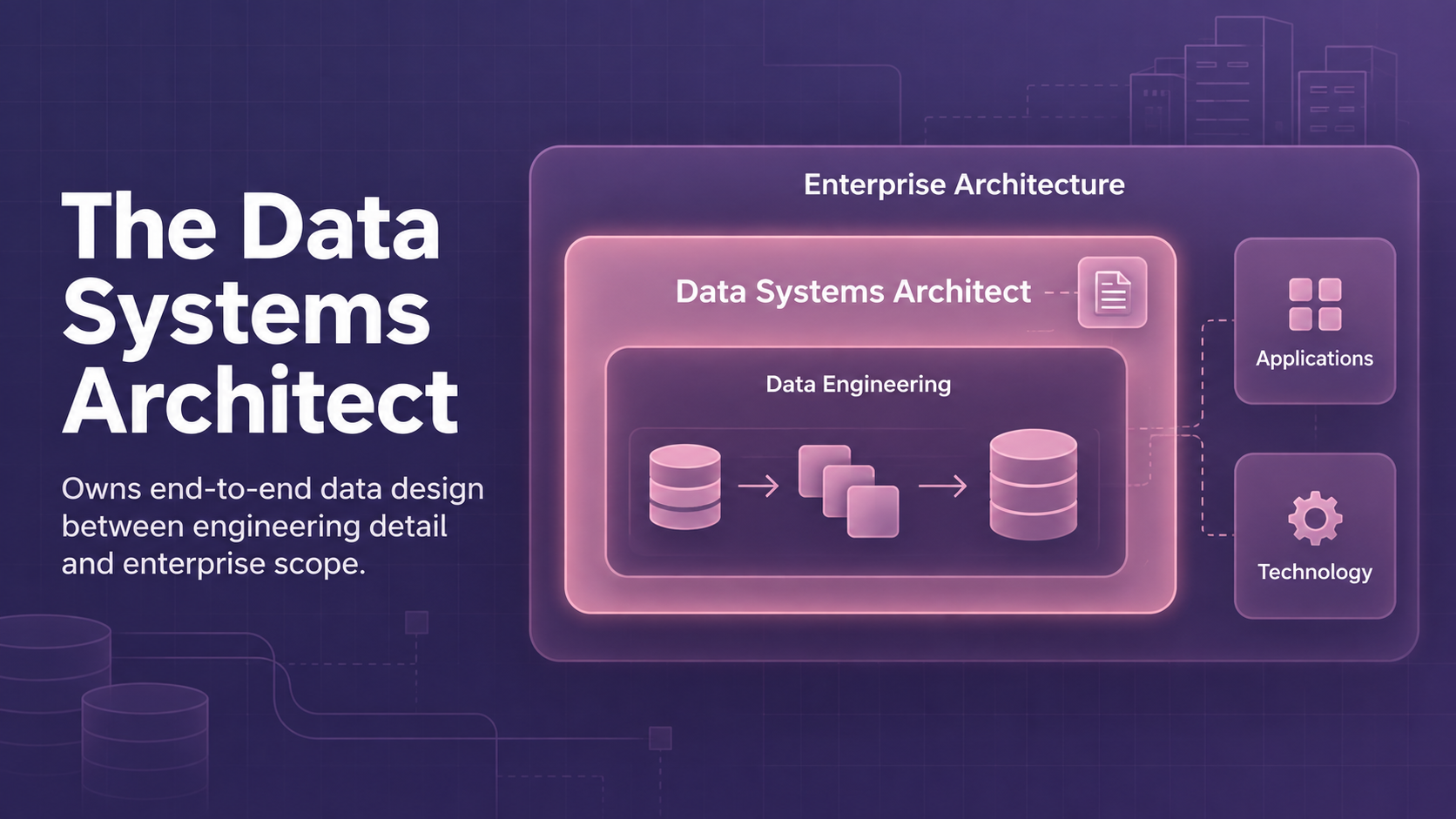
A data systems architect designs the end-to-end flow and defends the design under pressure. The job is mostly decisions with consequences, like choosing batch over streaming for a source, or setting the boundary between a warehouse and an object store.
The role is distinct from a data engineer, who builds and runs pipelines. An enterprise architect sits wider and covers application and technology alongside data. A good architect writes the rationale down, so the reason a table is partitioned by ingest date lives in a document rather than in memory.
Modern Data Architecture Principles
Data Architecture Frameworks Explained
A data architecture framework gives a vocabulary and a method for describing an architecture. Three dominant enterprise practices, and each answers a different question.
TOGAF
The Open Group Architecture Framework covers business, data, application, and technology domains through the Architecture Development Method. Data work sits in Phase C, where teams define the major data entities, describe the baseline, and specify the target.
TOGAF defines data entities rather than database schemas, which surprises teams wanting schema guidance. The framework suits firms already running enterprise architecture. For a fifty-person company, the ceremony outweighs the benefit.
DAMA-DMBOK
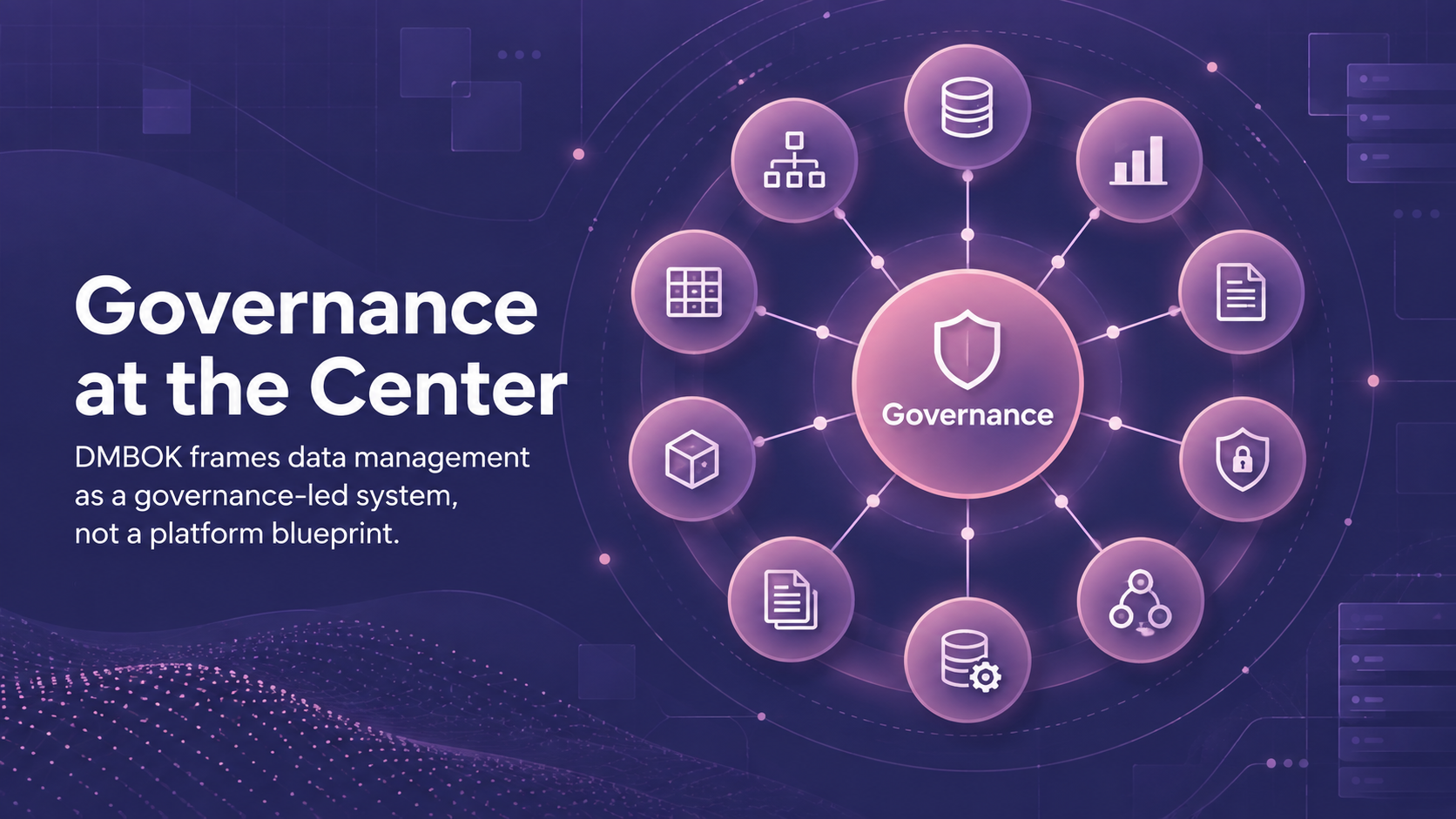
DAMA International's Data Management Body of Knowledge organizes the discipline into eleven knowledge areas, with governance at the center. Architecture, modeling, and storage sit around governance alongside security, integration, documents and content, master data, warehousing, metadata, and quality.
DMBOK is the strongest reference for data architecture and management as a combined practice. However, it is the weakest for picking a storage engine. Use DMBOK for a governance operating model and a shared vocabulary, never for a platform blueprint.
Zachman Framework
The Zachman Framework is a classification schema. Six interrogatives (what, how, where, who, when, why) cross with six stakeholder perspectives. Zachman names which artifacts should exist and who each one serves, without saying how.
The value is completeness checking. Running an architecture through the grid exposes missing artifacts, usually under "why".
How to Choose the Right Data Architecture Framework?
Match the framework to the problem, and use more than one where useful.
|
Framework |
Best For |
Main Limitation |
Typical Adopter |
|
TOGAF |
Aligning data work with enterprise roadmaps |
Heavy process, no design detail |
Regulated enterprises |
|
DAMA-DMBOK |
Governance, stewardship, vocabulary |
Silent on platform selection |
Firms building a data office |
|
Zachman |
Auditing artifact completeness |
Descriptive only, no method |
Architecture review boards |
|
No Formal Framework |
Small teams shipping a first platform |
Only experience catches gaps |
Startups and scale-ups |
Mature programs run TOGAF for planning and DMBOK for governance, treating Zachman as a checklist. Data architecture frameworks are cheap to adopt partially and expensive to adopt religiously.
Common Data Architecture Patterns
Data architecture patterns are the reusable shapes an architecture takes. Picking one is the most consequential decision in the design, and reversing the choice is where budgets die.
Data Lakehouse
The lakehouse keeps data in open formats on cheap object storage, then adds warehouse behavior on top. ACID transactions, schema enforcement, and indexing come with the pattern.
A 2021 CIDR paper argued the split between lakes and warehouses would collapse, and open table formats proved the point. A lakehouse suits teams running BI and machine learning against one copy.
Most data lake projects now start as lakehouse projects. The separate raw lake is now the bronze zone of something larger.
Data Mesh
Data mesh is an organizational pattern wearing technical clothes. Zhamak Dehghani's four principles are domain ownership, data as a product, self-serve platform, and federated computational governance.
Domain teams own their analytical data end to end, while a platform team supplies the paved road. Mesh solves a bottleneck, since a central data team cannot keep up with domain demand. Mesh creates a new problem if no domain can run a data product.
Data Fabric
Data fabric is a metadata-first pattern. Rather than moving everything into one store, a fabric builds an active metadata layer over distributed sources and drives access from there.
Fabric fits organizations with real constraints on consolidation, like residency rules or incompatible stacks from acquisitions. Vendors use the term loosely, so check what a product does.
Streaming Patterns: Lambda, Kappa, and Event-Driven
Lambda architecture runs a batch layer and a speed layer in parallel, then merges results at serving time. The design is reliable and doubles the code you maintain. Kappa drops the batch layer and treats the stream as the single source of truth, replaying the log when history needs reprocessing.
Event-driven architecture is broader than both. Systems publish events, other systems subscribe, and no producer knows who consumes. The operational cost is real, since schema evolution and delivery guarantees become your problem.
Side by side, the trade-offs are easier to weigh.
|
Pattern |
Best Use Case |
Strengths |
Trade-offs |
|
Lakehouse |
BI and ML on one governed copy |
Open formats, low storage cost |
Tuning skills needed, young tooling |
|
Data Mesh |
Many domains outpacing a central team |
Scales ownership, clears the bottleneck |
Needs domain talent and platform investment |
|
Data Fabric |
Sources you cannot consolidate |
Virtualized access, metadata-driven |
Query performance, loose vendor definitions |
|
Lambda |
Batch accuracy plus a fast path |
Proven, tolerant of late data |
Two codebases, reconciliation |
|
Kappa |
Stream-first products |
One pipeline, replayable |
Reprocessing cost, weak on complex joins |
|
Event-Driven |
Loosely coupled operational systems |
Producers and consumers evolve apart |
Schema governance, hard debugging |
REMEMBER: The shapes combine. A lakehouse with an event-driven ingestion layer is the most common production build.
When a Data Architecture Pattern is Overkill?
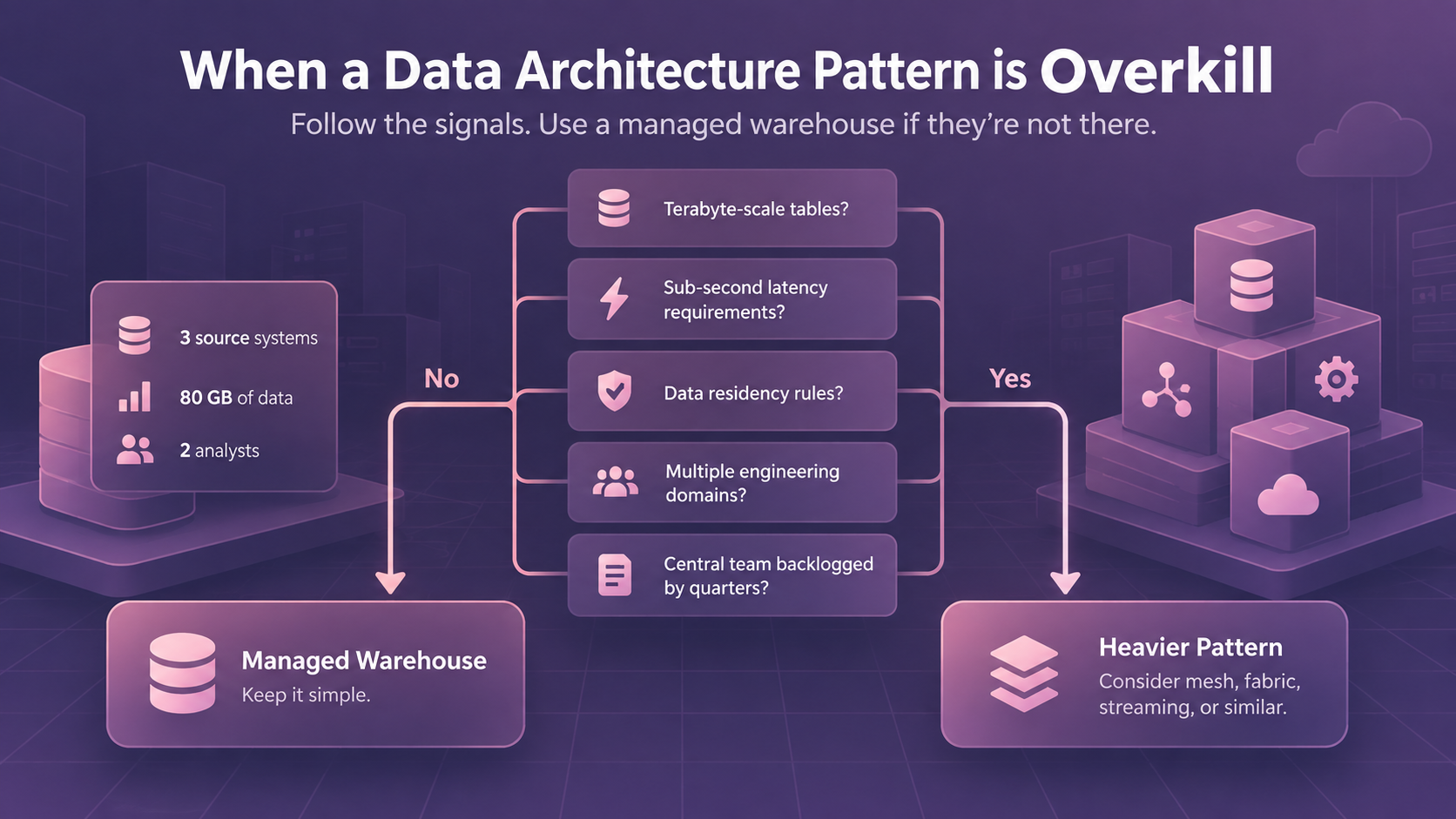
Most teams need less architecture than a vendor page suggests. A hypothetical case makes the point. A 40-person retailer with 3 source systems, 80 GB of data, and 2 analysts needs no mesh, fabric, or streaming backbone.
A managed warehouse, scheduled loads, and a documented model will serve the retailer for years. Five signals justify a heavier pattern. Several domains with their own engineers, terabyte-scale tables, latency needs in seconds, residency rules, or a central team backlogged by quarters. Absent such conditions, the simpler design wins.
Data Architecture Diagram: Examples and Key Layers
A data architecture diagram shows source systems and the path records take through ingestion, storage, processing, and serving. Governance controls apply across every stage and belong on the page.
A good diagram fits on one page, names systems rather than vendor logos, and marks batch and streaming paths differently. Five layers appear in nearly every version.
|
Layer |
What Happens |
Typical Questions |
|
Ingestion |
Records arrive by batch, CDC, or stream |
Cadence, volume, schema drift |
|
Storage |
Raw, cleaned, and curated zones |
Format, partitioning, retention, cost |
|
Processing |
Transformation, joins, quality rules |
Engine, orchestration, tests |
|
Serving |
Datasets exposed to consumers |
Latency, concurrency, semantics |
|
Governance |
Controls across all four layers |
Ownership, lineage, access, PII, quality |
Traditional Data Warehouse Architecture Diagram
The classic shape moves records from sources through ETL into staging. From there, they go into a dimensional warehouse before landing into a BI tool. Transformation happens before loading, so the warehouse holds modeled data only.
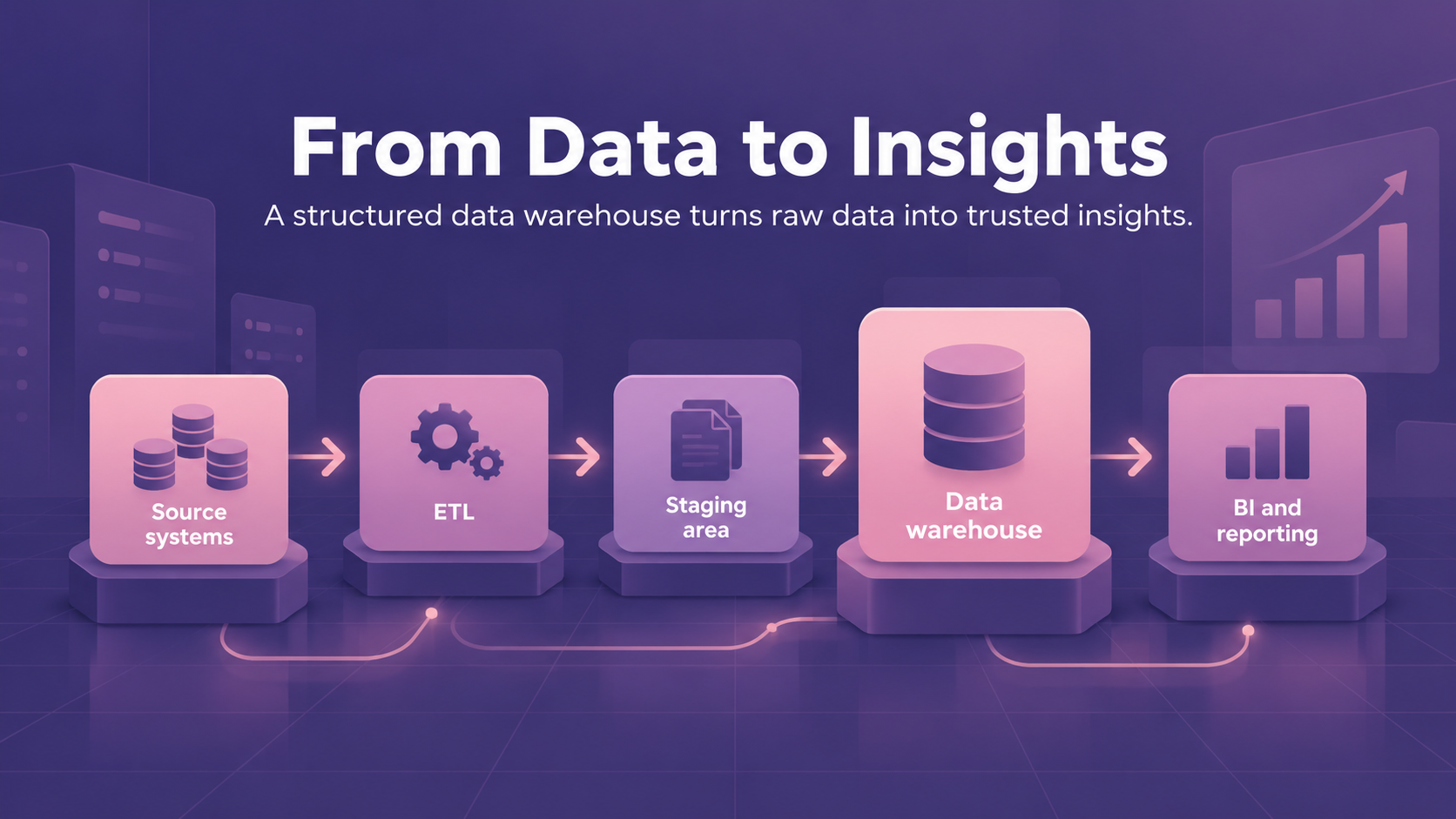
The design is predictable and still correct for finance-grade reporting. Limits show with semi-structured data, machine learning, and any source arriving faster than the nightly batch window. Plenty of data warehousing programs are healthy and need only a second path beside them.
Modern Cloud Lakehouse Architecture Diagram
The cloud lakehouse diagram replaces staging with zoned object storage, usually bronze, silver, and gold. Raw records land untransformed, cleaning happens in place, and curated tables serve BI, notebooks, and feature pipelines from the same files.
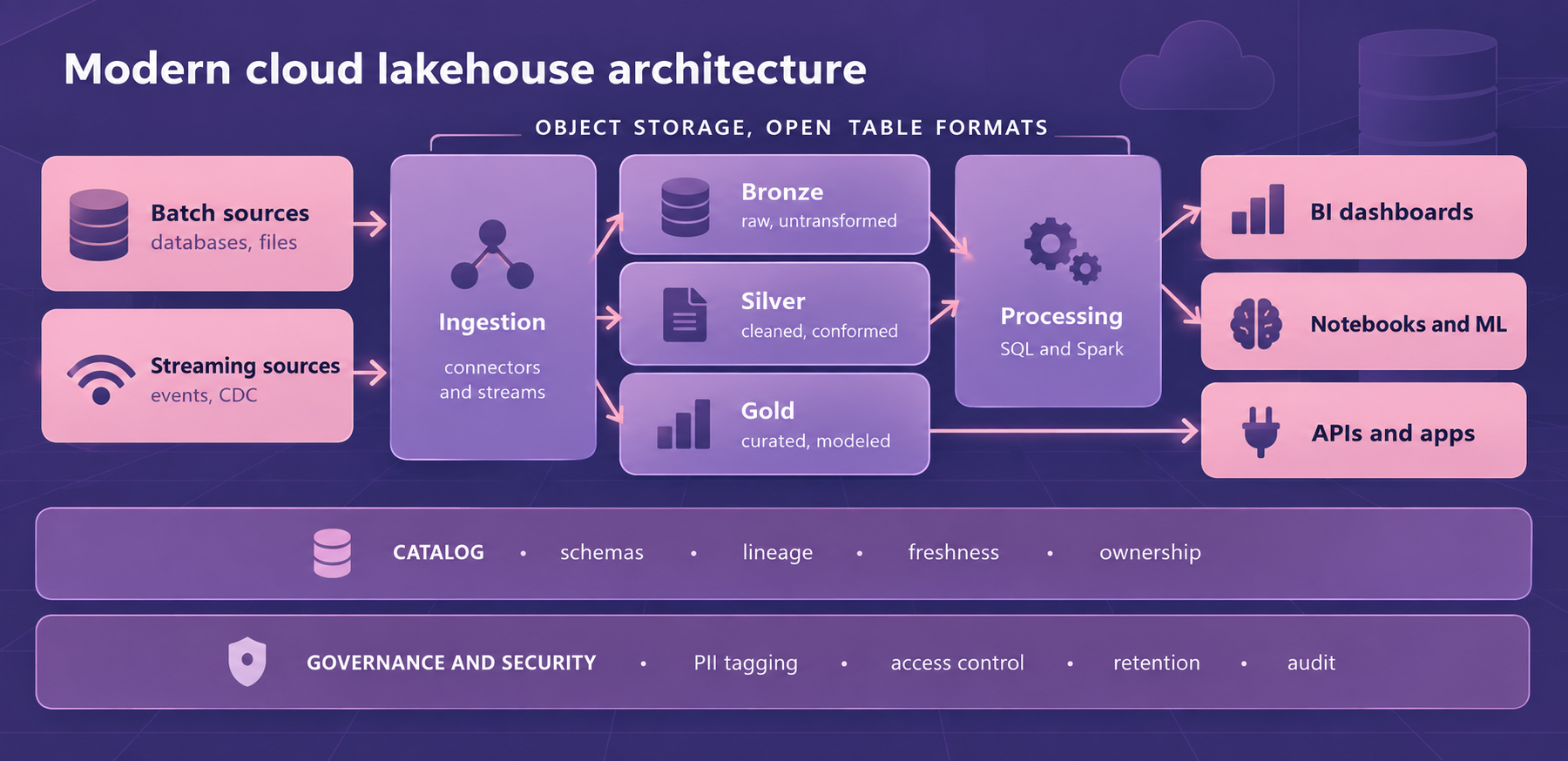
Transformation moved after loading, which is the real change. Streaming ingestion runs alongside the batch into the same bronze zone, and the catalog becomes a real component. Serving then fans out to dashboards, SQL engines, and data visualization tools, with no separate mart.
Data Mesh Architecture Diagram
A mesh diagram looks different because the boxes are teams. Each domain runs its own ingestion, storage, and serving, publishing data products with contracts. A central platform layer supplies storage, compute, catalog, and policy engines.
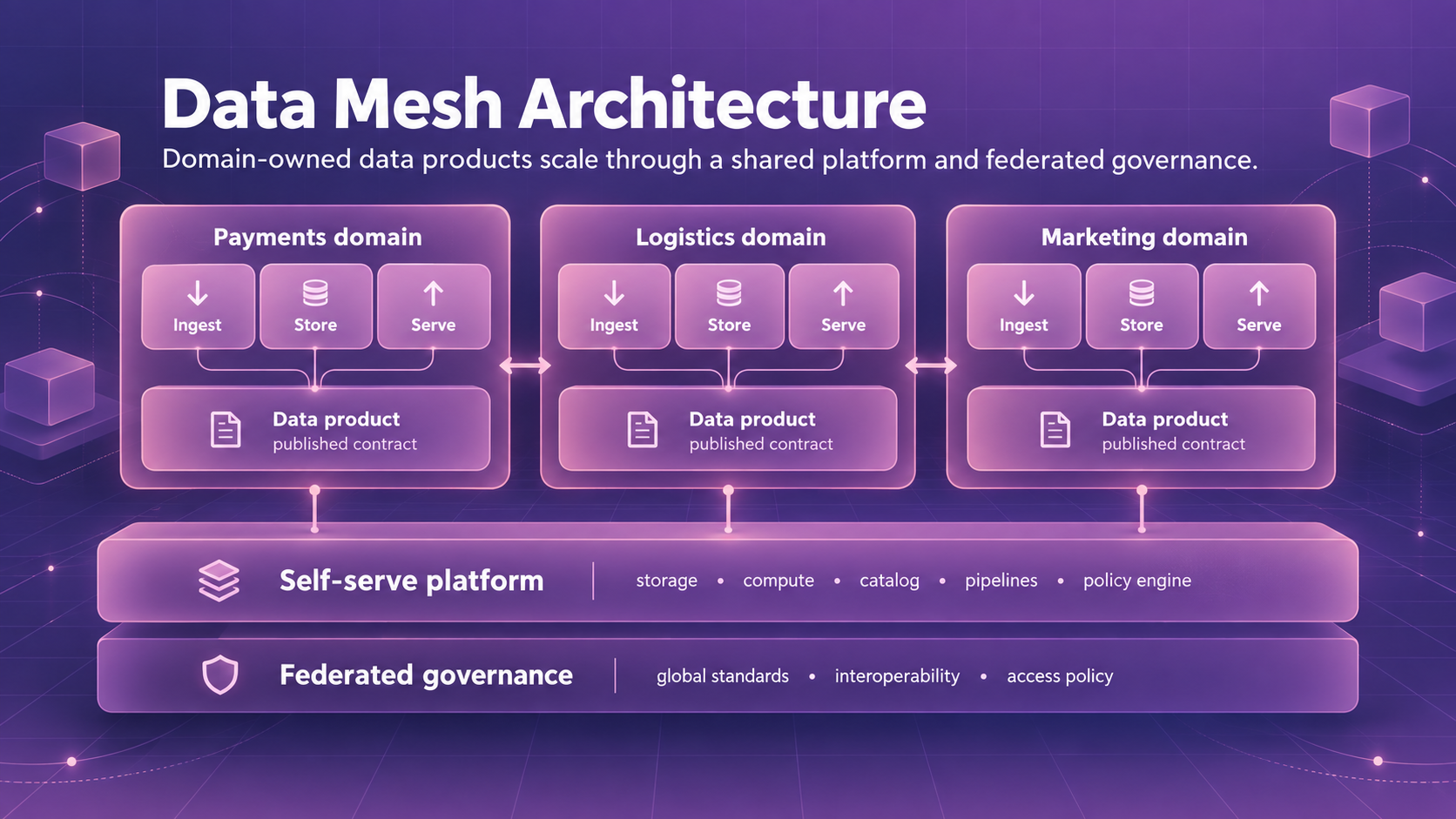
A federated governance body sets the standards every domain must meet. Drawing the diagram tests readiness, since domains with no engineers make a mesh a wish rather than a design.
The Data Architecture Design Process, Step by Step
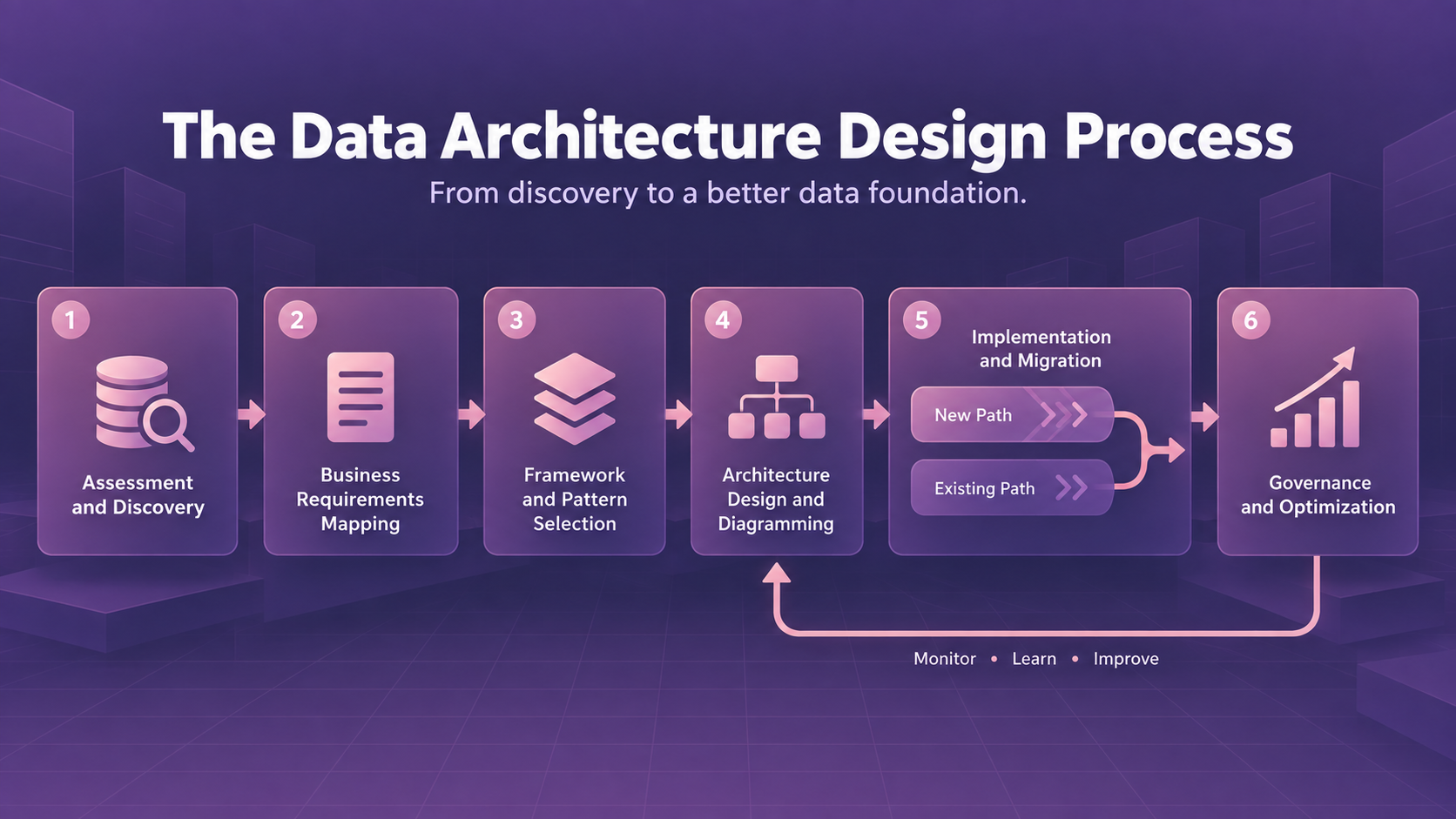
Data architecture design follows the same six steps in almost every engagement, internal or outsourced.
- Assessment and Discovery: Start by inventorying the sources and profiling the data. Map the flows already running, including the undocumented job sitting on someone's laptop.
- Business Requirements Mapping: Business decisions become technical constraints at this stage. Each decision sets its own latency, granularity, and retention requirement.
- Framework and Pattern Selection: The requirements turn into a shape here. The reasoning behind each choice gets recorded alongside it.
- Architecture Design and Diagramming: This step produces the target state. The deliverables are the diagram, the data models, the integration contracts, and a gap list against today.
- Implementation and Migration: Phase the move instead of running a single cutover. Dual-run both paths and switch one domain at a time, which reads slower on paper and costs less in practice.
- Governance and Optimization: The work continues after go-live. Cost tuning and quality monitoring run alongside a review cadence, which keeps the architecture honest.
What a Data Architecture Design Engagement Delivers
Ask any firm for the artifact list before signing. A serious engagement produces seven things:
- A current-state assessment naming the risks
- A target-state diagram
- Conceptual and logical data models
- A technology selection memo including rejected options
- A phased migration roadmap
- A governance operating model
- A decision log
The decision log matters most. Architectures fail slowly, and the failures trace back to a choice nobody can explain later.
Data Architecture Services: What an Engagement Covers
How to Choose a Data Architecture Consulting Company?
Data Architecture Consulting in Practice
Book a Free 30-Minute Meeting
Discover how our services can support your goals — no strings attached. Schedule your free 30-minute consultation today and let's explore the possibilities.
Book a Free Call