

Introduction
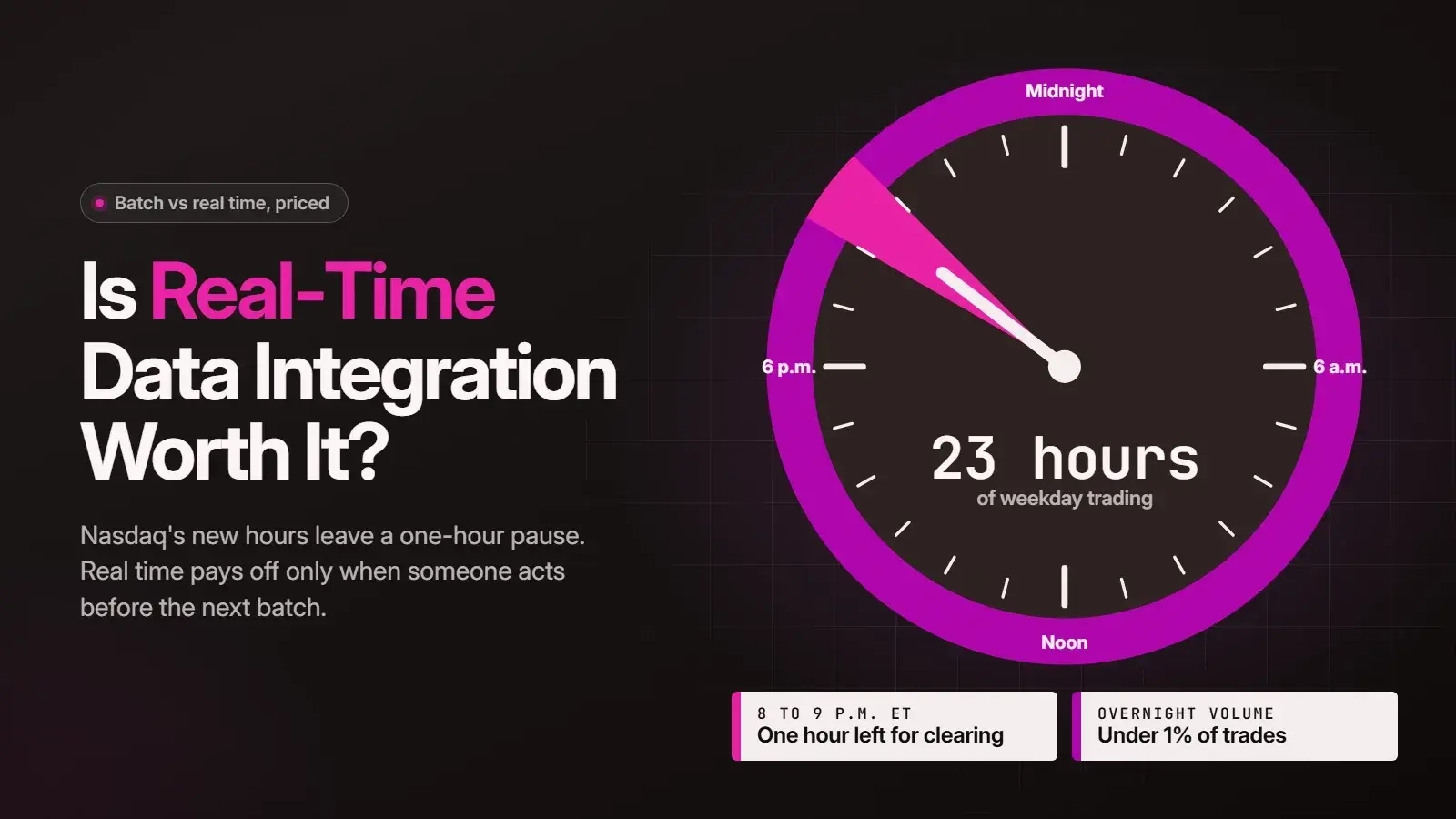
Nasdaq plans to open a Night Session on December 6, 2026, at 9 p.m. ET, moving US stocks toward 23-hour weekday trading. A November 10 Cooley 23-hour trading alert says the one-hour pause covers maintenance, clearing, and settlement.
Yet SEC staff data in the alert put overnight trading below 1% of stock volume. The extra hours serve a small share of trades.
Data teams face the same trade-off at a smaller scale. Real-time data integration moves each change from source to target within seconds. It’s worth the extra cost only when someone acts on the data before the next batch arrives.
This article explains the use cases that justify real time, what it costs compared with batch, and how to move from one to the other in stages.
What is Real-Time Data Integration?
Real-time data integration is the continuous movement of data changes from source systems to target systems within milliseconds or seconds of each change. Each insert, update, or event travels as it happens, instead of waiting for a scheduled run. Batch integration collects changes and moves them on a timetable, such as hourly or nightly.
Both patterns are forms of the wider practice explained in the data integration guide. Real time buys a shorter delay at the price of more moving parts and a higher running cost.
How Fast is Real Time?
Real time means a delay of milliseconds to a few seconds between a change at the source and its arrival at the target, while near real time and batch run slower. Vendors stretch the terms, so a “real-time” product may deliver every few minutes. The table pins each term to a typical delay range.
|
Term |
Typical Delay |
How Data Moves |
Typical Use |
|---|---|---|---|
|
Real Time |
Milliseconds to a few seconds |
Each change as it happens |
Fraud checks, live pricing |
|
Near Real Time |
A few seconds to a few minutes |
Small groups of changes |
Stock levels, shift dashboards |
|
Micro-Batch |
About one to 15 minutes |
Scheduled micro-batch loads |
Sales and marketing reports during the day |
|
Batch |
Hourly to daily |
Large scheduled loads |
Finance close, historical reports |
The delay a team can accept decides which row applies.
The micro-batch row describes scheduled loads, and micro-batch engines can run much faster. The Spark Structured Streaming docs say its queries run as a series of small batch jobs by default, with end-to-end latency as low as 100 milliseconds.
How is Batch Processing Different From Stream Processing?
Batch processing handles a bounded set of data on a schedule, while stream processing handles an unbounded flow of events as they arrive. Batch jobs start, finish, and can be rerun from the same input. Stream jobs never finish, so they must track their state and recover without losing their place.
The table sets batch processing vs stream processing side by side on cost and effort.
|
Factor |
Batch Processing |
Stream Processing |
|---|---|---|
|
Data |
Bounded set, such as one day’s orders |
Unbounded flow of events |
|
Delay |
Minutes to a day |
Milliseconds to seconds |
|
Compute |
Runs, then shuts down |
Runs all the time |
|
Failure Recovery |
Rerun the job |
Resume from a saved checkpoint |
|
Late or Out-of-Order Data |
Sorted before the run |
Handled as events arrive |
|
Common Tools |
Spark, dbt, AWS Glue jobs |
Kafka, Flink, Kinesis |
The stream buys a shorter delay with always-on compute and harder failure handling.
When Do You Need Real-Time Data?
You need real-time data when a person or system acts on it within minutes and a delay costs money. The test is what someone does with the data. If nobody acts until tomorrow morning, a faster pipeline changes nothing.
Where real time fits, the benefit shows up in revenue and losses. Fewer orders get oversold. More fraud gets caught before the money leaves.
Inventory and Pricing
Selling one stock pool across several channels is the clearest case for real-time inventory and pricing data. An order on one channel must lower the count on the others before the next buyer checks out. A nightly load leaves hours in which the last item can sell twice.
Fraud and Risk
A card payment is approved or declined in seconds, so fraud and risk checks run during the transaction itself. A fraud score built only from last night’s data misses today’s pattern. A checkout decision can’t wait for the next batch.
Operational Dashboards
Only an operational dashboard someone watches during the shift needs fresh data, and near real time usually covers it. A warehouse lead rerouting pickers fits this case. An executive dashboard read once a day doesn’t.
Customer Personalization
Personalization depends on fresh data when the response must reflect what the customer just did. A product suggestion based on the current session needs events from seconds ago. A monthly email segment works fine from a nightly load.
When is Batch Data Good Enough?
Batch data is good enough when the decision it feeds happens on a schedule. Month-end close, payroll, and board reporting all run on a calendar. Many requests for real time turn out to be requests for fresher batch.
How Does Real-Time Data Integration Work?
Real-time data integration works by capturing each change at the source and pushing it to targets without waiting for a schedule. Three methods do most of this work. The data integration techniques guide compares them with the other ways to move data.
Change Data Capture
Change data capture (CDC) reads a database’s transaction log and sends each insert, update, and delete as an event. It reads the log instead of scanning tables, so it adds little query load. Debezium offers CDC connectors for PostgreSQL, MySQL, SQL Server, and Oracle.
CDC is also the usual route for real-time data ingestion into a warehouse, and the change data capture guide covers the four capture methods and the setup for each database.
Event Streaming
Event streaming carries events such as orders or clicks through a broker that many systems can read at once. Apache Kafka, Amazon Kinesis, and Google Cloud Pub/Sub are common brokers. A streaming data pipeline built on one broker can deliver the same events to a warehouse, an alerting service, and an app.
A stream needs the same retry and alerting rules as a batch job, and data pipeline development covers both patterns.
Webhooks and APIs
Webhooks and APIs handle real-time data synchronization between business apps that don’t expose a database log. A webhook sends a message the moment something changes, such as an order status update. Polling an API is the fallback when an app has none.
The property research API built for Home Base shows the pattern. Guesty webhooks drive automatic reservation monitoring, with Slack alerts.
Does Real Time Cost More Than Batch?
Real time costs more than batch, because a stream runs all day while a batch job runs only when scheduled. The gap shows up first in compute. It grows with the on-call work and source load that a price list leaves out.
The AWS Glue pricing page prices compute at $0.44 per DPU-hour in its example, and prices vary by AWS Region. A Glue streaming job needs at least two DPUs.
The table applies the $0.44 rate to a hypothetical pipeline on two DPUs over a 30-day month.
|
Schedule |
Run Time |
Monthly Compute |
Data Delay |
|---|---|---|---|
|
Continuous Stream |
720 hours |
$633.60 |
Seconds |
|
Every 15 Minutes |
3 minutes per run, 2,880 runs |
$126.72 |
Up to about 18 minutes |
|
Hourly |
5 minutes per run, 720 runs |
$52.80 |
Up to about 65 minutes |
|
Nightly |
30 minutes per run, 30 runs |
$13.20 |
Up to about a day |
The always-on stream costs 12 times the hourly job and 48 times the nightly one.

Compute is only part of the bill. A stream that fails at 2 a.m. needs someone to fix it before the backlog grows, while a failed nightly job can wait for a morning rerun. Streams also need engineers who know brokers, checkpoints, and replays.
The source database pays too. The PostgreSQL replication documentation warns that replication slots can retain so much write-ahead log that it fills the space set aside for it.
Why Do Real-Time Pipelines Break?
Real-time pipelines break when events arrive late, twice, or in a shape the target doesn’t expect. A batch job sees the full set of data before it runs, so it can sort and deduplicate first. A stream must handle each problem as the event arrives.
Out-of-order events are the first problem. A cancellation can arrive before the order it cancels, so the target needs event timestamps and a rule for late arrivals.
Duplicates are the second. Many brokers deliver each event at least once, so a retry can send the same order twice. Writing to the target by primary key, as an upsert, makes a repeated event harmless.
Schema changes are the third. A renamed column or a changed type on the source can stop a stream. A schema registry with compatibility rules rejects the change before it reaches consumers.
A stream that keeps falling behind is the quieter failure. It ends up delivering in bursts, which is batch at a streaming price.
Should You Use Real Time or Batch?
You decide between real time and batch by asking four questions about the decision the data feeds. Each answer either keeps real time in play or rules it out. A pipeline that fails an early question stays on batch.
First, name who acts on the data. A report read once a day ends the test, because batch is enough.
Second, measure how fast the person or system acts. Action within minutes points to near real time, while action within seconds points to real time.
Third, put a price on the delay. If the delay costs less over a month than the extra compute and on-call cost, an hourly batch wins.
Finally, check whether the source can support it. Log-based CDC needs database settings that a vendor-hosted system may not allow.
How Do You Move to Real Time?
You move from batch to real time in stages, one source at a time, starting with the jobs already running. Each stage adds moving parts. Many teams stop once the delay is short enough.

Stage one is tuning slow batch jobs. The Amazon product enrichment built for Calm Ventures shows how far tuning alone can go.
The workflow groups up to 250 products per Keepa API request, which cut about 300,000 lookups to roughly 1,200 calls. Estimated processing time for 300,000 products fell from about 72 hours to eight.
Stage two is a shorter schedule. The food delivery data collection built for Loop AI runs a cron job every minute and processes newly available order activity. Orders from more than 2,500 restaurant locations reach analytics with under 60 seconds of data freshness, on a stack of Python, Scrapy, cron, and BigQuery.
Stage three is CDC or webhooks for the one source where minutes still matter, while the rest stays on batch. Data Prism’s data integration services scope that source with a latency target and a rollback plan before anything changes.
Stage four, event streaming across systems, makes sense only when several consumers need the same events within seconds. The data integration architecture guide shows how batch and streaming layers fit in one design.
When Does Real Time Pay Off?
Real-time data integration pays off when a delay costs more each month than the extra compute and on-call work. Fraud checks, stock levels, and live pricing usually clear the bar. Most reporting, finance, and planning data doesn’t, and an hourly or nightly batch serves it better.
Everything above comes down to what a delay costs, and the number differs for every pipeline. Data Prism’s data integration services include a free consultation to check whether real time is worth it for your use case.
Book a Free 30-Minute Meeting
Discover how our services can support your goals — no strings attached. Schedule your free 30-minute consultation today and let's explore the possibilities.
Book a Free Call

