Introduction
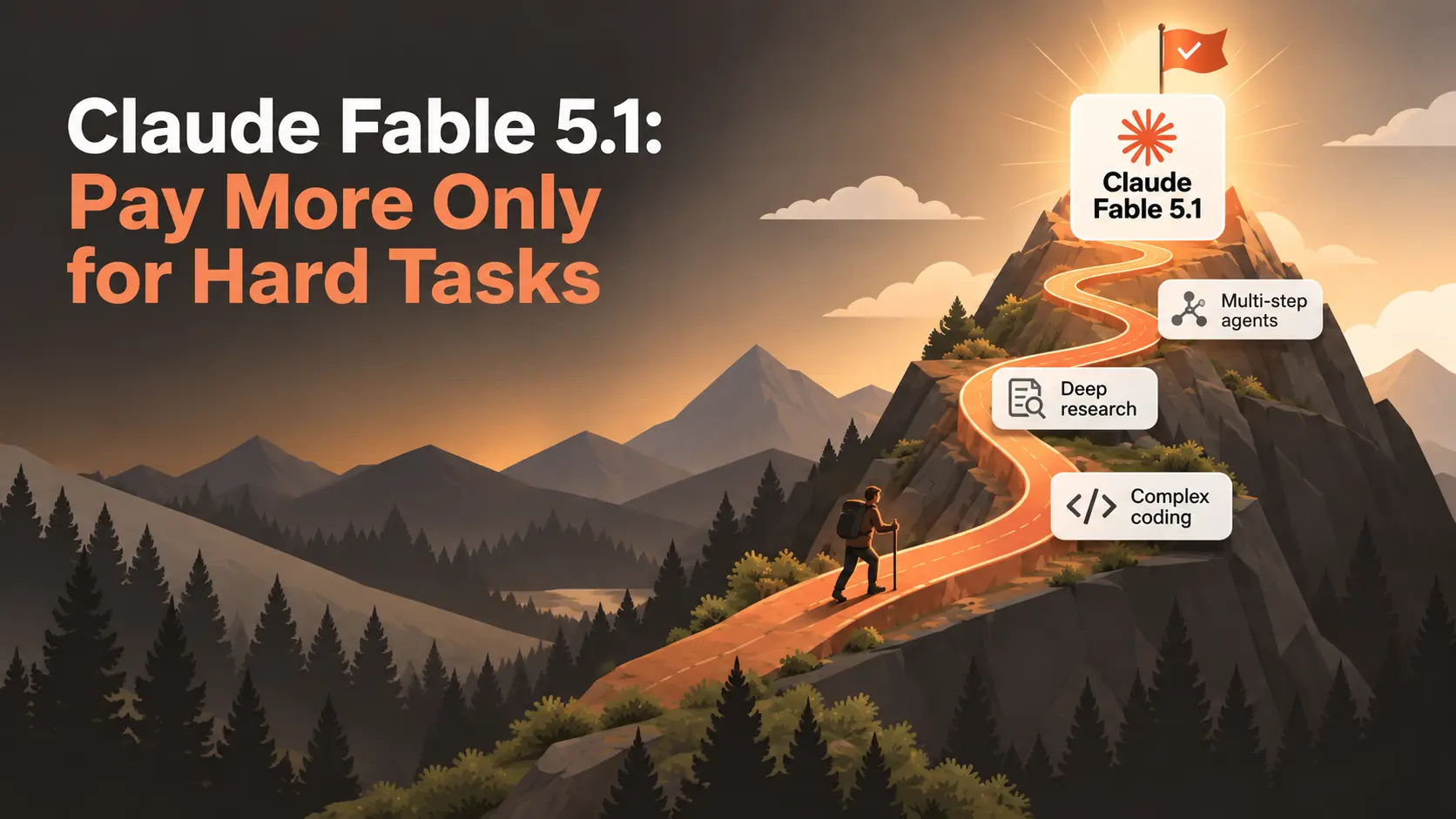
Anthropic recommends starting with its cheaper models. Anthropic's own model documentation says most workloads should start with Claude Opus 5, which costs $5 per million input tokens and $25 per million output tokens. Fable 5.1 costs twice as much at $10 and $50. Anthropic released Fable 5.1 on September 1, 2026, with the same pricing as Fable 5.
This premium can make sense for work that runs for hours without supervision, where a failed run costs far more than the tokens did. This article explains what Claude Fable 5.1 is, what it costs once cache reads are counted, and which workloads justify paying more for it than Opus 5.
What is Claude Fable 5.1?
Claude Fable 5.1 is Anthropic’s most capable, generally available model. Anthropic built the model for work that runs for hours at a time, and released it alongside Claude Mythos 5.1. Mythos 5.1 is the same underlying model carrying different safeguards, so Fable 5.1 goes to every customer while Mythos 5.1 goes only to vetted organizations in Project Glasswing.
The Fable name marks a capability tier above Opus in Anthropic's lineup. We covered that Opus tier in full already, and the same tier logic carries over here. Claude Fable 5.1 is a model, not a product, while Claude Code is an application that calls a model. Comparing the two names directly measures nothing. Outside the API, the model also reaches users through the Claude apps and Claude Cowork.
Anthropic aims Claude Fable 5.1 at four kinds of work: agentic coding, multistep research, document production, and computer use. The same four areas anchor Claude's wider feature set, which we map out in full elsewhere. The same four areas anchor Claude Features, which maps the wider feature set against them. All four run as long sessions in which the model has to remember what it has already done.
Claude Fable 5.1 at a Glance
The table below lists the specifications Anthropic publishes for Claude Fable 5.1.
|
Specification |
Claude Fable 5.1 |
|
Provider |
Anthropic |
|
Release Date |
September 1, 2026 |
|
Model ID |
Claude-fable-5-1 |
|
Context Window |
1M tokens |
|
Max Output |
128K tokens |
|
Thinking |
Adaptive, always on |
|
Default Effort |
High |
|
Input Price |
$10/MTok |
|
Output Price |
$50/MTok |
|
Cache Read |
$0.25/MTok |
|
Batch Discount |
50% on input and output |
|
Knowledge Cutoff |
June 2026 |
|
Comparative Latency |
Slower |
|
Status |
Active, generally available |
Claude Fable 5.1 Pricing Explained
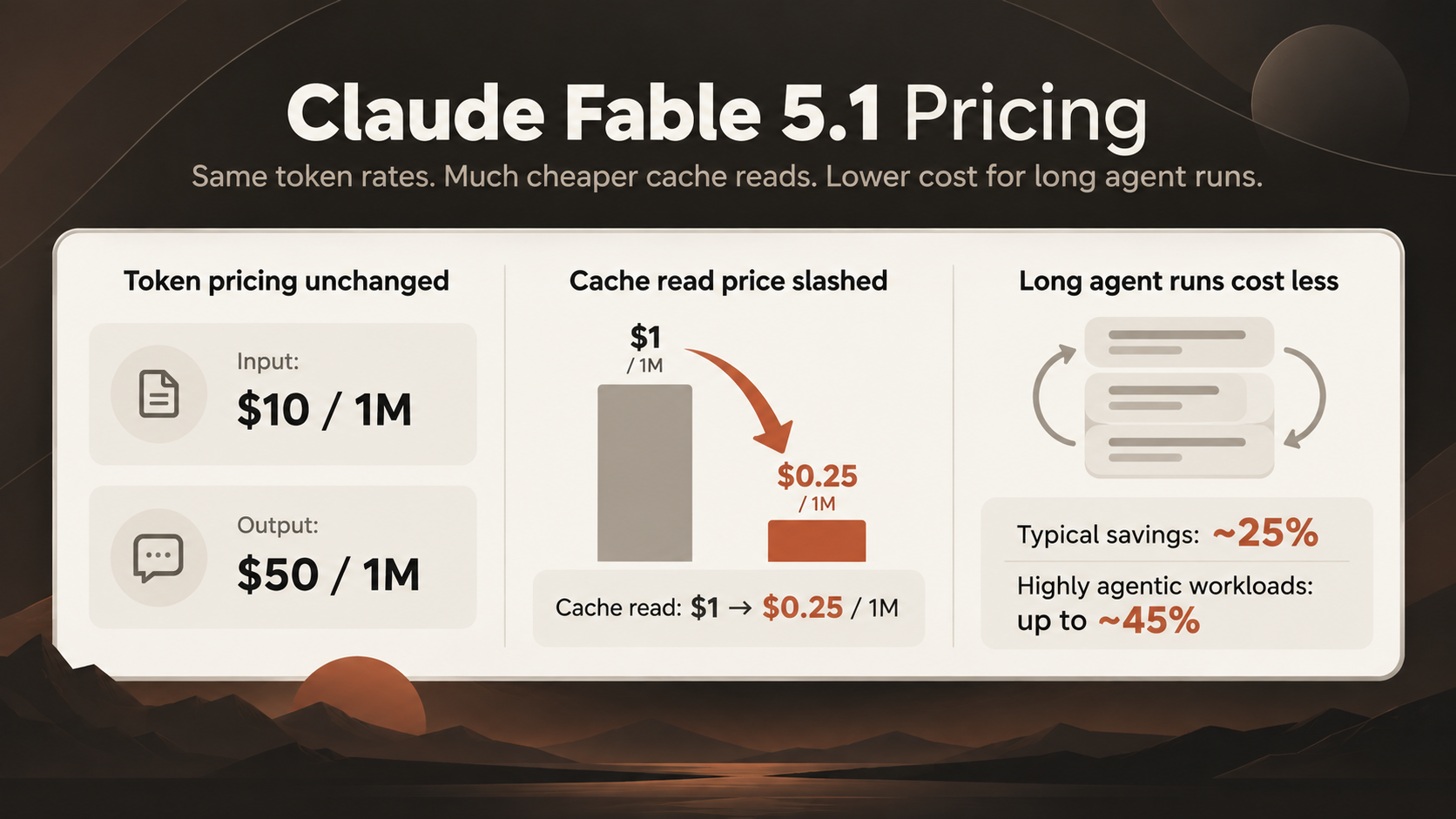
At launch, Anthropic left the headline rates alone. Claude Fable 5.1 pricing starts at $10 per million input tokens and $50 per million output tokens. The launch announcement put the savings elsewhere, cutting the cache read price from $1 to $0.25 per million tokens.
On long agent sessions, cache pricing decides the bill. For a five-minute cache, writes still cost $12.50 per million tokens, and a one-hour cache costs $20. The read price is now 0.025 times the base input price, whereas every other Claude model charges 0.1 times. Agents resend the same repository, system prompt, tool definitions, and history on every turn, so on a long session cached input often makes up most of the bill.
Anthropic estimates the cut reduces typical workloads by around 25% and highly agentic ones by up to about 45%. The same tier-over-provider math runs through AWS vs Azure vs GCP: What Cloud AI Models Cost in 2026. These estimates come from four weeks of real August 2026 usage at default effort, measured on Anthropic’s own traffic across Claude Enterprise, Claude Code, and the API.
Two other levers change the arithmetic. The Batch API halves both rates, to $5 per million input tokens and $25 per million output tokens. We tracked the same batch discount across the industry when the pricing war broke out. We tracked the same batch discount across the industry in AI Price War: Claude, GPT, and Grok Stopped Chasing Rank. It suits overnight document processing and evaluation runs nobody is waiting on. For workloads with a residency requirement, US-only inference adds a 1.1x multiplier.
Why is Fable 5.1 More Expensive Than Opus 5?
The premium exists because Anthropic sells Fable 5.1 for work that Opus 5 does not finish. Anthropic is direct about the order of operations: start with Opus 5, and move up when your evaluations at higher effort still fall short. The table compares the two models on the numbers Anthropic publishes.
|
Factor |
Claude Opus 5 |
Claude Fable 5.1 |
|
Input Price |
$5/MTok |
$10/MTok |
|
Output Price |
$25/MTok |
$50/MTok |
|
Cache Read |
$0.50/MTok |
$0.25/MTok |
|
Context Window |
1M tokens |
1M tokens |
|
Comparative Latency |
Moderate |
Slower |
|
Knowledge Cutoff |
May 2026 |
June 2026 |
|
Intended Workload |
Most production work |
Demanding reasoning and long-horizon agents |
The cache line is the detail most cost models miss. On cached reads, Anthropic charges $0.50 per million tokens for Claude Opus 5 and $0.25 for Fable 5.1. So the flagship costs half as much as the mid-tier model for cached reads, and twice as much for input and output. There’s no single crossover point, because it depends on how much of your session is cached.
Anthropic’s benchmark table shows where the capability gap sits. Fable 5.1 scores 52.6% on Terminal-Bench-Science 0.1 against 29.0% for Opus 5, and 55.8% on Terminal-Bench 4.0 against 52.3%. On AutomationBench, Fable 5.1 reaches 31.4% against 26.9%. These figures are vendor-run, measured with production safeguards enabled, which Anthropic says depressed its own scores on tasks where the safeguards intervened.

Claude Fable 5.1 for Agentic Coding
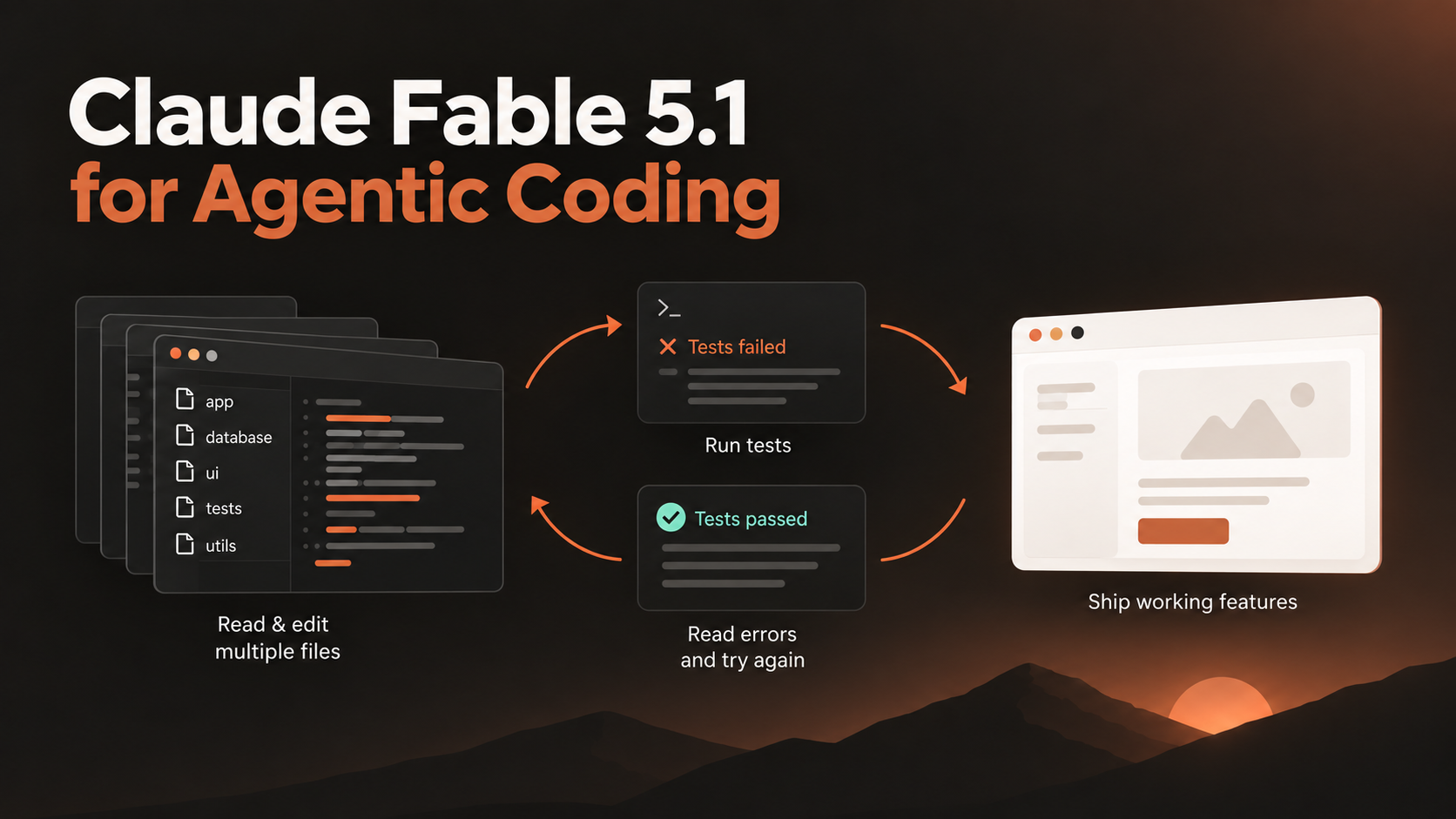
Long-running agentic coding means the model works through a task across many steps without a human approving each one. Claude Fable 5.1 reads the files and edits several of them. When the tests fail, the model reads the errors and tries again without being asked. However, autocomplete-style assistance predicts the next few lines inside one file, and the developer watching every step is the expensive part.
For coding, Anthropic is specific about the work it has in mind. The company points Claude Fable 5.1 at multi-file features, large refactors, and debugging and code review across hours-long sessions. The model writes its own tests and uses vision to check a built interface against the original design.
Cognition said the Devin team moved its Opus 5 traffic to Fable 5.1 on launch day, starting with code review, and credited the cache read cut for making a Fable-class model economical there. Two other partner reports show the ceiling.
Millennium described a crash that appeared roughly once in a million runs and had gone unexplained for four to five years. In one session, Fable 5.1 traced the crash to a bug in an external vendor library. At MongoDB, the model built a prototype in about three days, running unattended for hours between check-ins. Both accounts come from Anthropic’s launch page and describe the customers’ own testing.
Claude Fable 5.1 vs GPT-5.6 Sol and Gemini
On list price, Fable 5.1 is the most expensive of the three. This gap widens or narrows with prompt length, and the table below shows the current published rates.
|
Model |
Input and Output per MTok |
Context Window |
Long-Prompt Billing |
|
Claude Fable 5.1 |
$10 and $50 |
1M tokens |
Flat across the window |
|
GPT-5.6 Sol |
$4 and $20 promotional |
1.05M tokens |
2x input, 1.5x output above 272K |
|
Gemini 3.1 Pro |
$2 and $12 |
1M tokens |
$4 and $18 above 200K |
Two of the three rates carry conditions. OpenAI calls the GPT-5.6 Sol rate promotional and has committed to it at least through November 21, 2026, with cached input priced at $0.40 per million tokens. Google prices Gemini 3.1 Pro lowest of the three, and Gemini also reads audio and video, whereas the other two read text and images. Anthropic’s own comparison covers GPT-5.6 Sol and skips Gemini.
Artificial Analysis runs every model on one fixed test setup across labs. Fable 5.1 scored 66 on the Intelligence Index at max effort, against 63 for Opus 5, 62 for Fable 5, and 61 for GPT-5.6 Sol. This evaluation also put Fable 5.1 at $3.76 per index task against $2.34 for Opus 5.
Cost per Completed Task
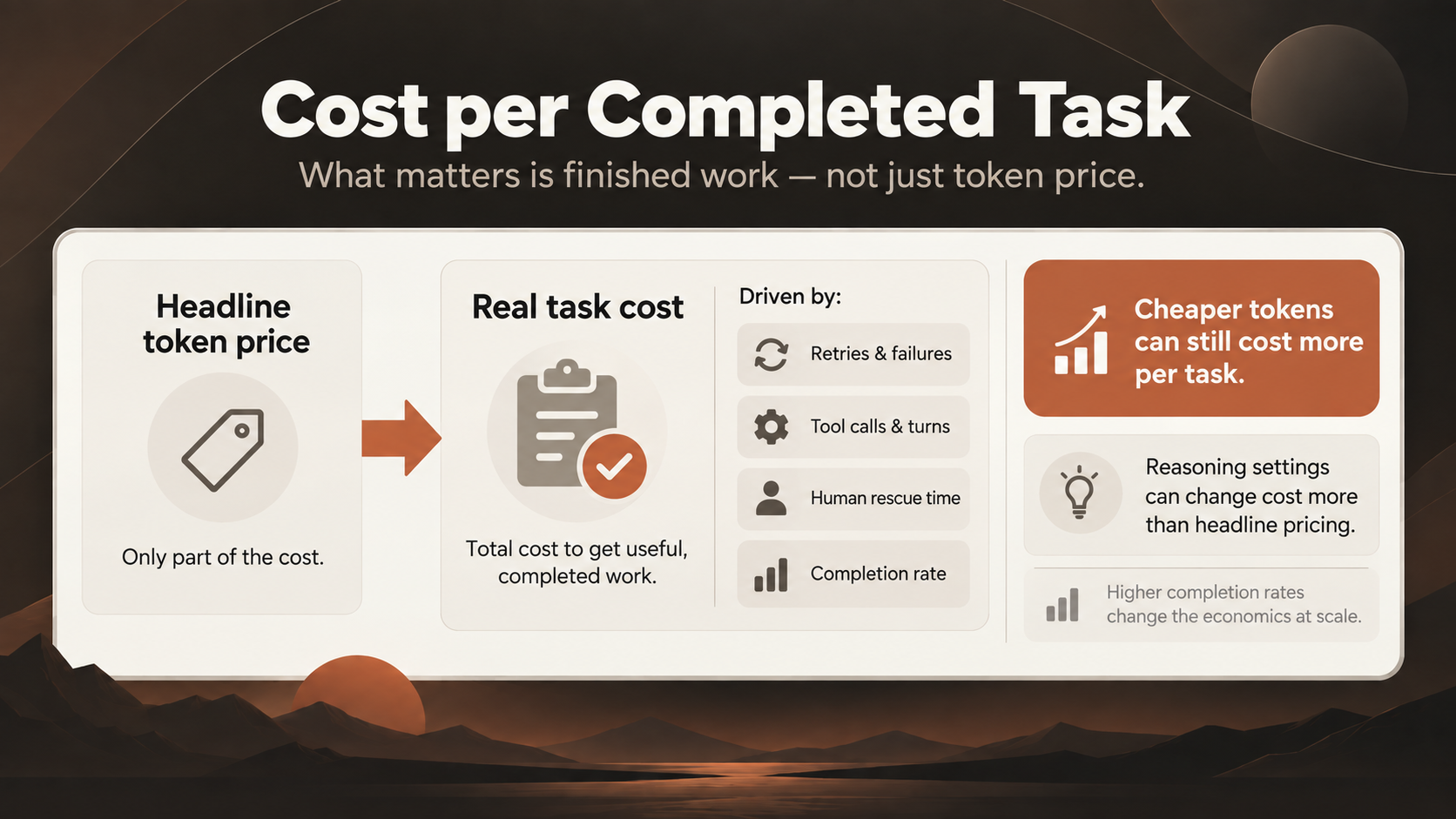
Token price is one input to the decision. In practice, a business pays for finished tasks, and each one absorbs retries, wasted turns, and the engineer who steps in when the agent stalls. At half the token price, a model isn’t cheaper once three attempts and a rescue are counted.
The gap shows up in the Artificial Analysis figures. Per-task cost rose about 20% over Fable 5 despite the lower cache price, because Fable 5.1 generated roughly 1.7 times as many output tokens. Reducing the reasoning setting from max to xhigh saved $1.04 per task. This means the reasoning setting can have a bigger impact on cost than the model's headline token prices.
Browserbase published completion figures from its hardest browser-agent benchmark. On that benchmark, Claude Fable 5.1 completed 82% of tasks in about 10 minutes each, against 74% for Opus 5 and 57% for Fable 5, while using fewer tokens than either model. This eight-point gap over Opus 5 changes the staffing arithmetic on a queue of thousands of tasks, long before the token bill enters the calculation.
Five figures decide whether the premium paid off, and a trial should record all five per task.
- Total tokens and cached share set the real rate, because cached prefix bills at $0.25 per million on Fable 5.1.
- Tool calls and turns cost tokens and wall-clock time even when the final answer is right.
- Retry and failure rate counts every run that produced nothing usable, including the runs that returned no error.
- Human intervention minutes belong in the total at a loaded hourly rate.
- Completion rate is the share of tasks finished without a person stepping in, and it is what the premium buys.
Where Fable 5.1 Fits in an Agent Architecture?
Claude Fable 5.1 fits at the planning and verification ends of an agent loop. This is where the reasoning is hardest and a wrong turn costs the most to unwind. A production agent works in a loop. It plans a step, runs the step, and checks the result before choosing the next one. Cheaper models handle the mechanical steps in between. This split is how most cost-controlled AI agent development work is structured now.
The longest reported run lasted 38 hours. Ramp described an unattended machine learning session where the model diagnosed a prior result as a label artifact and then started six parallel experiments. Around runs of that length, teams need memory, monitoring, and human approval gates. Claude Fable 5.1 supplies the reasoning and tool use, while your architecture supplies the controls.
Inside that architecture, effort settings shift with the product wrapping the model. Anthropic sets Fable 5.1 to high effort in Claude Code by default, and to medium in Claude Cowork and on Claude.ai. So a fair comparison pits Claude Code running Fable 5.1 against another coding agent running its own model, not the model names alone.
What Changed From Fable 5?
Three changes break existing code, and Anthropic’s migration guide covers all three. Forced tool use now returns a 400 error because thinking is always on, and a forced call would skip the thinking step. Thinking blocks are bound to the model that wrote them, so no earlier model can read Fable 5.1’s. Editing an earlier turn invalidates every thinking block after it, so agent loops need append-only history.
Five changes add capability. Per-message effort lets you raise the setting for a hard step and lower it for routine ones without invalidating the prompt cache. Instead of injecting a reminder into history and deleting it later, turn-scoped system messages carry it for one turn.
A new display option returns the model’s progress updates as readable text. Cache reads carry the lower price, and content provenance adds Anthropic’s text watermark plus signed C2PA credentials on generated files.
Several behaviors changed with no code change at all. Now, parallel tool calling is more variable, so the model may issue one tool call per turn, whereas Fable 5 uses several in a batch. Claude Fable 5.1 writes fewer progress updates during long tool runs, answers from memory more often at low effort, and rewrites whole files when a targeted edit would do.
Who Should Use Claude Fable 5.1?
Claude Fable 5.1 earns its rate in a narrow band of work, and the list below marks the edges.
- Development teams get the most on large refactors, cross-repository changes, and debugging a cheaper model already failed to solve.
- Research and analysis teams use Claude Fable 5.1 for multistep investigation where each finding changes the next question.
- Enterprises running long agents reach for the model where a stalled run pulls an expensive person back into the loop.
- AI product teams route the hardest tier of user requests to Fable 5.1 and leave the rest to cheaper models.
- High-volume applications should start with Opus 5, Sonnet 5, or Haiku 4.5, and escalate only what fails.
Simple classification, short summarization, and routine chat do not need this model. These three meet the quality bar on cheaper generative AI options, so there’s no case for frontier rates on that work.
Conclusion
Claude Fable 5.1 is worth using when the task is hard, long, and expensive to get wrong. The model leads the independent Intelligence Index while costing the most per completed task of any model Artificial Analysis tracks. It also doubles Fable 5’s score on agentic scientific research. Both facts hold at once, which is why the workload decides the answer.
The right model delivers the required outcome at the lowest practical total cost. On a support macro, a small model gets there. On a 38-hour unattended research run, Claude Fable 5.1 may be the one that gets there.
Everything above assumes you can measure completion rate and intervention cost on your own workloads, and most teams can't yet. This shortfall is exactly what a proper AI strategy engagement is built to close. We’re happy to walk through your agent architecture on a 30-minute call and show you where model routing and AI integration would cut the bill while holding completion steady.
Book a Free 30-Minute Meeting
Discover how our services can support your goals — no strings attached. Schedule your free 30-minute consultation today and let's explore the possibilities.
Book a Free Call