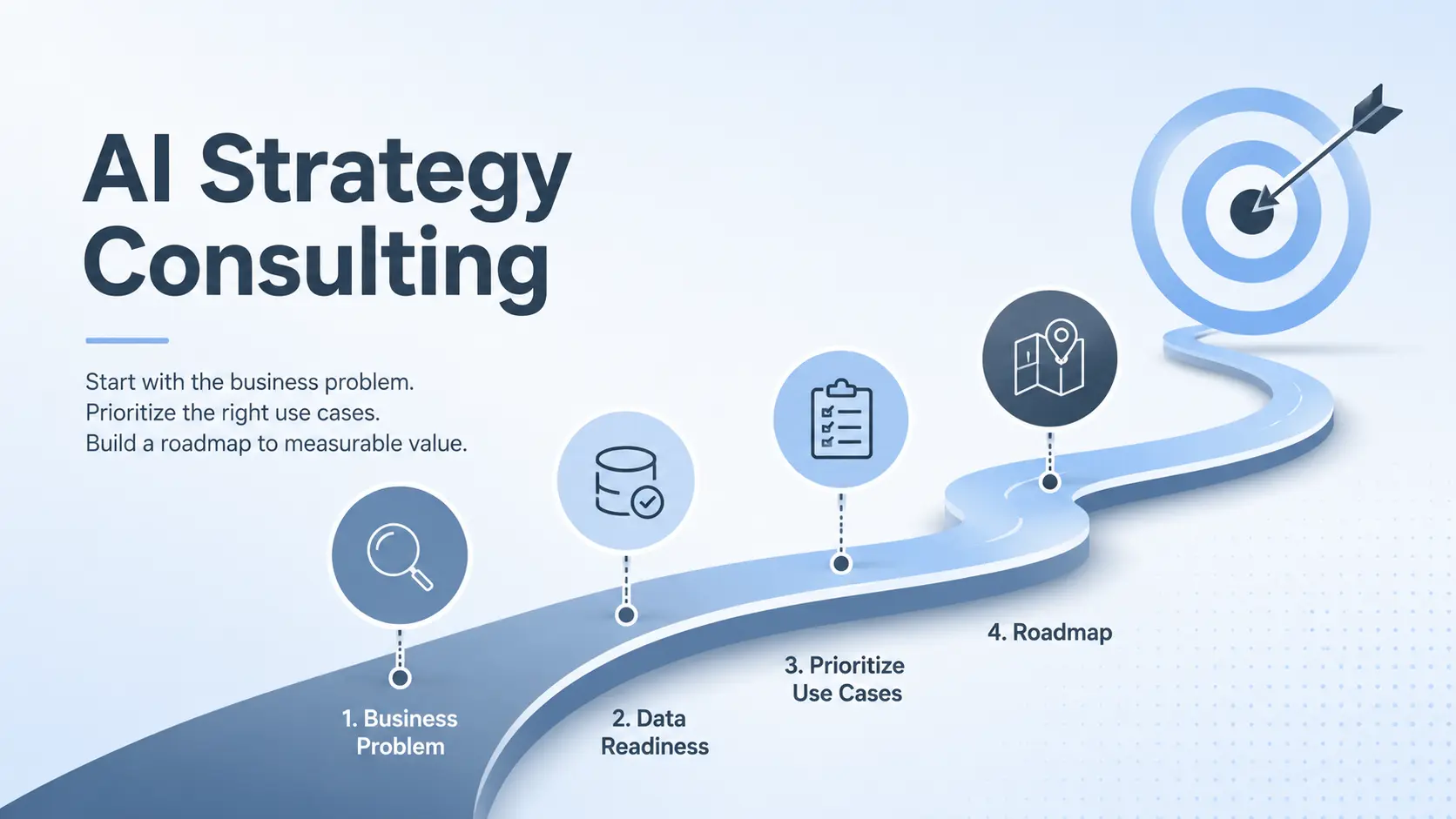
AI Strategy Consulting: Process, Services, and Roadmap

Usman AshrafSep 7, 2026
AI strategy consulting roadmap from business problems and data readiness to prioritized use cases and measurable value.

Summarize with AI

Introduction

Most AI projects fail for reasons unrelated to the model. RAND interviewed 65 data scientists and engineers about why AI projects go wrong. The most common root cause was a misunderstanding about the problem the AI was meant to solve. The technology worked, but the team aimed it at the wrong target.

AI strategy consulting exists to stop the same mistake from repeating. The work starts with a business problem, then moves backward to the data and systems the problem needs. Choosing AI automation tools starts in the same place. This article explains what AI strategy consulting is, what an engagement includes, and how to build an AI roadmap your teams can follow.

What is AI Strategy Consulting?

AI strategy consulting helps an organization decide where AI creates business value and which projects to fund first. The work also covers the data, systems, and controls each project needs. An engagement ends with a plan for moving the selected projects from pilot into production.

An AI strategy consultant produces decisions, not code. The usual output is a readiness assessment and a ranked list of use cases. A phased road map, with named owners and budget ranges, sits atop both.

Five overlapping services get sold under similar names and rates, so the labels are worth separating. Our guide to AI services breaks all ten categories down in full. Here, AI strategy sets direction, and AI consulting can cover direction plus architecture and delivery. AI development builds the system. AI implementation puts it into live operations. AI transformation coordinates all of the above across multiple departments simultaneously.

Why Do Businesses Need an AI Strategy?

Businesses need an AI strategy because experiments without a clear business case often get cut. AI adoption keeps rising, with around one in five US businesses using it and adoption even higher among larger companies.

At the same time, many AI projects are being dropped. A large share of companies abandoned AI initiatives in 2025, and many proofs of concept never made it into production.

The main barriers are usually practical rather than technical. Data quality and readiness are major issues, and many companies struggle to move AI pilots into real-world use.

A strategy settles five arguments before anyone writes code.

  • Where the Money Goes: Spending concentrates on a small number of high-value problems instead of spreading across pilots.
  • What the Data Can Support: Gaps surface early, while they are still cheap to fix.
  • Who Owns the Outcome: Each use case gets a business owner rather than sitting with IT by default.
  • How Success is Judged: Baseline numbers are recorded before the pilot, not reconstructed afterward.
  • What Order Things Happen in: Teams build capability in sequence, so the second project reuses the first.
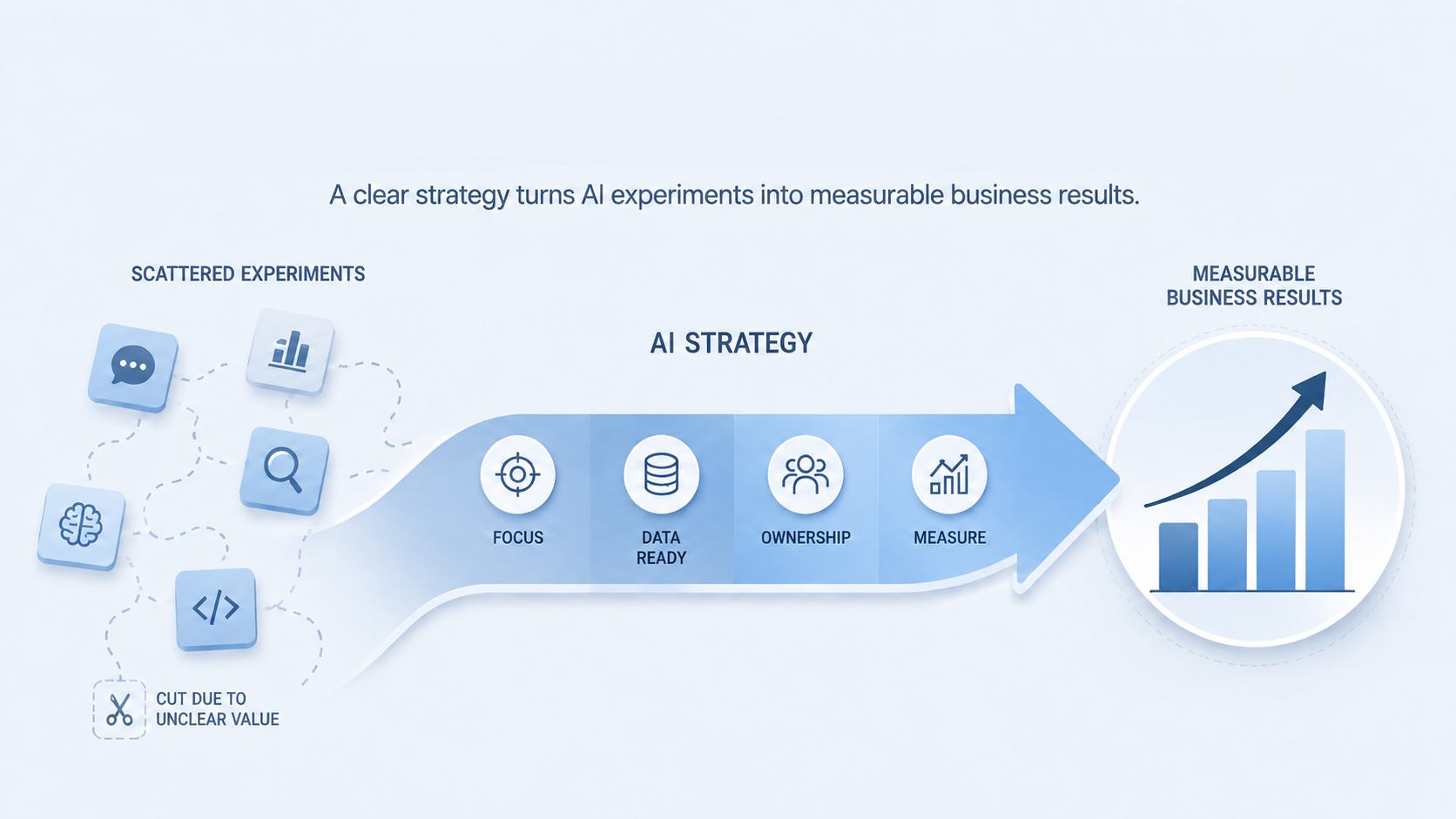
AI strategy diagram showing scattered experiments becoming measurable business results through focus, data, ownership, and measurement.

What Does an AI Strategy Consultant Do?

An AI strategy consultant runs five pieces of work in the following order.

  • Business Assessment: Map the goals, processes, and pain points leadership already cares about. Existing AI pilots get reviewed here too, including the stalled ones.
  • AI Readiness Assessment: Score the organization on data, infrastructure, skills, process maturity, and governance. The score tells you what’s buildable in this quarter and what is not.
  • Use-Case Discovery: Find the processes where AI could move revenue, cost, productivity, customer experience, or decision quality.
  • Prioritization: Rank each use case on value, complexity, data availability, risk, and time to value. The ranking is where most of the argument happens.
  • Roadmap Development: Turn the ranked list into phases with owners, budgets, and checkpoints.
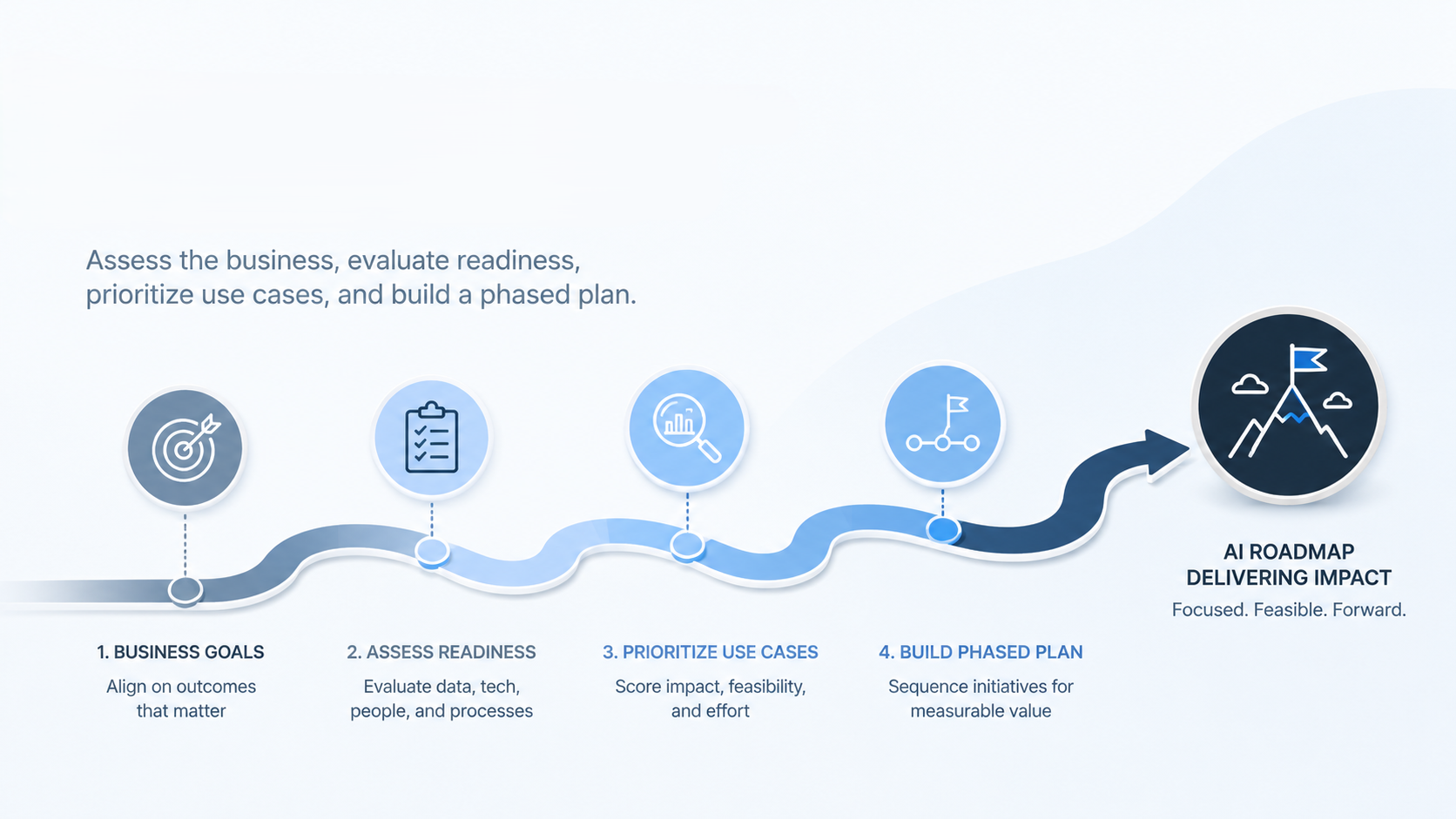
AI roadmap diagram showing four steps from business goals and readiness assessment to prioritized use cases and phased delivery.

What Do AI Strategy Consulting Services Include?

AI strategy consulting services usually bundle the following components. Smaller engagements drop some of them.

Service

Purpose

Typical Output

AI Readiness Assessment

Judge whether the organization can support AI in production

Scored report with gaps

AI Use Case Assessment

Identify practical AI opportunities across functions

Long list of candidate use cases

AI Maturity Assessment

Benchmark current AI capability against peers

Maturity level and target state

AI Strategy

Set priorities, direction, and investment logic

Strategy document

AI Roadmap

Establish phases, sequence, and timing

Phased delivery plan

Technology Assessment

Evaluate models, platforms, and infrastructure options

Architecture recommendation

Data Strategy

Define data requirements and close the gaps

Data plan tied to use cases

AI Governance

Set policies, controls, and human oversight

Governance framework

ROI Planning

Define business and financial metrics

KPI model and baseline

Implementation Strategy

Convert strategy into an executable plan

Delivery plan and resourcing

AI Strategy Consulting vs AI Consulting

The two terms overlap, and many firms use them interchangeably. The practical difference is scope.


AI Strategy Consulting

AI Consulting

Primary Focus

Direction and priorities

Whatever the business needs from AI

Main Question

Where and why should we use AI?

How can AI solve this problem?

Typical Output

Strategy and roadmap

Strategy, architecture, and delivery guidance

Time Horizon

Medium to long term

Project-specific or ongoing

Typical Buyer

Leadership

Leadership, IT, product, and operations

AI Strategy vs AI Development

AI strategy decides what gets built and why. AI development decides how.

Let’s suppose a company wants an AI customer-service assistant. The strategy work decides which interactions to automate, on which channels, and with what knowledge behind them. It also names the risks worth controlling. Then, it fixes the one metric proving the assistant worked. 

The development work covers architecture, model selection, API integration, knowledge retrieval, testing, and deployment. Mature AI programs need both. A strategy nobody can build is a slide deck, and a system nobody asked for is expensive shelfware.

AI Strategy Consulting vs AI Implementation Consulting

AI strategy consulting decides what the organization should do, while AI implementation consulting gets the chosen system live. The split shows up in the deliverable.


AI Strategy Consulting

AI Implementation Consulting

Main Focus

What should the organization do?

How does the chosen solution get deployed?

Primary Output

Strategy and roadmap

Working system in production

Core Activities

Assessment, prioritization, planning

Development, integration, testing

Typical Timing

Before funding decisions

After priorities are set

Success Measure

Clear direction and a defensible business case

Deployment and measured business results

Takeaway: Both services often come from the same partner. Splitting them across two vendors adds a handover, and scope tends to change quietly at handovers.

How to Assess AI Readiness?

An AI readiness assessment checks five dimensions, and each one can stop a project on its own.

Dimension

What to Check

Common Red Flag

Data

Quality, availability, access, lineage, security

The data exists, but nobody can get it out of the source system

Technology

Cloud, APIs, data platform, existing software

Core systems have no API and no vendor roadmap for one

Process

Process maturity, consistency, automation potential

Every branch office does the process differently

People

Skills, business ownership, leadership support

The project has a technical lead and no business owner

Governance

Security, privacy, compliance, risk, AI policy

No agreed answer on what data may go into a third-party model

Readiness is not pass or fail. A low data score changes the sequence, so the first project becomes a data project. NIST’s AI Risk Management Framework is a reasonable starting point for the governance dimension, and its four functions map cleanly onto a strategy document.

How Do Businesses Identify AI Use Cases?

Businesses identify AI use cases by looking for processes with a specific shape. Good candidates involve large volumes of information, repetitive judgment, unstructured documents, natural-language interaction, forecasting, or classification.

A mid-sized distributor makes a useful running example. The accounts payable team handles 1,200 supplier invoices every month. Most are processed by hand. 

A rules-based tool already reads invoices from three regular suppliers. Each of the three sends the same template every time. The tool struggles with the rest because vendors send PDFs in different layouts. Similarly, line items often fail to match the purchase order, and some invoices arrive as phone photos.

The invoice process has every marker of a strong candidate. Volume is high, and the work repeats. The inputs are documents, and every error carries a measurable cost. Common candidates elsewhere include customer support triage, sales research, document data extraction, internal knowledge search, demand forecasting, and fraud detection.

Not every problem needs AI. If a process is already deterministic and its rules rarely change, a plain integration will be cheaper to build and easier to audit.
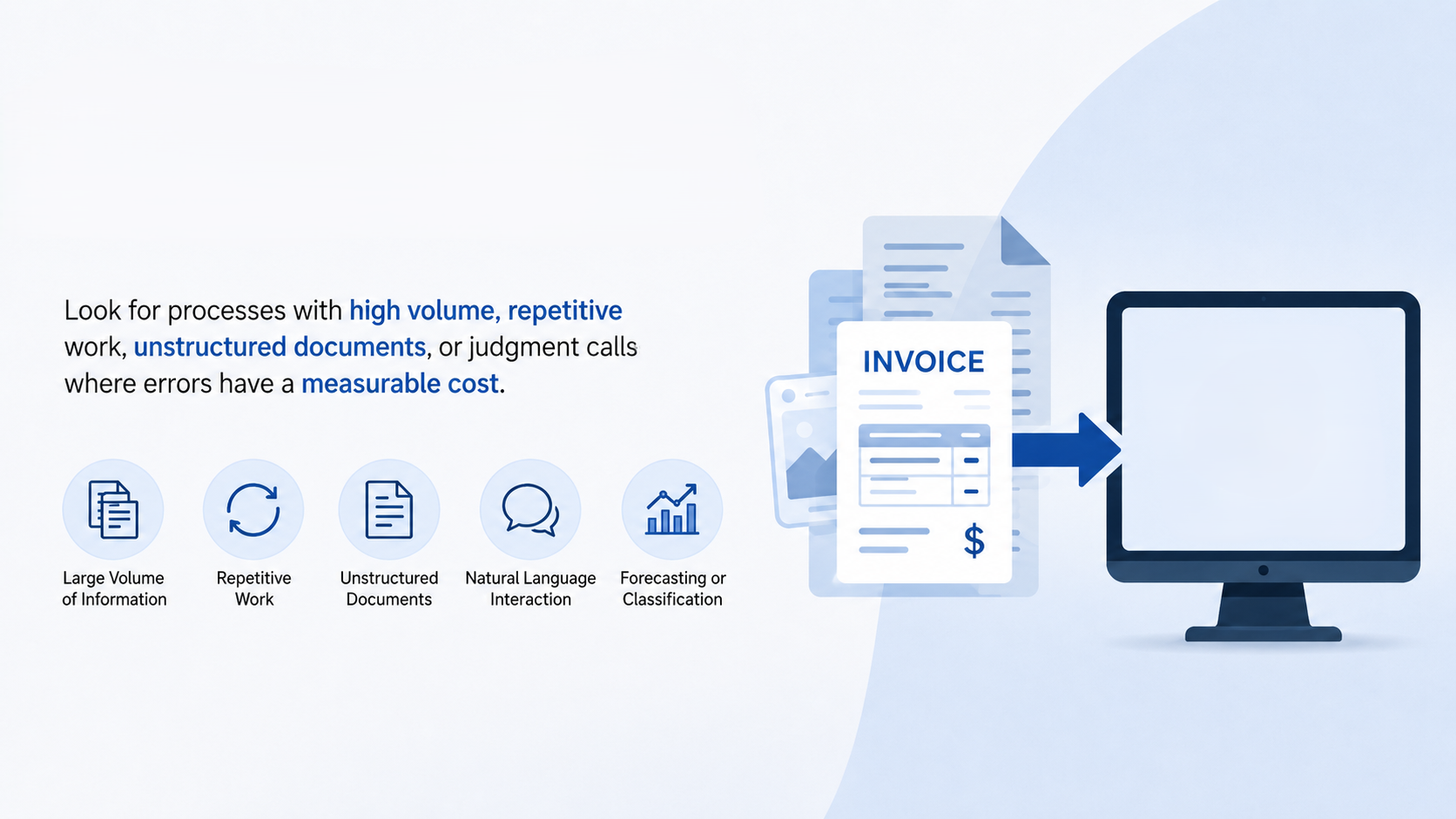
AI automation diagram showing high-volume, repetitive processes and invoices moving from documents into a digital system.

How to Prioritize AI Projects?

Prioritization is where an AI strategy earns its fee, because it converts a wish list into a funding decision. Score each candidate on business impact, implementation complexity, data availability, expected cost, risk, and time to value.

Use Case

Business Value

Complexity

Data Readiness

Risk

Priority

Invoice Processing

High

Medium

High

Low

High

Internal Knowledge Assistant

High

Medium

Medium

Medium

High

Fully Autonomous Financial Decisions

High

Very high

Variable

High

Low for now

The highest-priority project is rarely the most impressive one. Invoice processing wins here because the data already exists in a usable form and the failure mode is a human correcting a line item. Autonomous financial decisions score just as high on value and lose on everything else.
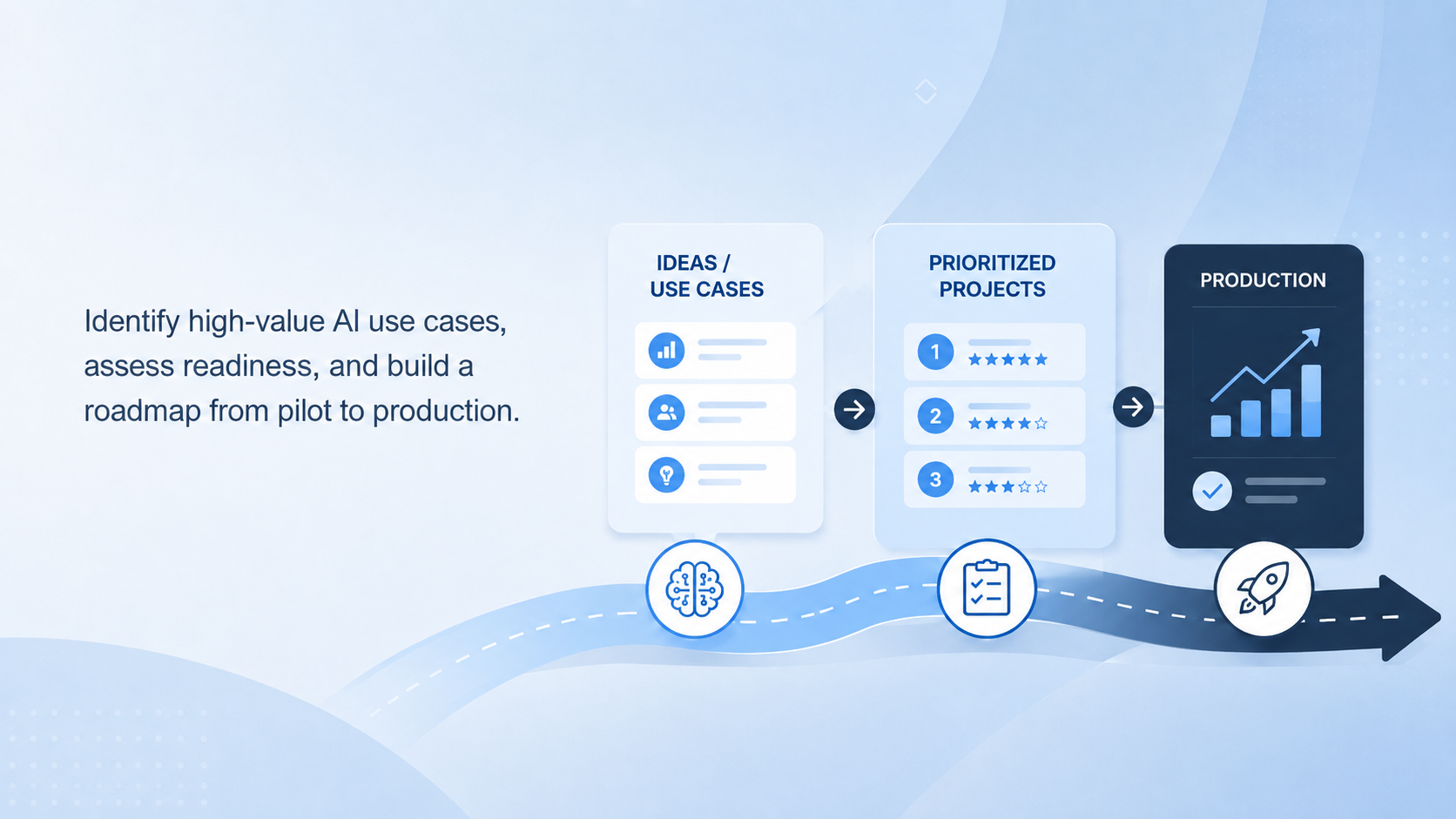
AI use case roadmap showing ideas prioritized into projects and advanced from pilot to production based on value and readiness.

How to Build an AI Roadmap?

An AI roadmap sequences the ranked list into phases, and six phases cover most programs.

  • Assess: Establish the current state of data, technology, process, and governance.
  • Prioritize: Choose two or three use cases and define their success metrics.
  • Pilot: Build a narrow version of the top use case against real data.
  • Implement: Deploy into the live workflow with monitoring and human review.
  • Scale: Extend the working capability to adjacent processes and teams.
  • Optimize: Track cost per task, accuracy, and adoption, then tune.

For the distributor, the pilot covers invoices from the 20 highest-volume vendors, with a human approving anything above a set amount. Implementation connects the extraction step to the ERP through AI integration work. Scaling adds purchase-order matching. Each phase has an exit test, so a failing pilot stops the spend instead of quietly becoming a program.

What Should an AI Strategy Include?

A usable AI strategy document answers the following in writing.

  • Objectives and Use Cases: The business goals, the ranked use cases, and the reason each one made the list.
  • Data and Technology: Required data sources, quality gaps, target architecture, model choices, and integration points.
  • Governance and Security: Access controls, privacy rules, human review points, and the policy for third-party models.
  • People and Ownership: A named business owner per use case, skills gaps, and the training plan.
  • Money and Time: Budget ranges, timeline, and the checkpoints where funding continues or stops.
  • Measurement: Baseline numbers, target KPIs, and who reports them.

If the document cannot tell an engineer what to build first, it is a wish list rather than a strategy. Send it back.

Enterprise AI Strategy and AI Transformation

Enterprise AI strategy carries extra weight because the same problems repeat across business units. Multiple departments run overlapping pilots. Legacy systems resist integration. Data sits in silos with different owners and different definitions of a customer.

The fix is portfolio thinking. Instead of approving projects department by department, leadership maintains one ranked portfolio with one governance model behind it. Vendor choices, model access, and security review all move to the portfolio level. Enterprise AI consulting engagements usually spend as much time on the operating model as on the use cases.

AI transformation consulting goes further. Automating invoice processing is a single initiative. Transformation means coordinated AI capability across customer service, sales, finance, operations, and IT. The coordination is the hard part, because it forces changes to processes, skills, governance, and reporting lines. Most organizations earn the right to attempt it by shipping two or three initiatives first.
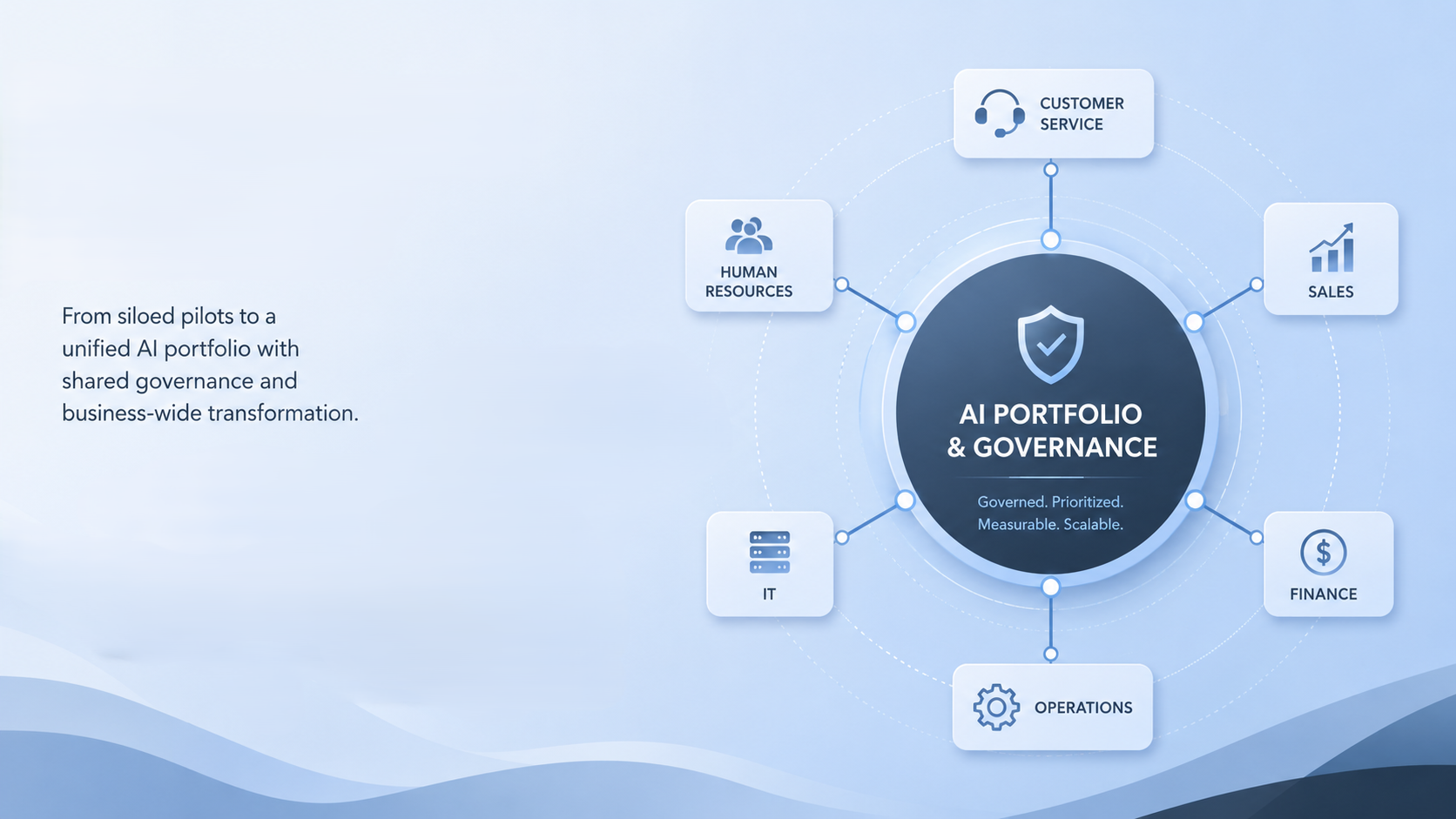
AI portfolio and governance diagram connecting customer service, sales, finance, operations, IT, and HR around a central hub.

AI Strategy for Small Businesses and Startups

Smaller organizations should optimize for time to value. The best first project has an obvious ROI number and an existing workflow. Customer-support assistants, invoice processing, sales lead research, and internal knowledge search all fit the criteria. Existing SaaS platforms often cover the requirement without custom work, and AI automation usually beats building a model from scratch.

Startups face a different question. Strategy work there validates the AI product idea and picks an architecture strong enough to survive the next 10x of usage. It also sets inference-cost limits early and keeps model providers swappable. The main risk is unnecessary complexity. Four services and two vector stores are hard to debug at the exact moment the first real customers arrive.

AI Strategy by Business Function

Most AI use case assessments start function by function, because budgets and owners follow the same lines. The table below lists the recurring patterns across mid-sized and enterprise clients.

Function

Practical AI Use Cases

Sales

Lead scoring, prospect research, proposal drafting

Marketing

Personalization, content workflows, segmentation, campaign analytics

Finance

Invoice processing, forecasting, fraud detection, document analysis

Customer Service

Assistants, ticket classification, knowledge retrieval

Operations

Workflow automation, document processing, demand forecasting

IT

Service desk triage, incident classification, code assistance

An AI adoption strategy rarely covers every row at once. Pick the function with the clearest baseline numbers, because it will produce the ROI evidence the next round of funding depends on.

AI Strategy and Data Strategy

AI strategy and data strategy are the same plan viewed from two ends. The business outcome sets the AI application. The application sets the data requirements. The requirements then set the architecture work.

Most organizations discover their real constraint is not model quality. The blocker is usually data locked inside a system with no API. Duplicated customer records across three platforms cause the same trouble, and so does a permissions model nobody wants to expose to a chatbot. 

Fixing the data problems is data engineering work, not AI work. The same discovery-first logic applies whether the gap is data extraction or a full migration, and it belongs in phase one of the roadmap. A modern data architecture makes the second and third use cases much cheaper than the first.

AI Strategy and AI Agents

Agentic AI changes what a strategy has to cover. An agent takes multi-step actions, calls tools, and writes to systems, so the strategy has to specify permissions rather than just outputs.

Four decisions settle whether an agent is appropriate.

  • Task Fit: The task needs a result someone can check, not just a plausible-looking output.
  • System Access: Name every system the agent may read from, and name the shorter list it may write to.
  • Approval Points: Decide where a human signs off before an action commits.
  • Monitoring: Plan how the team spots a bad run and rolls it back.

Autonomy is a cost, not a feature. Start with a narrow scope and a human approval step, then widen it once the error rate is known. AI agent development works best when the underlying process is already stable.

How to Measure AI ROI?

Measure AI ROI against business numbers, not model accuracy. A system can score well on a benchmark and still deliver nothing, because nobody uses it or the workflow around it stays manual. Accuracy is not adoption.

Pick two or three business metrics per use case and record the baseline before the pilot starts. Processing time, cost per task, error rate, automation rate, and revenue influenced all work as candidates. For the distributor, the honest measures are invoices processed per hour and the share of invoices never needing a human touch.

Adoption belongs on the list, as well. A tool most of the team ignores has not returned its cost, whatever the accuracy score says.

Common AI Strategy Mistakes

  • Starting with the Model: Choosing a platform before naming the business problem. This is RAND’s most common failure cause, and it survives every technology cycle.
  • Running Too Many Pilots: A dozen experiments with no route to production consume the same budget as two funded projects.
  • Assuming the Data is Fine: Data quality is the single most cited blocker in survey after survey, and it never improves on its own.
  • Leaving Ownership with IT: Projects without a business owner lose their champion at the first budget review.
  • Skipping the ROI Baseline: Without a before number, nobody can prove the after number.
  • Over-Automating: Giving an agent more autonomy than the process can safely support turns a small error into a repeated one.
  • Ignoring Integration: An AI application gets opened twice and forgotten if it sits outside the systems people already use.

How to Choose an AI Strategy Consulting Firm?

Look for a partner who is able to assess, plan, and then build. Strategy-only firms hand over a roadmap they have never had to deliver. Build-only firms tend to solve the problem in front of them rather than the right one. 

Put these questions to every shortlisted firm before signing.

  • How do you identify and prioritize use cases, and what does the scoring model look like?
  • How do you assess AI readiness, and what happens if we score badly on data?
  • How will ROI be measured, and who owns the baseline numbers?
  • Can you support implementation, or does the engagement end at the document?
  • How do you handle data access, security, and third-party model policy?
  • What does support look like after the roadmap is delivered?

Evidence beats logos. Any AI strategy consulting company should be able to walk through a use case it deprioritized and explain the reasoning. The answer says more than a client list does.
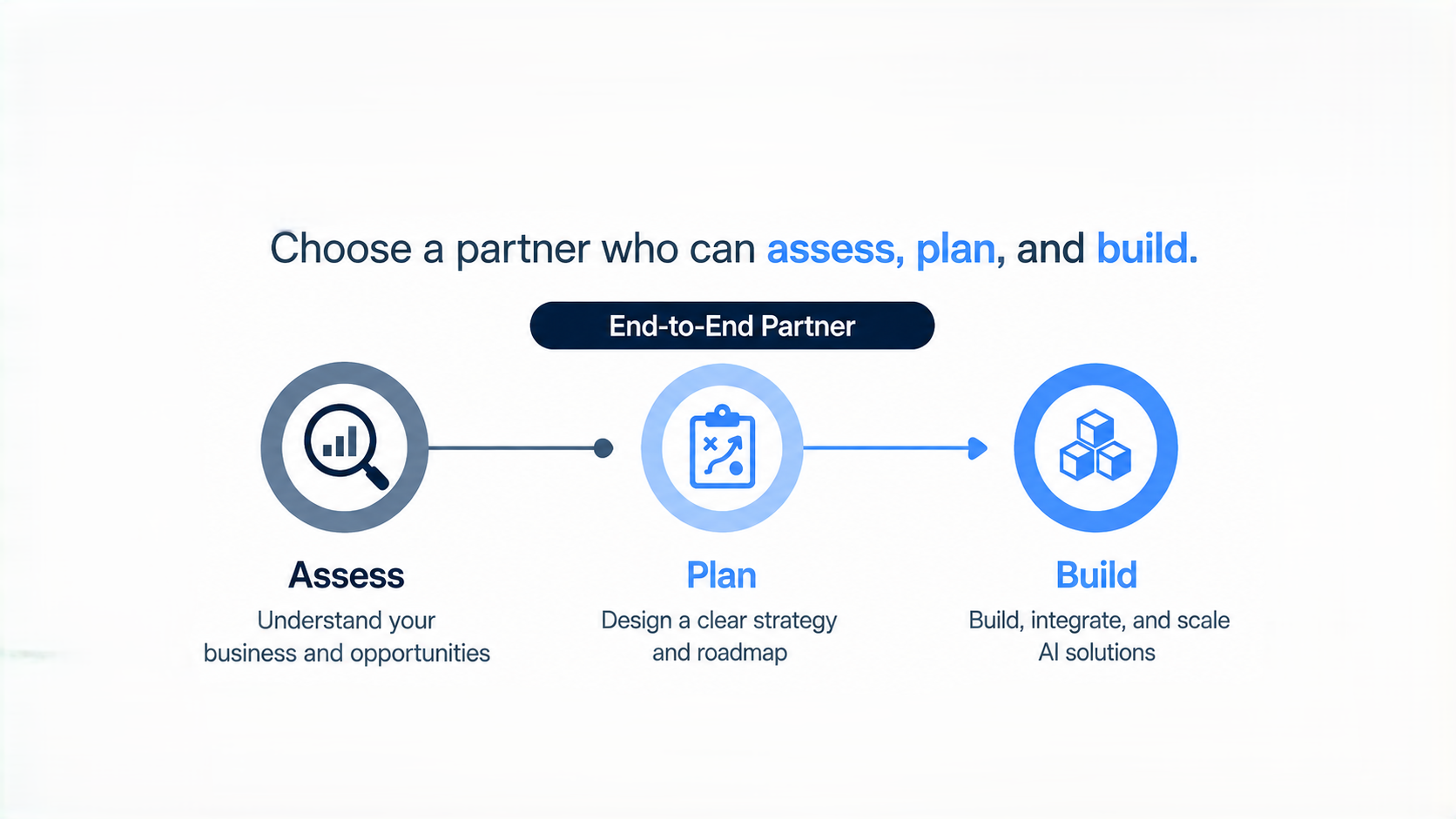
End-to-end AI partner framework showing three stages: assess business opportunities, plan a strategy, and build scalable AI solutions.

How Much Does AI Strategy Consulting Cost?

Cost depends on scope rather than a standard rate card. The main drivers are organization size, business units in scope, use-case count, data complexity, and the state of the existing technology. Architecture and implementation planning add to the total again.

Four engagement shapes cover most of the market. A focused AI readiness assessment evaluates current capability and takes the least time. An AI strategy project adds use-case discovery, prioritization, and a roadmap. An enterprise AI strategy spans multiple departments and adds governance and operating-model work. Ongoing AI advisory keeps a consultant available as the portfolio changes. 

NOTE: Ask for scope and deliverables in writing before comparing prices between firms.

When Should a Business Hire an AI Strategy Consultant?

Hire an AI strategy consultant when the decision problem is bigger than the build problem. The clearest signals:

  • Leadership wants AI but has no agreed direction.
  • Several AI opportunities compete for the same budget.
  • Pilots keep starting and none reach production.
  • Departments are experimenting independently and duplicating spend.
  • Data readiness is unknown, and nobody has checked.
  • The choice between building, buying, and integrating is unresolved.
  • AI will touch regulated data or customer-facing decisions.

If none of these apply and you already know exactly what to build, skip the strategy engagement and go straight to delivery.

Conclusion

A working AI strategy connects business goals to AI opportunities. Then it adds data, technology, people, and measurement to the system. Every link is a decision someone has to make and own. The strategy earns its cost only if it is concrete enough to tell a delivery team what to build first, and honest enough to name what to stop.

Everything above assumes someone inside the business has time to run the process end to end. Most leadership teams do not, which is why the pilot backlog keeps growing. Data Prism helps companies assess AI readiness, rank use cases, and take the top projects through to production. Our AI consulting and strategy team is happy to walk through your situation on a FREE 30-minute call.

Book a Free 30-Minute Meeting

Discover how our services can support your goals — no strings attached. Schedule your free 30-minute consultation today and let's explore the possibilities.

Book a Free Call

Frequently Asked Questions

AI strategy consulting helps an organization decide where AI creates business value, which projects to fund first, and what data and technology each one needs. The output is a readiness assessment, a ranked set of use cases, and a phased roadmap. It answers where and why before anyone decides how.

An AI readiness assessment scores an organization on data, technology, process, people, and governance. Each dimension can block a project on its own. A weak data score does not cancel the program, but it usually means the first phase of the roadmap becomes a data project rather than an AI project.

AI strategy consulting focuses on direction, priorities, and investment decisions. AI consulting is broader and can include architecture, integration, and delivery guidance alongside strategy. Buyers differ too. Leadership usually buys the strategy work, while IT, product, and operations buy the wider AI consulting.

Cost depends on organization size, the number of use cases and business units in scope, data complexity, and whether implementation planning is included. A focused readiness assessment sits at the low end, and a multi-department enterprise strategy at the high end. Compare scope and deliverables rather than headline day rates.

Book Consultation