Introduction
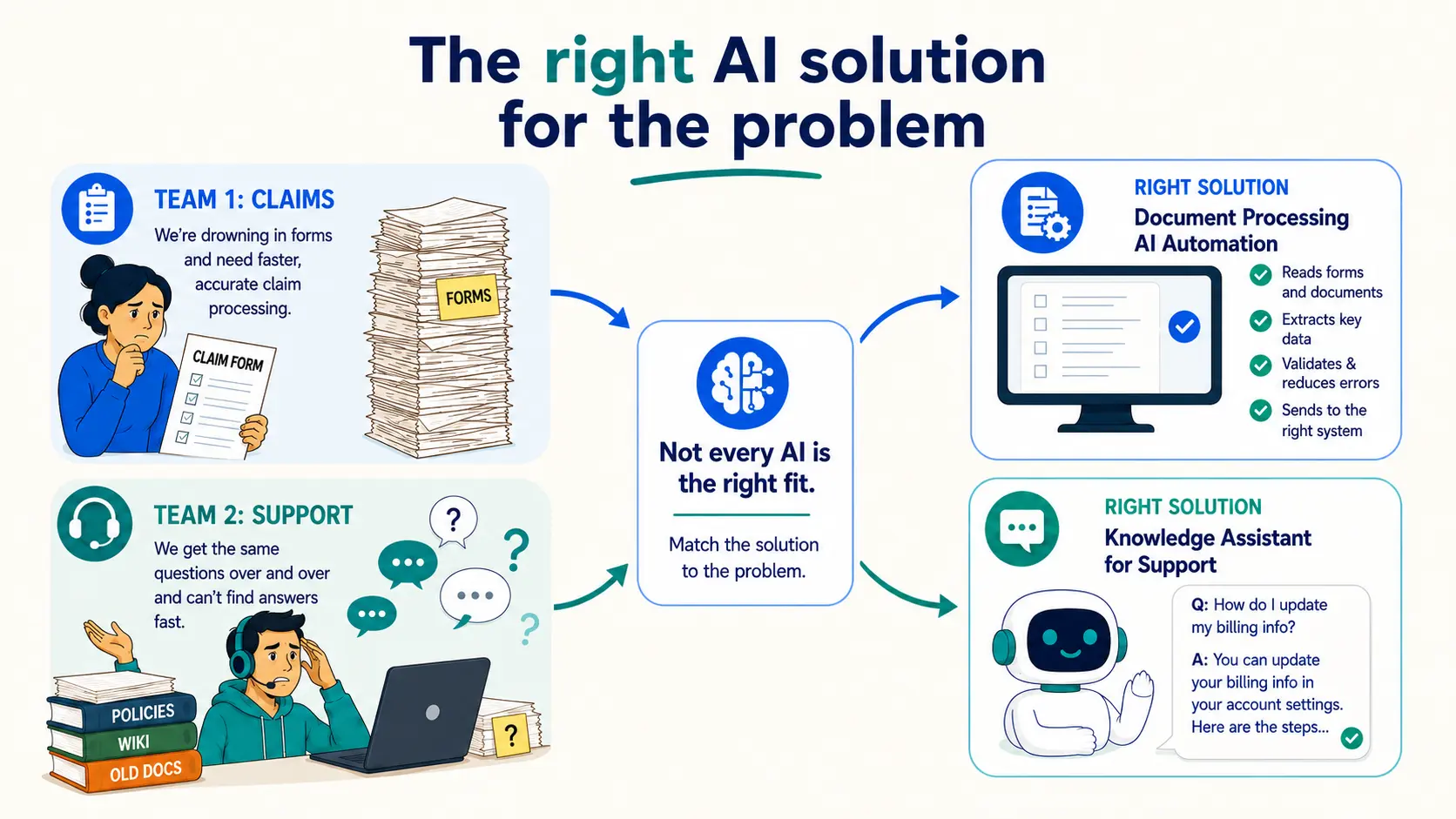
A claims team wants software that reads 6,000 forms a month. A support team wants an assistant who answers customer questions using documentation that nobody can find. Both teams call the project “AI,” and both start by searching for AI services.
The term covers a wide range of work. It stretches from a two-week feasibility study to a production system your staff uses every day. Picking the wrong category can be catastrophic, because a strategy engagement can’t build software and a development team can’t tell you which problem deserves the budget.
As AI adoption grows, more companies are having to decide what kind of AI work they actually need. About 19.8% of U.S. businesses reported using AI, with the rate reaching 37% among firms with at least 250 employees.
This article explains what AI services are, the 10 main types, and how they differ from AI consultancy. It also shows how to match a type to your own problem.
What are AI Services?
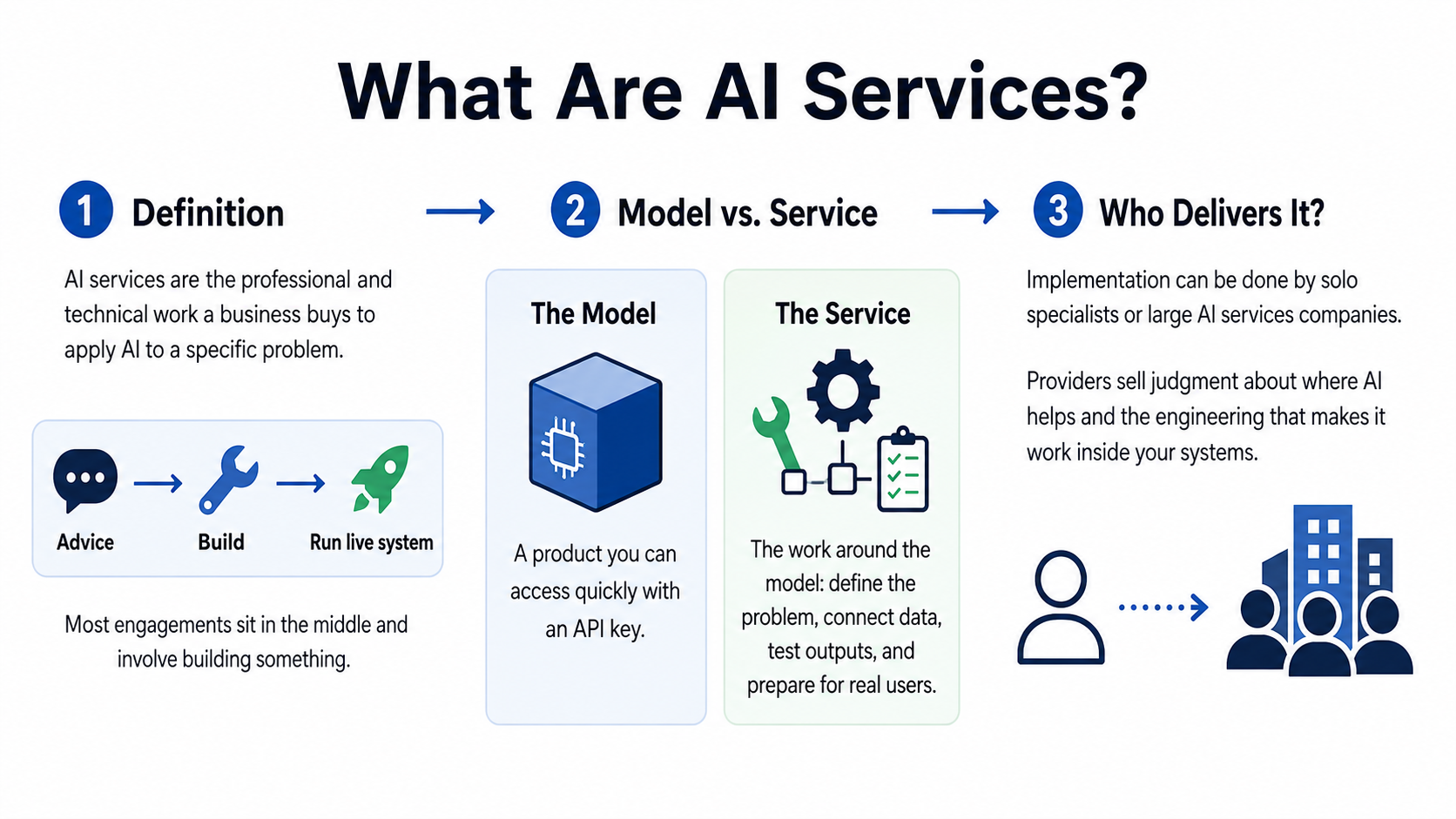
AI services are the professional and technical capabilities a business buys to apply artificial intelligence to a specific problem. The work ranges from advice at one end to running a live system at the other. Most engagements sit in between and involve building something.
The model itself is a product, and an API key gets you access in minutes. The service is the work around the model. It starts with choosing the problem the model should work on. Someone then connects the model to your data and checks the output before real users see it.
The people who do the implementation range from single specialists to large AI services companies. Most AI service providers sell judgment about where a model helps and the engineering that makes it work inside your systems.
What Do AI Services Do?
AI services solve operational problems. Take the claims team handling 6,000 claim forms a month. Staff open each PDF, read the policy number, amounts, and treatment codes, and then type the fields into the claims system.
An AI service replaces most of the reading and typing. The flow looks like this:
The same shape applies to other work. A support system sorts incoming messages by intent, and a forecasting model predicts next month’s demand. An assistant answers staff questions from approved company documents. Each one counts as a service because someone designs the flow and keeps it running after launch.
How Many Types of AI Services are There?
No official classification exists. Providers group their offerings differently, so one company’s AI development covers what another sells as AI automation. Counting categories matters less than knowing which one fits your problem.
The framework below uses 10 categories. The categories overlap in practice, and most real projects combine two or three.
|
AI Service |
What It Does |
Example |
|
AI Consulting |
Finds opportunities and sets the plan |
AI roadmap |
|
AI Development |
Builds custom AI solutions |
Internal AI application |
|
Generative AI |
Creates and interprets content |
Document assistant |
|
AI Automation |
Automates business workflows |
Claim processing |
|
AI/ML Development |
Builds predictive models |
Demand forecasting |
|
AI Applications |
Builds AI-powered software |
Customer support app |
|
AI Data Services |
Prepares and structures data |
Data extraction |
|
Agentic AI |
Performs multi-step tasks |
Research agent |
|
AI Implementation |
Connects and deploys AI systems |
CRM integration |
|
Managed AI |
Runs AI capabilities for you |
Hosted AI platform |
AI Consulting and AI Strategy Services
AI consulting decides what to build and whether the result will pay for itself. The engagement reviews your processes and returns a shortlist of use cases. It also checks whether the data behind each one exists. Cost and return estimates complete the process.
A logistics company with five candidate projects is the standard case. Strategy consulting ranks the five by likely impact, then estimates what each one would take to build. This ranking step is exactly what a dedicated AI strategy engagement goes deeper on. The deliverable is a roadmap, not software.
Takeaway: AI consulting services suit companies with more ideas than evidence.
AI Development Services
These services build the system your business will use. Custom AI development covers assistants, recommendation systems, document intelligence, AI-powered search, predictive tools, and internal APIs.
A hospital group wants one search box across 40,000 clinical policy documents. The project needs development rather than advice. Someone has to index the documents, apply the permissions, and put a working interface in front of the staff. AI software development services handle the parts a strategy deck can only describe.
Takeaway: Development work starts where the strategy deck stops.
Generative AI Services
Generative AI services build systems that produce and interpret language, code, and images. The common projects are internal assistants, document summarization, drafting support, and question answering over company content.
Retrieval-augmented generation (RAG) is the pattern behind most generative AI projects. The system searches your approved documents first, then asks the model to answer using what it found. Answers stay tied to company sources instead of the model’s general training.
Takeaway: Generative AI services also include the unglamorous parts. Someone has to write evaluations, set access rules, and decide what happens when the model is wrong.
AI Automation Services
AI automation services provide AI capabilities to a business workflow. The claims flow above is one example, and choosing the right automation platform is the decision that comes right after it. Customer messages are another. The system reads the intent, and then drafts a reply from your knowledge base. Anything unusual goes to a human agent.
Email triage follows the same pattern. The system sorts incoming mail and pulls out the useful fields. The record then lands in the right queue.
Takeaway: AI automation pays off where staff spends hours on repetitive information work.
AI and Machine Learning Development Services
Machine learning learns patterns from your historical data and predicts a number or a category. Generative AI produces content. The distinction matters when you buy, since AI/ML development services need history that generative projects often don’t.
A retailer wants next month’s demand forecast by product. The ML system learns from past sales, seasonality, promotions, and stock levels. Fraud scoring, churn prediction, and predictive maintenance work the same way.
Takeaway: AI and ML services need usable history, which usually means a working data pipeline. Without the history, there is nothing to learn from.
AI Application Development Services
AI application development services build a whole product around the model. They add the parts a raw model has no opinion about. The list runs from the interface and user permissions to audit trails, admin controls, and reporting.
Access to a model is a starting point. An application is what your team logs into on Monday morning.
Takeaway: The application layer earns its cost once several teams share the system, because each team needs different permissions and its own view of the data.
AI Data Services
AI depends on the data your systems can read. AI data services cover collection, extraction, cleaning, transformation, labeling, and validation.
The claims project makes the dependency clear. Someone has to pull historical claims out of PDFs, email attachments, and broker portals before any model runs. The clinic names in the files appear four different ways, so they need to be aligned first. Our data extraction services and data collection services handle the pulling and aligning.
Custom models add one more requirement to the same stage. AI training data services produce the labeled examples the model learns from, and someone has to ensure the labels remain consistent.
Agentic AI Services
An AI agent plans a sequence of steps toward a goal. It uses your tools and business systems along the way. A procurement agent takes a purchase request, searches approved suppliers, and compares prices. The recommendation then goes to a person for approval. Research workflows fit the same shape, where the agent gathers the sources and returns the numbers in a structured summary.
Agent capability improved quickly on OSWorld, a benchmark of computer tasks. Accuracy rose from roughly 12% to 66.3% in a year, coming within six percentage points of human performance.
Takeaway: A third of attempts still fail. Agentic AI development services earn their fee by deciding where the agent acts alone and where a person signs off, especially when money moves.
AI Implementation and Integration Services
A working model still has to reach the people who need it. AI implementation services connect the system to your CRM, ERP, ticketing platform, and document store. The same engagement covers deployment and monitoring.
Permissions are the first thing to get right. A system that surfaces records the user should not see fails on day one, whatever its accuracy. Similarly, monitoring is the part teams underestimate. Insurers change claim form layouts, so extraction accuracy drifts. In such cases, somebody must notice before the adjusters do.
Managed AI Services and AI as a Service
Managed AI services put the running of the system with the provider. The scope can cover infrastructure, model access, monitoring, retraining, and support.
AI as a service means renting a capability instead of building one. You call a hosted API for document extraction or translation and pay for what you use. AI cloud services from the major platforms work the same way, and both suit teams with no machine learning staff of their own.
The claims team from earlier is a typical buyer. The provider keeps the extraction models running, and the team keeps working the exceptions.
AI Services vs AI Consultancy: What is the Difference?
Despite the overlap, there is a significant difference between the two. AI consultancy decides what to build and whether it is worth building. AI services cover the advice plus the building, integration, and running of the system.
|
Dimension |
AI Services |
AI Consultancy |
|
Who You Deal With |
Engineers, data specialists, delivery leads |
Strategists and analysts |
|
Main Goal |
Build, deploy, integrate, or operate AI |
Decide what AI should be used for |
|
Typical Output |
Application, automation, model, integration |
Roadmap, assessment, recommendations |
|
Timing |
Planning through operation |
Discovery and planning |
|
Example |
Build a claims processing system |
Decide whether claims are the right first project |
Customer support shows the split. Consultancy decides which request types should be automated and what a wrong answer costs you. The service work starts once the consultancy has answered both questions. Someone builds the assistant and connects it to the ticketing system, then tests it against real tickets, and watches accuracy after launch.
Takeaway: Consultancy is often the first phase of a larger AI services engagement, rather than a separate purchase.
Which AI Service Does Your Business Need?
Match the situation to the category before you shortlist providers. Each row below pairs a sentence you might recognize from your own meetings with the service type that answers it.
|
If This Sounds Like You |
Start With |
|
“We could automate several things and don’t know which one is worth it.” |
AI consulting and strategy |
|
“We know what we want built.” |
AI development services |
|
“Our staff needs a system to log into, not an API.” |
AI application development services |
|
“We process thousands of documents by hand every month.” |
AI automation services |
|
“We want an assistant that answers questions from our documents.” |
Generative AI services |
|
“We want to predict demand, churn, or risk.” |
AI/ML development services |
|
“Our data sits in PDFs, portals, and inboxes.” |
AI data services |
|
“We want a system that completes multi-step tasks.” |
Agentic AI services |
|
“We bought an AI tool and can’t connect it to anything.” |
AI implementation and integration |
|
“We have no team to run this after launch.” |
Managed AI services |
Most projects need two of the ten categories, and the second one is usually data or integration work.
How to Choose an AI Services Company?
Ask about outcomes before capabilities.
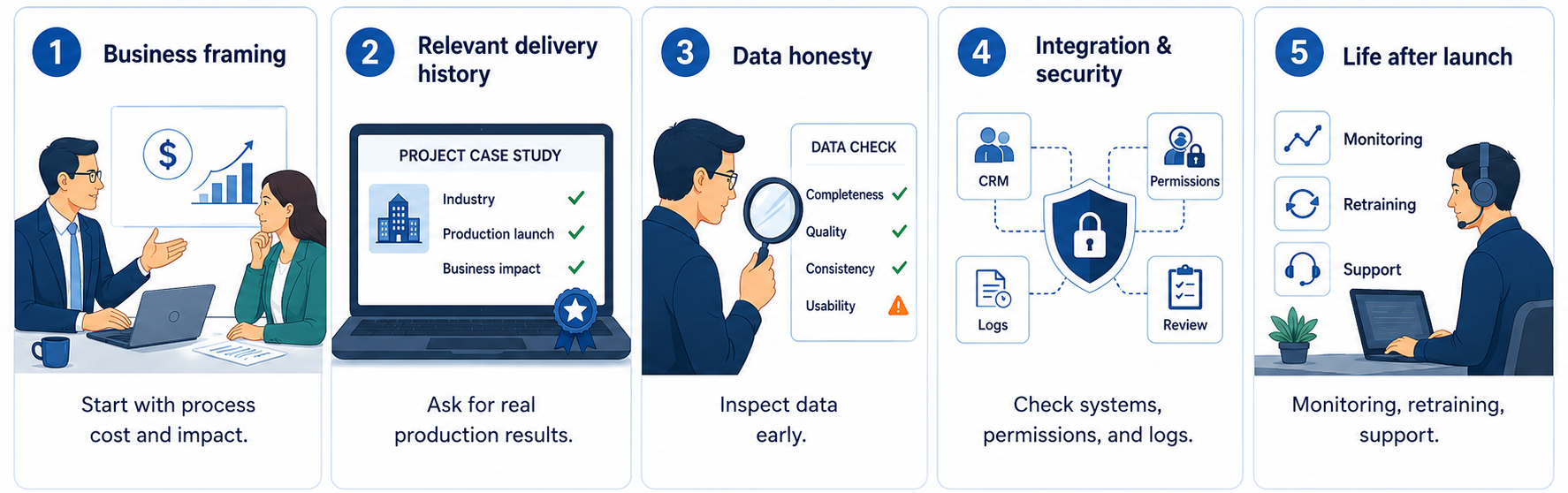
- Business framing: The provider should ask what the process costs you today before recommending a technology.
- Relevant delivery history: Ask for a project in your industry that reached production, not a demo.
- Data honesty: A provider that inspects your data early is telling you something useful, even when the answer is “not yet.”
- Integration and security: Check how they handle your CRM, permissions, access logs, and review requirements.
- Life after launch: Monitoring, retraining, and support should appear in the proposal, with named owners.
NOTE: A provider that leads with a model name rather than your workflow is selling a tool.
How Much Do AI Services Cost?
No universal price exists, and any number quoted before scoping is a guess. Scope is the first driver. Count the workflows in the project and the systems that need integrating. Data condition comes second. Messy source files add weeks of cleanup before any model runs. Model usage, security review, and support expectations set the rest.
Three rough bands help with budgeting. A short consulting engagement produces an assessment and a roadmap, while a single automation covers one workflow with one or two integrations. An enterprise AI application spans multiple teams and systems, and each layer incurs ongoing costs after launch.
Takeaway: Ask providers to price discovery separately. It keeps the first bill small while the scope becomes clear.
How to Start an AI Services Project?
AI services projects fail at a documented rate, and starting well is mostly about avoiding the known causes. A preliminary 2025 report from MIT’s Project NANDA found that about 95% of enterprise generative AI pilots produced no measurable profit and loss impact.
S&P Global Market Intelligence put the abandonment rate alongside it. 42% of companies abandoned most of their AI initiatives before the projects reached production, up from 17% a year earlier. Both reports point to workflow and integration, rather than model quality.
Six steps address the workflow and integration causes.
- The Workflow and Its Baseline: Count the hours, the volume, or the error rate you want to change.
- Check That AI Is the Right Fix: A broken approval process stays broken after automation.
- Look at the Data: Find out where it lives and what condition it is in.
- Choose the Service Type: Use the table above to pick consulting, development, automation, or data work.
- Build and Test on Real Cases: Run the system against last quarter’s real documents, including the awkward ones.
- Integrate, Then Measure the Baseline Again: Compare the same number you counted in step one.
Takeaway: Always start with one workflow. Enterprise AI development services can wait until the first project has a result worth repeating.
What to Do Next?
The right AI service depends on the problem rather than the technology in the headlines.
Companies that don’t know where to start need AI consulting, and companies that already know what they want need AI development services. Repetitive information work points to AI automation services, while large document collections point to generative AI services, and predictions point to AI/ML development.
Everything above assumes you can name the workflow you want to change, and most teams can once they look at where the hours go. We’re happy to walk through your process on a free 30-minute call and name the service type that fits, including the cases where no AI service is the right answer.
Book a Free 30-Minute Meeting
Discover how our services can support your goals — no strings attached. Schedule your free 30-minute consultation today and let's explore the possibilities.
Book a Free Call