

10 Leading Intelligent Document Processing Companies

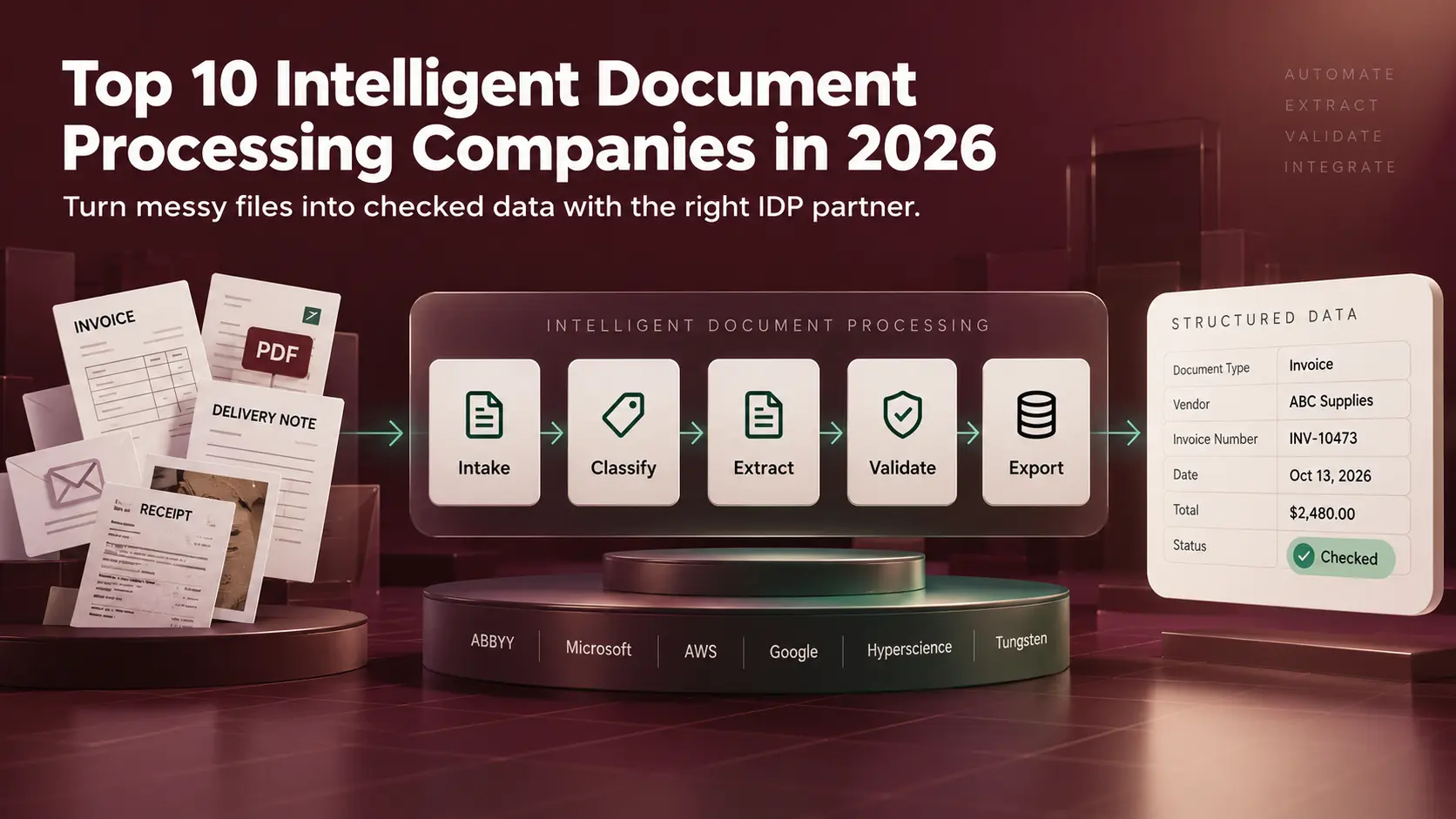
Cover reading Top 10 Intelligent Document Processing Companies in 2026, with files flowing from intake to export.
Written byPrincipal Data/AI Architect
Technically reviewed byMoiz ud DeenData & AI Integration Engineer
Published
Updated
Reading time
10 min

Summarize with AI

Introduction

The IRS planned to process every paper-filed Form 940, 941, and 1040 digitally by the 2025 filing season. As of May 2025, contractors had scanned 5 percent of 9.8 million paper returns. Contractor-selection delays slowed scanning, as did workers unable to wait weeks for background clearances.

The scanning tools existed, so the gap was people to build and run the work. Intelligent document processing companies are hired for this job. This guide explains how the top 10 firms were picked, what IDP is, and what IDP costs.

How These Intelligent Document Processing Companies Were Evaluated

Shortlisting started with US firms building or running IDP pipelines, not only selling software. Each firm then had to pass five checks. Firms passing every check made the list below.

  • Based in the US, with a team building or running IDP pipelines
  • Delivers on a named IDP platform, such as UiPath, ABBYY, Hyland OnBase, or Amazon Textract
  • Has at least one published case study with a measurable document-processing result
  • Holds partner status or a proven track record on the platform
  • Has a clear best-fit buyer by industry, document type, or tech stack

No company paid to be listed. Data Prism publishes this list and ranks itself first for growing firms needing custom extraction. Places two to ten are ordered by documented results and fit. Every result comes from the firm’s own case studies.

What Is Intelligent Document Processing (IDP)?

Intelligent document processing (IDP) is AI software built to turn forms, invoices, contracts, and emails into clean, structured records. The difference between OCR and intelligent document processing is scope. Optical character recognition (OCR) only turns images into text. IDP adds classification, field extraction, validation, and human review.

Day to day, IDP collects files and sorts them by type. Machine learning or language models read the files. Business rules check the results. Low-confidence fields go to a person, and reviewer corrections feed retraining. Approved records then reach the ERP or CRM through AI integration work.

The payoff shows up where documents wait for keying. Ardent Partners' 2025 benchmarks put the average invoice at 9.2 days and about $9.55 to process. Claims and patient intake forms in healthcare wait the same way.

IDP Platforms vs Intelligent Document Processing Companies

An IDP platform is software a business licenses, while an intelligent document processing company is a services firm hired to build and run the pipeline. Most buyers need a platform plus intelligent document processing services on top. The table maps the main platforms to the firms below.

Platform Type

Examples

Firms Below Using Them

Cloud API

Amazon Textract, Azure AI Document Intelligence, Google Document AI

Caylent, Data Prism

Packaged IDP Platform

ABBYY Vantage, Tungsten TotalAgility, ILINX

Naviant, KeyMark, Zia Consulting, ImageSource

RPA-Suite Add-On

UiPath Document Understanding

Auxis, Ashling Partners

Content Platform With Capture

Hyland OnBase

Naviant, KeyMark, DataBank IMX

Any platform still needs an API to land extracted data, but some older systems have none. In such cases, RPA bots type approved values into legacy screens the way a clerk would. Several IDP companies on this list pair extraction with RPA for this reason.

The best intelligent document processing platforms for one company can be a poor match for another. A platform alone suits clean, single-type documents and an in-house team. Mixed layouts and multi-system approvals usually call for an IDP company and broader process automation.

Top 10 Intelligent Document Processing Companies in the USA

The leading intelligent document processing companies below each suit a specific buyer. Most published rankings skip which platform each firm uses. So, every entry names the platform and a documented result. The table below shows each firm's best-fit buyer and main platform.

Firm

Best For

Main Platform

1. Data Prism

Growing firms needing custom extraction

OpenAI, Textract, Document AI

2. Auxis

UiPath finance teams wanting nearshore support

UiPath

3. Ashling Partners

AP teams wanting one firm to build and run UiPath

UiPath

4. Naviant

Healthcare payers moving off legacy OCR

ABBYY Vantage, Hyland OnBase

5. Caylent

AWS-based teams adding LLM extraction

Amazon Textract, Bedrock

6. KeyMark

OnBase shops wanting capture built or outsourced

Hyland OnBase, Tungsten

7. DataBank IMX

Health systems using OnBase

Hyland OnBase

8. XBP Global

Enterprises outsourcing mailroom work

Proprietary platform

9. ImageSource

Agencies on Microsoft 365

ILINX

10. Zia Consulting

Teams replacing aging capture software

Tungsten Automation

1. Data Prism

Data Prism is an AI services firm with offices in Atlanta, Georgia, and Dubai. The firm builds IDP pipelines on Tesseract, Gemini Vision, OpenAI, Amazon Textract, and Google Document AI. Uncertain fields go to human review before reaching an ERP or CRM.

Data Prism homepage with an AI Automation & Data Engineering for Growing Businesses headline and proven impact figures.

For FirstList, OpenAI turns free-form Facebook posts into standardized listings. The published case studies report 70% less manual processing. Still, Data Prism has no large-scale invoice or claims project yet.

Document extraction sits inside a wider set of Data Prism service lines, from AI planning through data infrastructure. The table below pairs each service area with the work behind it.

Service Area

What Data Prism Builds

Data Collection and Extraction

Document extraction, web scraping, and multi-source data feeds

AI Agents and Generative AI

Custom AI agents, AI apps, and LLM-powered workflows

AI Integration

AI connected to CRMs, ERPs, warehouses, and business tools

Automation

Business process automation, RPA, and no/low-code workflows

AI Strategy and Consulting

Readiness assessments, use-case scoring, and phased AI roadmaps

Data Engineering

Pipelines, warehouses, data lakes, migrations, and Snowflake consulting

Analytics and Visualization

Dashboards and reporting built on warehouse data

API Integration and Custom Software

CRM, marketing, and social media APIs, real-time syncing, and custom apps

Named client projects span real estate (Scout), recruiting (GrabJobs), cruise travel (Playbook Travel), restaurant delivery data (Loop AI), and furniture manufacturing (Kaemark). Data Prism suits startups, SMBs, and mid-market companies, especially SaaS and marketplace businesses handling data from many sources.

The firm holds a 5.0 rating across nine Clutch reviews. Data Prism suits growing firms needing custom extraction.

2. Auxis

Auxis is a Fort Lauderdale, Florida, firm owned by Grant Thornton Advisors. Auxis builds IDP on UiPath Document Understanding through nearshore teams in Latin America. One retailer reached 95% touchless invoices from the 20 largest vendors within six weeks.

Auxis homepage with a Modernizing Business Operations Since 1997 headline over a night city skyline.

Auxis suits UiPath finance teams wanting nearshore support.

3. Ashling Partners

Chicago-based Ashling Partners builds and runs UiPath systems. UiPath named Ashling its 2026 Agentic Transformation Partner of the Year. A 2026 case study reports invoice processing cut from about 30 minutes to under five.

Ashling Partners homepage with an Intelligence Unleashed, Amplified by AI headline beside winding road photos.

Ashling Partners suits AP teams wanting one firm to build and run UiPath.

4. Naviant

Naviant, based in Verona, Wisconsin, implements ABBYY Vantage and Hyland OnBase. ABBYY named Naviant its 2026 Partner of the Year. Naviant cites $1.6M in yearly savings for one of the largest US healthcare payers after replacing legacy OCR.

Naviant homepage with an Intelligent Automation That Meets You Where You Are headline on a dark purple background.

Naviant suits healthcare payers moving off legacy OCR.

5. Caylent

Caylent is an AWS Premier Tier partner in Irvine, California. The firm builds document extraction on Amazon Textract and Bedrock. An undated Venminder case study lists a 65-day backlog cleared in four days as an expected outcome.

Caylent homepage with a Caylent Accelerate for Agentic Cloud Operations headline over boats on dark water.

Caylent suits AWS-based teams adding LLM extraction.

6. KeyMark

KeyMark, in Liberty, South Carolina, sets up invoice and mailroom capture on Hyland OnBase, Tungsten Automation, and UiPath. KeyMark also runs capture as a managed service. In a KeyMark case study, two American Tire Distributors staff manage over 50,000 documents.

KeyMark homepage with a headline saying an AI initiative is only as good as the data feeding it, on a purple background.

KeyMark suits OnBase shops wanting capture built or outsourced.

7. DataBank IMX

Kyocera Document Solutions owns DataBank IMX, a Philadelphia-area firm. DataBank implements Hyland OnBase. Its PageIQ pairs AI extraction with human validation. A case study shows a large health system cutting per-document indexing cost from $1.50 to $0.68.

DataBank homepage with a We Ensure Your Work Actually Works headline beside a document funnel illustration.

DataBank IMX suits health systems using OnBase.

8. XBP Global

XBP Global, based in Irving, Texas, runs outsourced mailroom, invoice, and claims processing on a proprietary agentic AI platform. XBP cites up to 16,000 documents a day for Die Autobahn. XBP's second-quarter 2026 revenue fell 14% year over year on a pro forma basis. A strategic review is under way.

XBP Global Asia homepage with an AI enabled operations headline over a night cityscape and a Get in Touch button.

XBP Global suits enterprises outsourcing high-volume mailroom work.

9. ImageSource

ImageSource has operated from Olympia, Washington, for over 30 years. The main product is ILINX, an IDP platform able to run inside Microsoft 365. In an undated ImageSource case study, Alaska's Division of Public Assistance cut SNAP application completion time by 75%.

ImageSource homepage with an Operational AI from intake to decision headline over two colleagues at a laptop.

ImageSource suits agencies on Microsoft 365.

10. Zia Consulting

Boulder-based Zia Consulting is a Platinum partner of Tungsten Automation. The firm moves clients off legacy Kofax and Ephesoft tools. In a 2024 Zia project, a records retrieval company cut turnaround from 24 hours to 30 minutes.

Zia Consulting homepage with a Cloud and Managed Services headline on green and service cards under Problems We Solve.

Zia Consulting suits teams replacing aging capture software.

What IDP Costs

Intelligent document processing solutions come in four delivery routes, each priced differently. Cloud APIs bill per page. Packaged platforms bill per year, while services firms bill per project or per document. The table compares the routes.

Option

Pricing Model

Public Price Point

Cloud API (Textract, Azure, Document AI)

Per page

$0.0015 to $0.07 per page on Textract

Packaged Platform (Rossum, ABBYY)

Annual license

Rossum Starter from $18,000 a year

Implementation Partner

Project fee

Quoted per project

Outsourced Processing

Per document

Quoted per document

Routes often combine, since most partners build on a cloud API. Per-page cloud APIs also offer the most startup-friendly pricing, because the bill grows with document volume. Amazon's Textract pricing shows how far per-page rates move by feature, from plain text to forms and tables.

Build work is the hardest line to price, since scope depends on target systems and review screens. A rough cost estimator sizes the build side before vendor calls.

How Accurate Is IDP on Real Documents?

IDP accuracy depends on which fields get measured. Header fields such as invoice number and total usually score high. Line items, handwriting, and poor scans score lower, so a headline 99% often hides which 1% is wrong. Testing on your own ugliest documents gives the only figure worth trusting.

Arithmetic checks catch silent errors, such as subtotal plus tax failing to equal the total. Matching invoices to purchase orders also needs clean vendor records. A quality assessment shows gaps before the pilot.

Where Your Documents Live: Security and Compliance

IDP vendors handle invoices, claims, IDs, and medical records, so storage matters as much as accuracy. Ask where each copy is stored and for how long. Then ask how deletion is proven and whether audit logs record reviewer corrections. Finally, confirm which steps fall inside HIPAA or SOC 2 scope.

What to Track After IDP Goes Live

Most IDP savings get won or lost after go-live. Accuracy drifts when suppliers change layouts. Review queues also grow when nobody owns them. Track touchless rate, exception rate, review time, and cost per document.

Workday's January 2026 research found nearly 40% of AI time savings lost to rework. Name a review-queue owner before launch, because case-study projects went live in six weeks to three months.

How to Choose an IDP Services Company

The right IDP services company depends on your documents, volume, and current platform. A UiPath shop gains little from a Hyland specialist. The only fair test is a proof of concept on your real documents. Teams unsure whether their data is ready can take a short readiness scorecard before shortlisting.

Setting pass marks for the proof of concept is part of any AI strategy work. Reject accuracy promises made before seeing samples. Reject designs with no exception path too. Low volumes and a single fixed template rarely justify an IDP project, since template OCR rules already cover them.

Final Verdict on Intelligent Document Processing Companies

The best intelligent document processing company is the one already fluent in your platform. UiPath AP teams should start with Auxis or Ashling Partners, and ABBYY or Hyland shops fit Naviant, KeyMark, or DataBank IMX. Caylent suits AWS builds, XBP Global outsourced mailrooms, ImageSource government forms, and Zia legacy migrations. Data Prism fits growing firms needing a custom pipeline.

Some workflows span email, shared drives, and an accounting tool. Building extraction around these tools is closer to an AI automation project than a platform purchase. When document capture is only one step in a longer process, a related list compares business process automation companies that automate the steps after extraction.

For teams with mixed invoices, statements, or forms but no clear platform owner, Data Prism's data extraction services cover PDF, invoice line-item, and OCR extraction. Any provider, Data Prism included, should start with a pilot on the team's ugliest samples.

Book a Free 30-Minute Meeting

Discover how our services can support your goals — no strings attached. Schedule your free 30-minute consultation today and let's explore the possibilities.

Book a Free Call

Frequently Asked Questions

An intelligent document processing company builds or runs systems to read business documents and extract their data, from document intake through review to ERP delivery.

The firms on this list mostly build on Amazon Textract, Azure AI Document Intelligence, and Google Document AI as cloud APIs. ABBYY Vantage, Tungsten TotalAgility, UiPath Document Understanding, and Hyland OnBase lead among packaged platforms. No rating holds across every document type, so test a shortlist on real samples.

Pick a partner already certified on the platform your team runs, then ask for a proof of concept on real documents. Check where low-confidence fields go, who owns the review queue after launch, and where document copies are stored.

No tool wins for every team, so the best IDP software is whichever scores highest on your samples. Cloud APIs from AWS, Microsoft, and Google suit developers with clean documents.

Yes. Most builds send extracted fields to an ERP or accounting tool through APIs, connectors, or RPA bots. Custom links fall under API integration work.

Healthcare teams use IDP for claims, referrals, and intake forms. Low-confidence fields go to a reviewer, since a wrong value can reach a patient record.

Yes. People still review low-confidence fields and handle the exceptions IDP can't process. A named owner for the review queue keeps extraction accuracy from drifting.

Book Consultation