Introduction
What is Data Migration Testing?
Data migration testing is the process of checking that the data moved from a source system to a target system is complete, accurate, and usable. It works by comparison, where every check asks whether the target stores what the source stored. These checks are designed not to conflict with the agreed transformation rules.
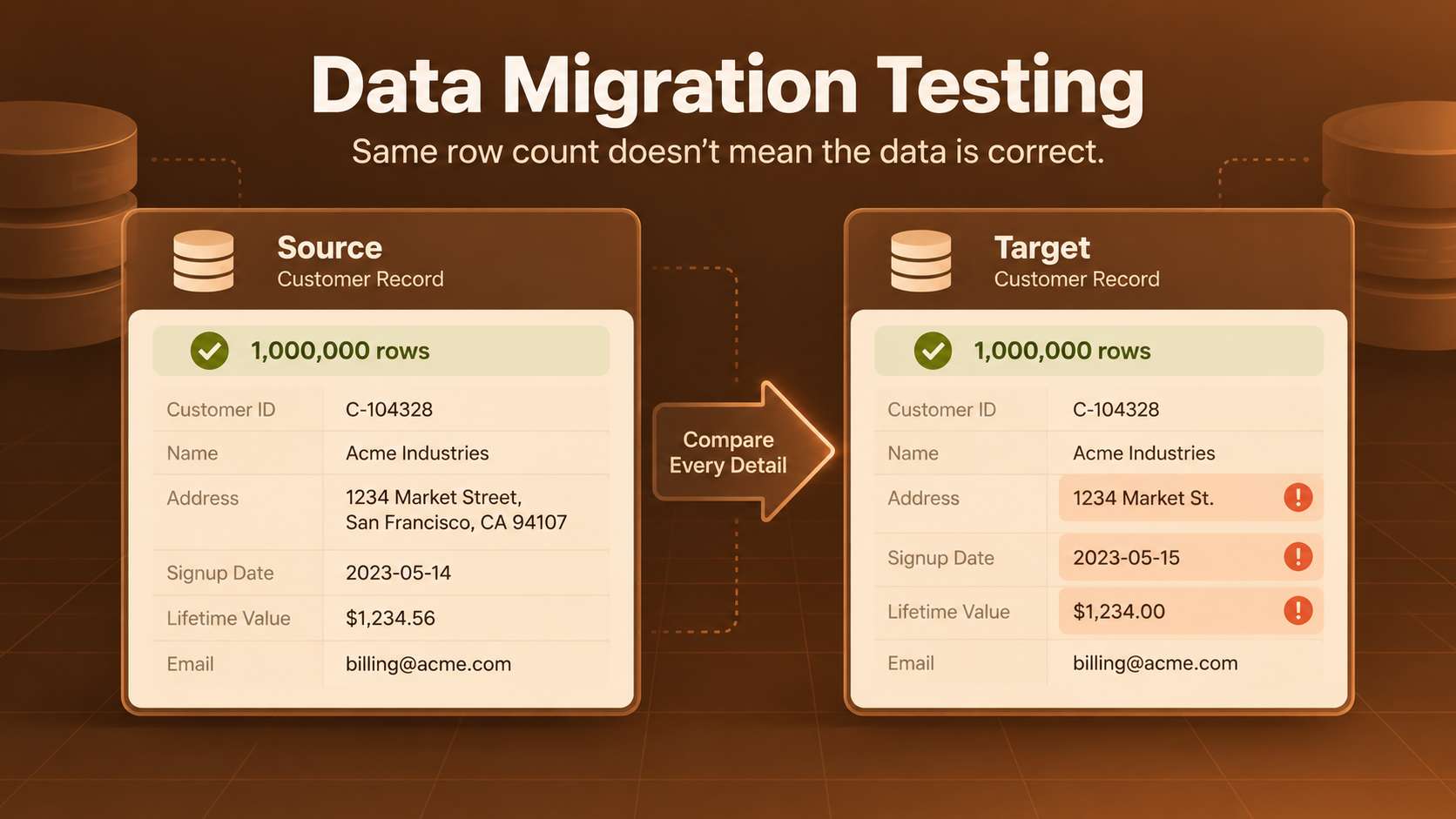
A small example can help you understand it better. A CRM database stores 1,000,000 customer rows. After the migration, the target should store 1,000,000 customer rows with the same IDs. Every email address should survive the move unchanged.
However, counts alone don’t settle it. The target can store the right number of rows and still truncate an address field. A date can shift by a day after a time zone conversion. A currency value can round in the wrong direction.
So the checks run wider than volume. They cover completeness, accuracy, integrity, transformation logic, data quality, application behavior, performance, and access control.
Testing also starts earlier than most plans assume. The mapping document is the first testable artifact, because one wrong rule there produces wrong data in every run that follows.
Why Does Data Migration Testing Matter?
Types of Data Migration Testing
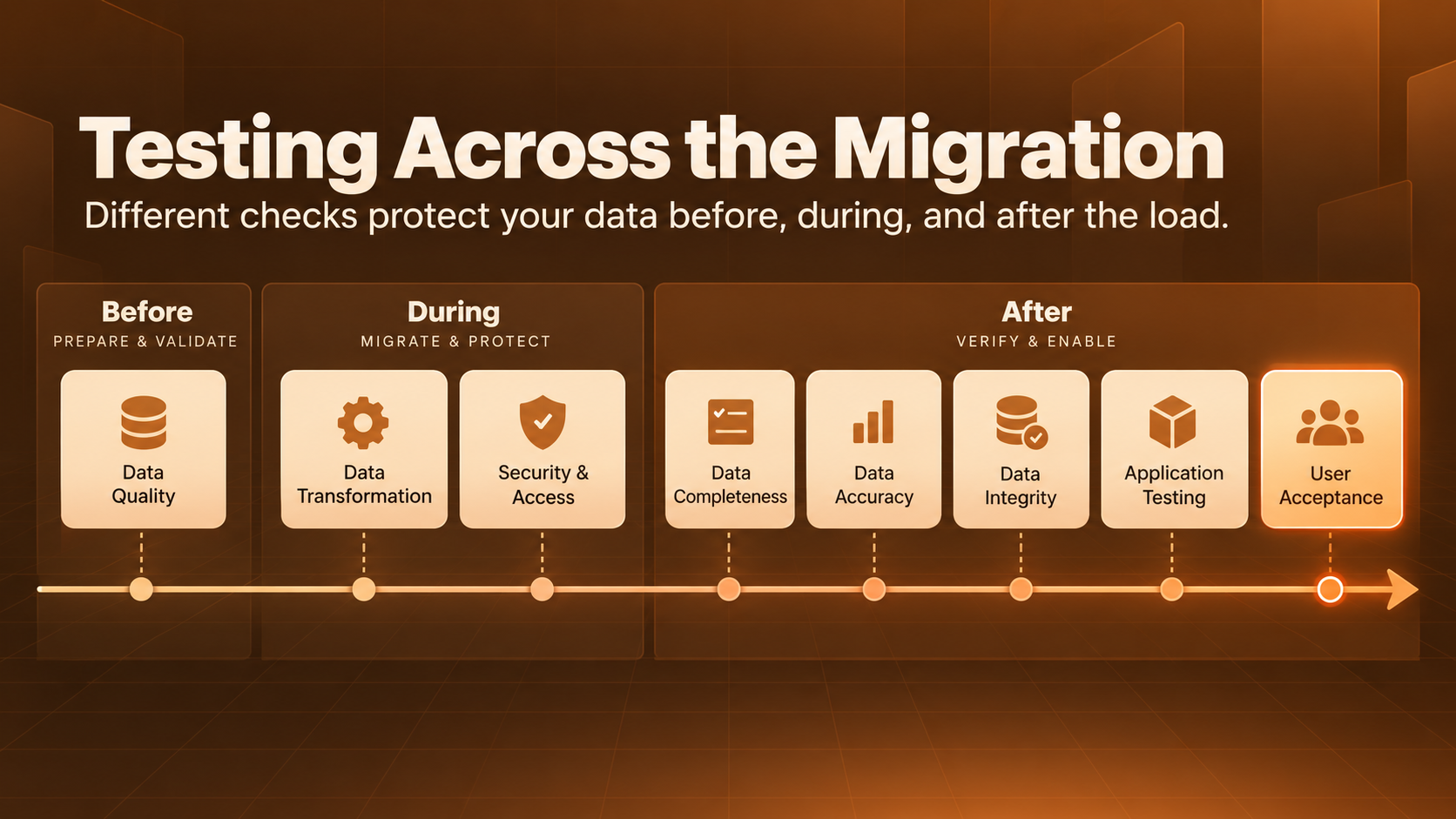
Data migration testing splits into checks that answer different questions about the same load.
- Data Completeness: Checks that every required record and field has arrived. Start with row counts for each table, then check for missing values in required fields.
- Data Accuracy: Matches field values between the source and target. Check all critical fields and use samples for the rest.
- Data Integrity: Checks primary keys, foreign keys, and other rules in the target system. Common dbt data tests can help check these rules.
- Data Transformation: Checks that each mapping rule gives the correct result. Test things like combined names, converted currencies, and changed status codes.
- Data Quality: Looks for duplicates, wrong formats, and values outside the allowed range. This check can also be done before migration to find bad source data.
- Application Testing: Checks that applications and business processes work correctly with the new data. Reports and integrations should also return the expected results.
- Security and Access: Checks user roles, permissions, encryption, and data masking. Sensitive data should have the right protection after migration.
- User Acceptance: Lets business users check their own data. They can find problems that automated tests may miss.
NOTE: Reconciliation and performance testing both get their own sections below, because each one does more work than its label suggests.
The Data Migration Testing Process
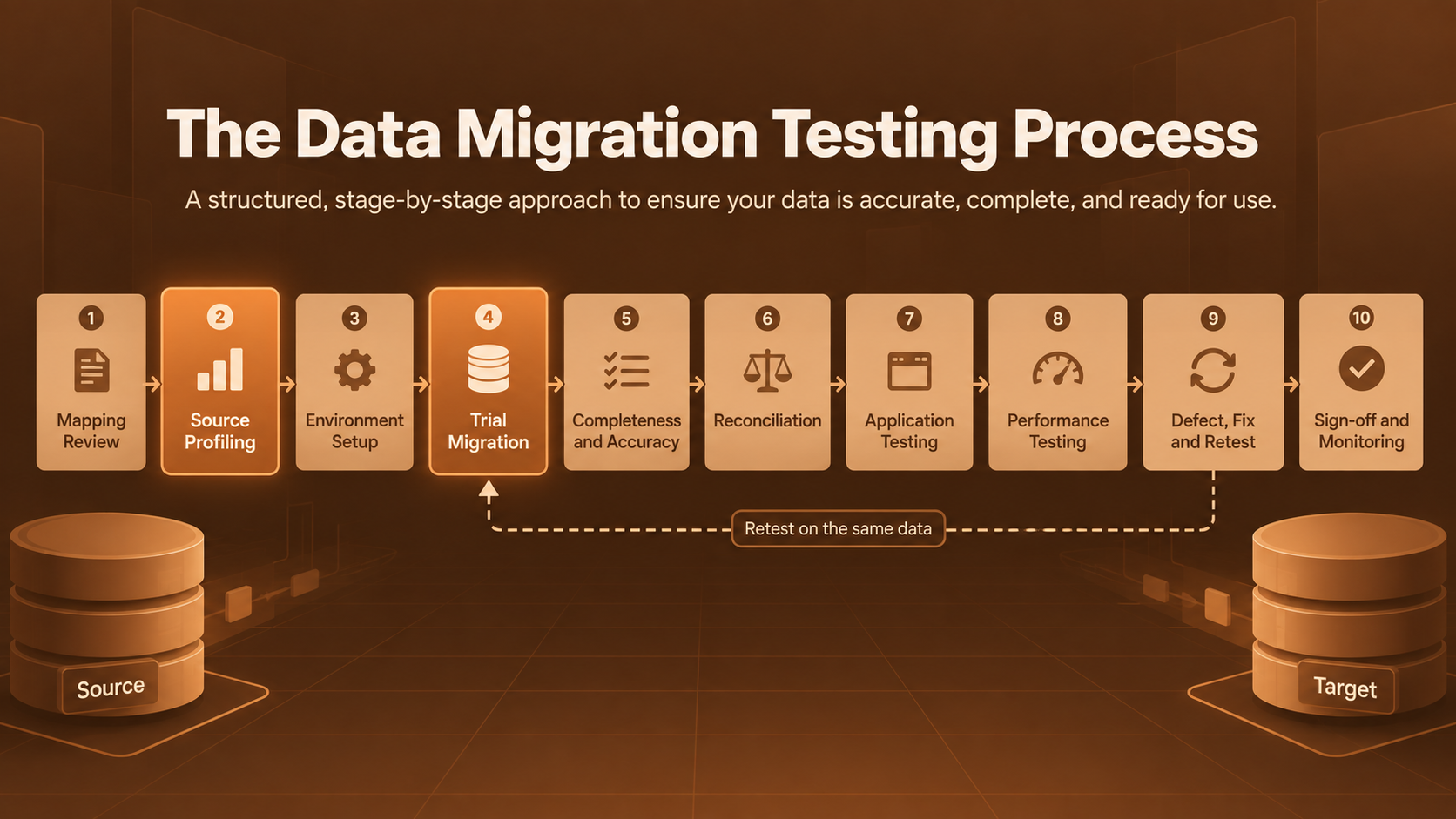
It runs in stages, and each stage has an owner, a piece of evidence, and a pass rule agreed in advance.
|
Stage |
What Gets Tested |
Evidence |
Pass Criteria |
|
Mapping Review |
Source-to-target rules |
Signed mapping document |
Every field has a rule and an owner |
|
Source Profiling |
Nulls, duplicates, formats, ranges |
Profiling report, baseline counts |
Known defects logged before the load |
|
Environment Setup |
Target schema, access, volumes |
Environment checklist |
Target matches the agreed design |
|
Trial Migration |
Load behavior and rejections |
Job logs, error counts |
Errors triaged, none unexplained |
|
Completeness and Accuracy |
Counts and field values |
Validation query output |
Zero unexplained differences |
|
Reconciliation |
Counts, sums, hashes |
Reconciliation report |
Differences inside agreed tolerance |
|
Application Testing |
Reports, screens, integrations |
Test script results |
Processes complete end to end |
|
Performance Testing |
Runtime and resource use |
Timing and resource metrics |
Migration fits the cutover window |
|
Defect, Fix and Retest |
Failed cases only |
Updated test evidence |
Retest passes on the same data |
|
Sign-off and Monitoring |
Production behavior |
Signed acceptance, alerts live |
Exit criteria met |
Two stages carry most of the risk. Profiling is the first, because it sets the baseline every later comparison depends on. The trial migration is the second, since it turns mapping assumptions into rows somebody can query.
Evidence matters as much as the result. A saved result set with its query text and timestamp beats a screenshot of a passing check.
Pass criteria belong in the plan before the run, not in a discussion after it. Some of the checking behind them is already automated for you. AWS Database Migration Service compares each source row with its matching target row, then reports the mismatches it finds.
Data Migration Reconciliation Testing
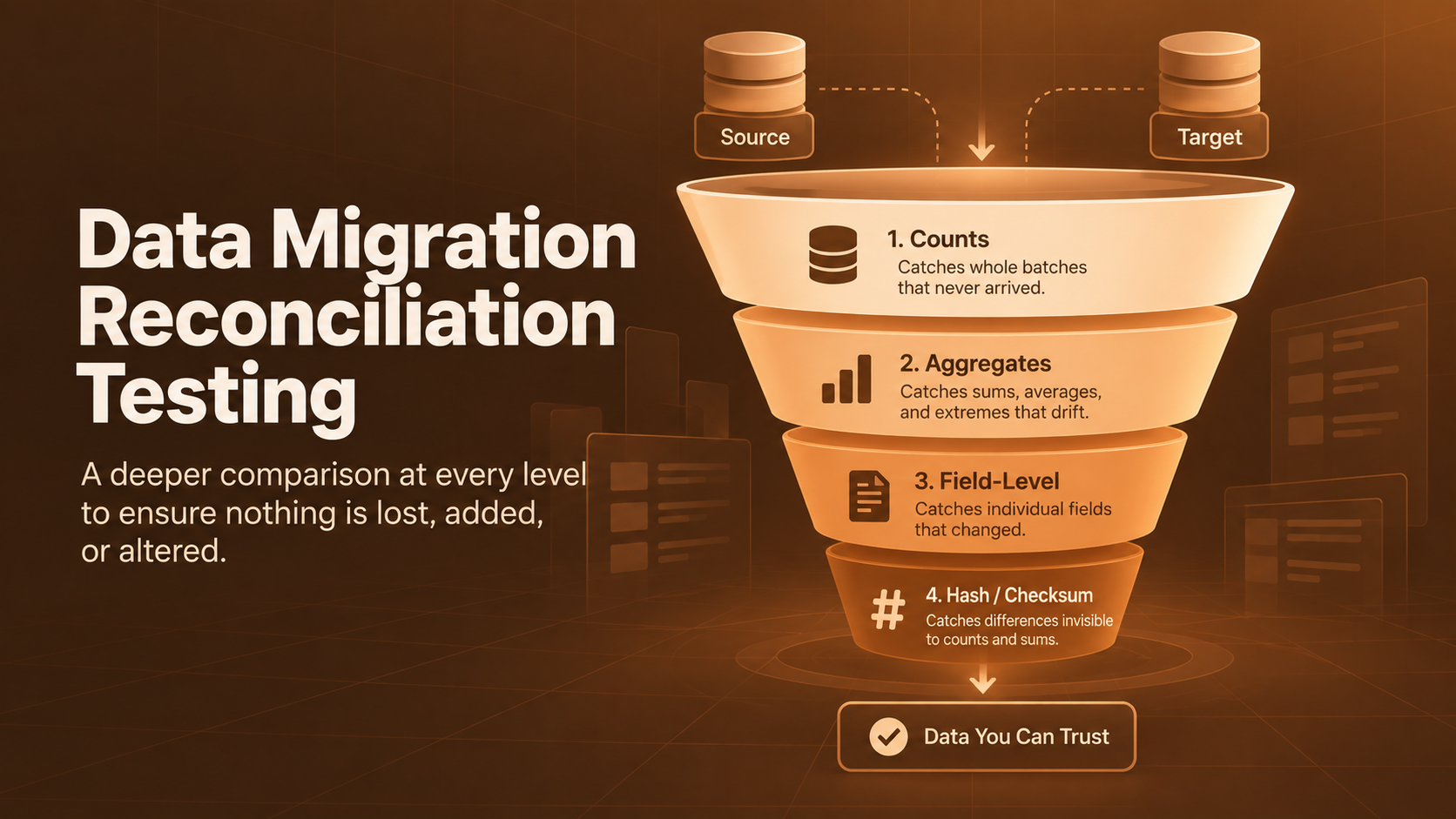
Data migration reconciliation testing compares source and target datasets to prove that nothing was lost, added, or altered on the way across. Reconciliation runs at four levels.
It begins by recording counts per table to catch whole batches that never arrived. Then, aggregates compare sums, averages, and extremes on numeric columns. Next, field-level comparison covers the columns the business depends on. Finally, hash or checksum comparison catches the differences that counts and sums both miss.
This investigation has a short list of usual causes. For example, a filter in the extract query may have excluded rows or a constraint in the target may have rejected them. Similarly, a transformation rule may have failed on a specific pattern, such as a date before 1900, or a name with an unusual character. Also, deduplication logic may have merged records the business wanted kept apart.
Once the systems are intentionally kept apart, the next question is how to determine whether the differences between them are acceptable. That requires explicit tolerance thresholds and a way to identify exceptions when those thresholds are exceeded.
Tolerance thresholds are legitimate, but each one needs a number and an owner. A 0.01% variance on clickstream events may be acceptable to the business. The same variance on general ledger entries is not.
Every run should produce an exception report listing the failing keys, not a pass or fail flag on its own. Engineers can only fix what they can identify.
Tooling helps at scale. For example, the Data Validation Tool from Google Cloud runs count, aggregate, schema, and row-level checks between different platforms. Likewise, Percona Toolkit's pt-table-checksum checksums MySQL tables in chunks and reports the chunks that differ.
What a Data Migration Test Plan Should Contain?
Data Migration Performance Testing
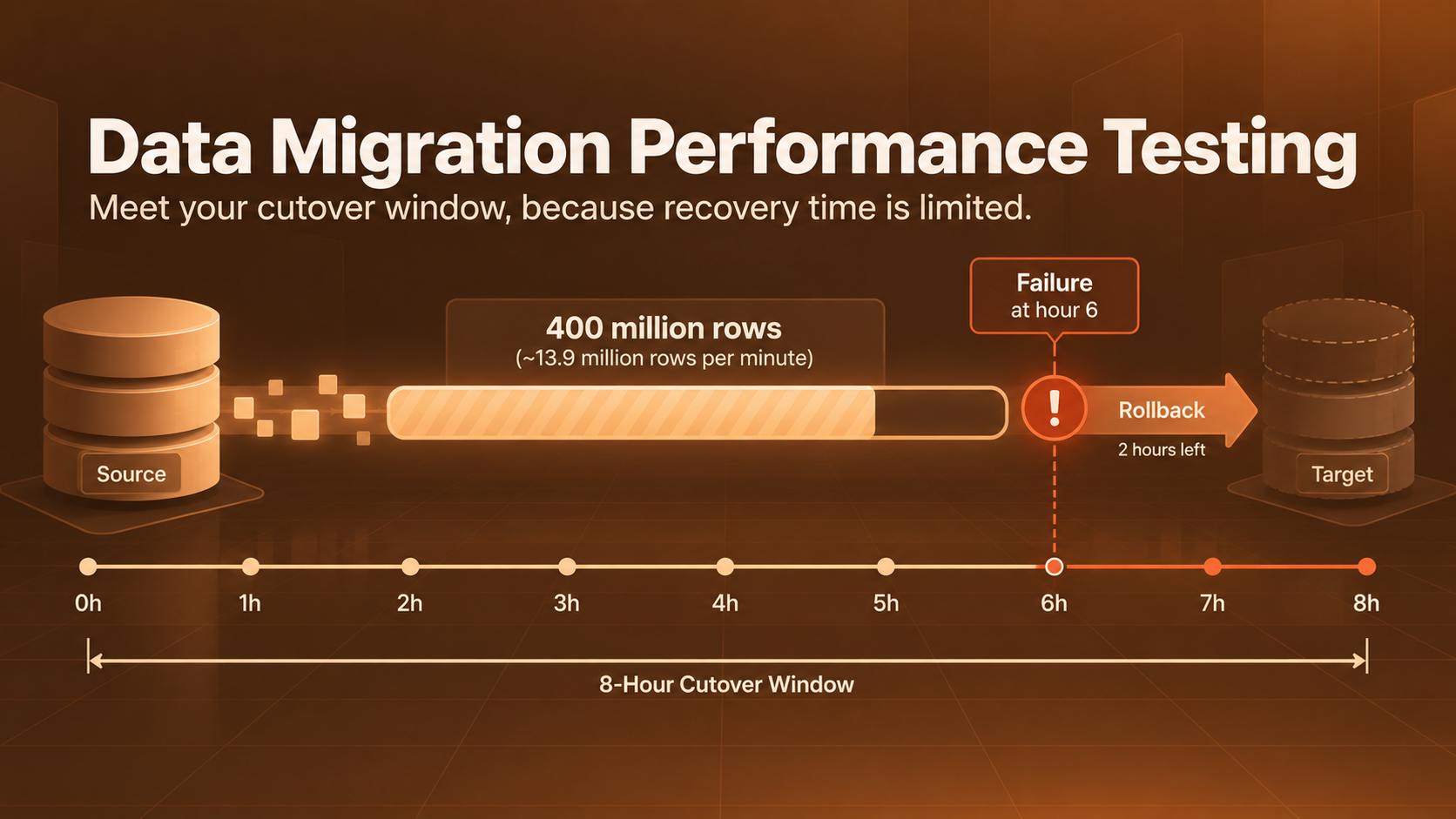
Data migration performance testing measures how long the migration takes and what it costs the systems around it. For instance, we need to define the numbers before the first timed run. The cutover window is the anchor, while throughput targets follow from it. A team with an eight-hour window and 400 million rows to move already knows the rate it has to beat.
Measure a full-volume run rather than a sample. A job that moves 100,000 rows in a minute can behave differently at 100 million. Indexes, logging, and locking all come into play at volume. Batch size is usually the first lever worth tuning, and target-side indexing is the second.
Watch the source system too. Extraction competes with the users still working in it. A migration that slows the live application has failed a test, even when every row lands correctly.
Recovery time needs its own measurement. If the cutover fails at hour six of an eight-hour window, the rollback has to finish inside what is left. Teams that already run repeatable loads through production data pipelines get their recovery numbers for free. The same tooling advantage is covered in our roundup of migration tools. The job has run under real conditions many times.
Data Migration Testing Checklist
Conclusion
Book a Free 30-Minute Meeting
Discover how our services can support your goals — no strings attached. Schedule your free 30-minute consultation today and let's explore the possibilities.
Book a Free Call