

Introduction
Meta released its first coding agent on August 5, 2026. Muse Code arrived in beta with Muse Spark 1.2, the model built to run it. Meta trained the two against each other before shipping either one.
Anthropic and OpenAI have sold coding agents since 2025, so Meta has certainly arrived late. Developers in this market already have habits, and Muse Code has one day of public use behind it. So, what is Meta actually offering?
A capable second-tier model, a narrower product than either rival, and a price nobody else is matching. One distinction runs underneath all of it. Muse Spark is an AI model, in the same category as Claude Opus and GPT. Muse Code is a product built around the model, in the same category as Claude Code and Codex.
For this reason, comparing Muse Spark with Claude Code is a category error, and plenty of launch-week coverage made this exact mistake. This article explains what Muse Spark and Muse Code are, what they cost, and why pricing is the only part that changes the market.
What is Muse Spark?
Muse Spark is Meta’s proprietary frontier model, built by Meta Superintelligence Labs. Meta released the first version on April 8, 2026, under the internal codename Avocado. It broke with the Llama line in one obvious way. Meta does not publish the weights.
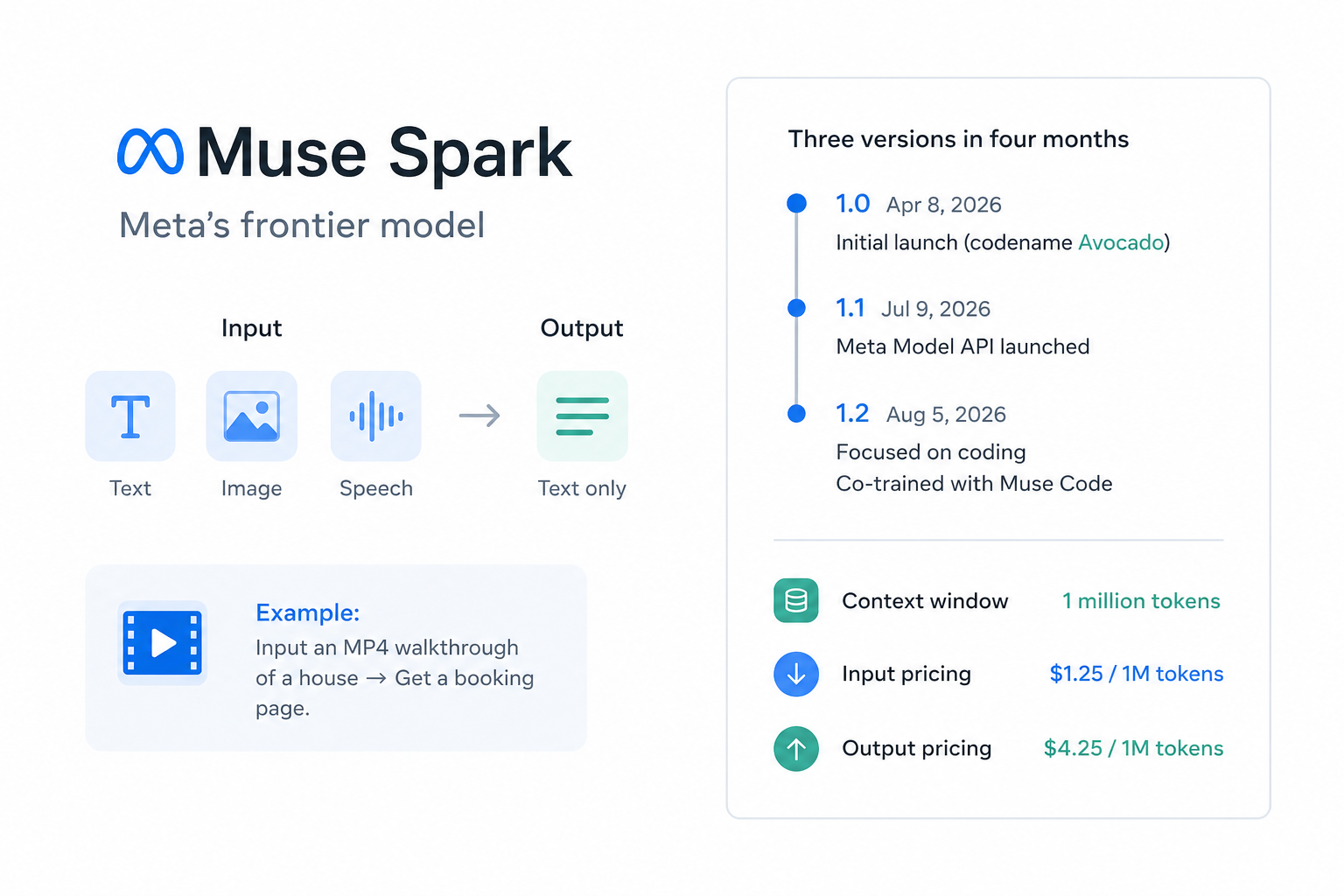
Closed weights aside, the input range is wider than a chatbot’s. Muse Spark accepts text, images, and speech. Output is text only, so multimodal here means perception rather than generation. Meta’s own launch demo fed an MP4 walkthrough of a house into the terminal and got a booking page out of it.
Three versions of the model have arrived in four months. After the initial launch in April, Muse Spark 1.1 landed on July 9, 2026, and brought the paid Meta Model API with it. Muse Spark 1.2 followed on August 5.
The newest version focused almost entirely on coding. Meta co-trained it with Muse Code, so the model was tuned against the exact tool set it would later be sold with. Meta also used Muse Spark 1.1 to generate coding environments and grade candidate solutions, which produced training data for 1.2 without human annotation.
Muse Spark 1.2 kept the specs of 1.1 unchanged. The context window is 1 million tokens, and pricing is $1.25 for each million input tokens and $4.25 for each million output tokens.
What is Muse Code?
Muse Code is Meta’s terminal coding agent for large repositories. Meta CEO Mark Zuckerberg described its job as “planning changes, writing code, validating the results” when announcing the release. It installs on macOS or Linux with a single curl command, and no Windows support is there, as of now.
The install is the whole setup. Muse Code has no graphical interface, no IDE extension, and no cloud runner. The agent lives in the terminal and nowhere else, which is a narrower launch surface than what competitors offer.
The narrow surface hides one genuinely different idea. Most coding agents spawn a helper agent for each subtask and kill it when the subtask ends. Muse Code keeps a set of specialized background agents alive for the whole session. Meta says these agents “remain active throughout each session,” which avoids repeating the same file reads on every delegation.
Parallel agents need a shared record of what each one did. The runtime keeps a local append-only event log of every model call, tool run, approval, and edit. Meta calls the result replay-exact and restart-safe, so a crash mid-task doesn’t throw away the work. On a 12-hour refactor, crash recovery matters more than most benchmark scores do.
Three skills ship by default. The /plan command turns a task into a plan you approve before execution. The /grill command stress-tests the plan until it holds. The /goal command drives toward a stated objective.
Meta published one demonstration to show how far the design stretches. The company ran Muse Spark 1.2 (on GPU kernel optimization for NVIDIA Hopper hardware) over more than 1,000 tool calls and up to 24 hours. NOTE: Treat the result as Meta’s demonstration rather than a promise, because kernel work has a tight feedback loop that most repository work lacks.
Muse Code vs Claude Code vs Codex
All three are coding agents built for software engineering, and the similarity stops there.
|
Feature |
Muse Code |
Claude Code |
OpenAI Codex |
|---|---|---|---|
|
Core Model |
Muse Spark 1.2 |
Opus 5, Sonnet 5, Haiku 4.5, Fable 5 |
GPT-5.6 Sol, Terra, Luna |
|
Availability |
Public beta, macOS and Linux |
Generally available |
|
Pricing |
Tokens only, two tiers |
Subscription from $20/month or API tokens |
Included in ChatGPT plans from $0, or API tokens |
|
Interface |
Terminal only |
Terminal, web, desktop, IDE |
CLI, IDE extension, web, iOS, Slack |
|
Subagents |
Parallel subagents in isolated worktrees |
Agent Teams for parallel work |
Parallel task execution |
|
Tool Support |
Yes |
Yes, with MCP support |
|
Cloud Execution |
No |
Yes |
Yes, Codex cloud sandbox |
|
Code Review |
No |
Yes |
Yes, on GitHub pull requests |
|
Best Suited |
Cost-sensitive terminal work |
Long multi-file changes with model choice |
Teams already inside ChatGPT and GitHub |
Claude Code and Codex each cover four or five surfaces. Muse Code covers one. Codex reviews pull requests on GitHub and runs tasks in the cloud while your laptop is closed, and Muse Code has no answer for either.
Model choice is the other gap. Claude Code lets you route cheap work to Haiku 4.5 and hard work to Opus 5 or Fable 5. Muse Code runs Muse Spark 1.2, and only Muse Spark 1.2.
Muse Code Benchmarks and Performance
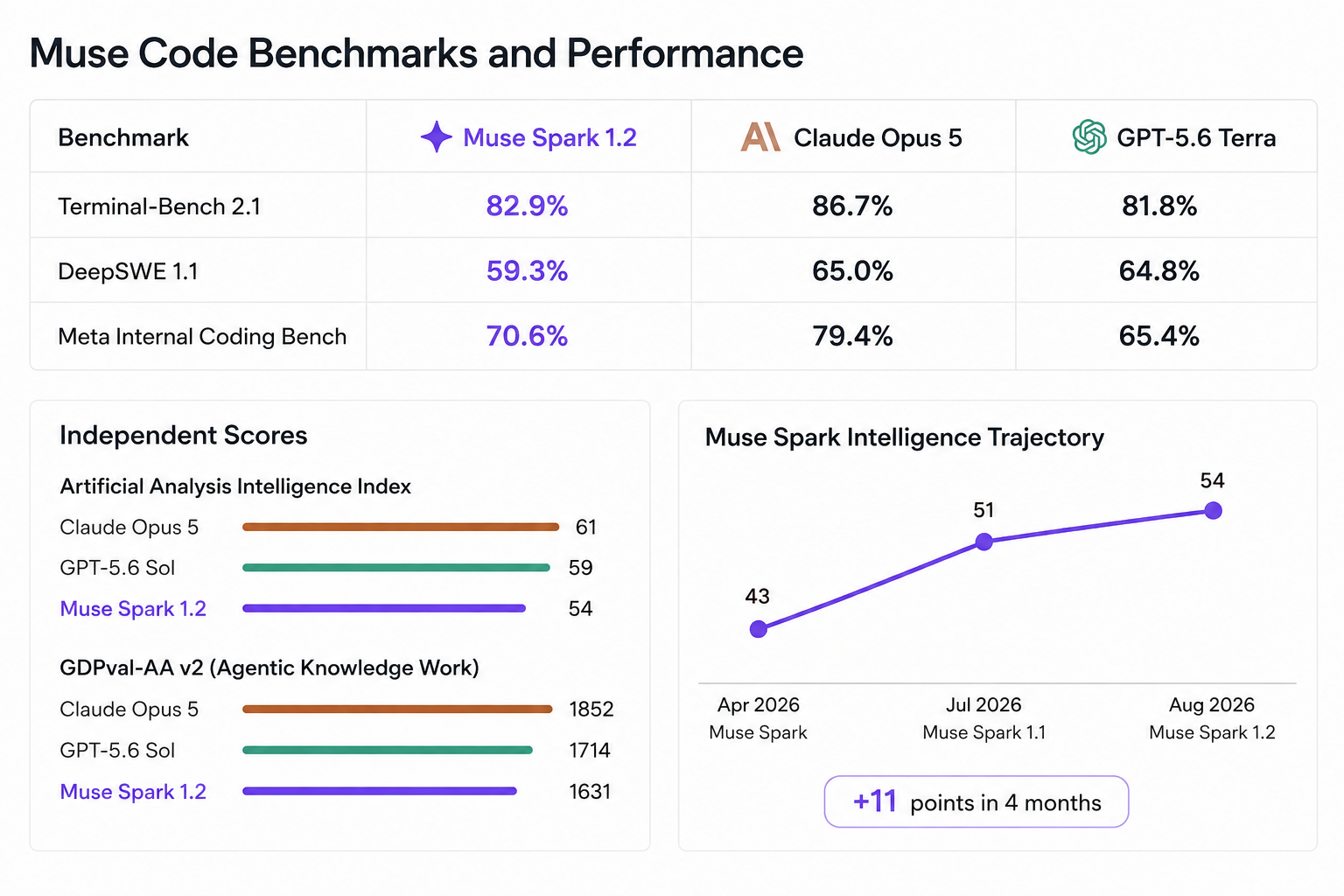
Claude Opus 5 beat Muse Spark 1.2 on every coding benchmark Meta published, including the one Meta built itself.
|
Benchmark |
Muse Spark 1.2 |
Claude Opus 5 |
GPT-5.6 Terra |
|---|---|---|---|
|
Terminal-Bench 2.1 |
82.9% |
86.7% |
81.8% |
|
DeepSWE 1.1 |
59.3% |
65.0% |
64.8% |
|
Meta Internal Coding Bench |
70.6% |
79.4% |
65.4% |
Vendors do not usually publish the chart where they come second. Meta published three of them, as VentureBeat noted in its launch coverage. The decision reads as a bet that the price story would carry the launch. Every number in the table above came from Meta.
Meta’s evaluation report is unusually specific about the method, and it also carries two caveats worth reading. Meta states that its setup may not be “specifically tuned for proprietary third-party models,” so rival scores may understate them. Meta also compared against Claude Opus 5 and GPT-5.6 Terra, skipping Claude Fable 5 and GPT-5.6 Sol, which are the stronger models at both labs.
Independent testing tells the same story. Artificial Analysis scored Muse Spark 1.2 at 54 on its Intelligence Index, against 61 for Claude Opus 5 and 59 for GPT-5.6 Sol. On GDPval-AA v2, which measures agentic knowledge work, Muse Spark 1.2 is placed fifth at 1631 Elo against 1852 for Opus 5.
The trajectory is steeper than the ranking suggests. The original Muse Spark scored 43 in April, Muse Spark 1.1 reached 51 in July, and 1.2 added three more points in under a month. Meta has gained 11 points in four months, which is quite an improvement.
Muse Spark and Muse Code Pricing
Muse Code has no subscription. Billing is per token, on one of two tiers, and the gap between them is the most aggressive thing in the launch.
|
Tier |
Input per 1M |
Cached input per 1M |
Output per 1M |
Rate limit |
Training rights |
|---|---|---|---|---|---|
|
Standard |
$1.25 |
$0.15 |
$4.25 |
3,000 requests/minute per team |
Meta does not train on your prompts |
|
Contributor |
$0.10 |
$0.002 |
$0.20 |
60 requests/minute per team |
Meta may train on prompts and completions |
The contributor tier is 12.5 times cheaper on input and 21 times cheaper on output. It also carries a rate limit 50 times tighter, which signals that Meta built it for individuals rather than production traffic. Both tiers require a payment method before Muse Code will do any work.
Anthropic and OpenAI charge in a different band as can be seen in the table below.
|
Model |
Input per 1M |
Output per 1M |
Subscription |
|---|---|---|---|
|
Muse Spark 1.2 (standard) |
$1.25 |
$4.25 |
None |
|
Muse Spark 1.2 (contributor) |
$0.10 |
$0.20 |
None |
|
Claude Opus 5 |
$5.00 |
$25.00 |
Pro $20, Max $100 or $200 |
|
Claude Sonnet 5 |
$2.00 |
$10.00 |
Same plans |
|
GPT-5.6 Sol |
$5.00 |
$30.00 |
ChatGPT Free to Pro |
|
GPT-5.6 Terra |
$2.00 |
$12.00 |
Same plans |
|
GPT-5.6 Luna |
$0.20 |
$1.20 |
Same plans |
You can clearly see two kinds of pricing in the table, and they are not interchangeable. API rates bill actual tokens with no ceiling, which suits automation and unattended runs. Subscriptions bill a flat monthly fee against session limits, which suits a developer working all day interactively. Hence, a Claude Max seat at $200 a month often costs less than the same work billed through the API.
Muse Code sits outside the choice entirely, because Meta has not shipped a subscription. Every hour of use is metered, and a heavy day has no upper bound.
Most developers never touch API rates at all. They pay $20 or $100 a month and stop thinking about tokens, which Meta's headline price does not answer. A Claude Max seat covers a full month of heavy use for less than a single unbounded day can cost on metered billing.
Is Muse Spark Cheaper Than Claude and GPT Models?
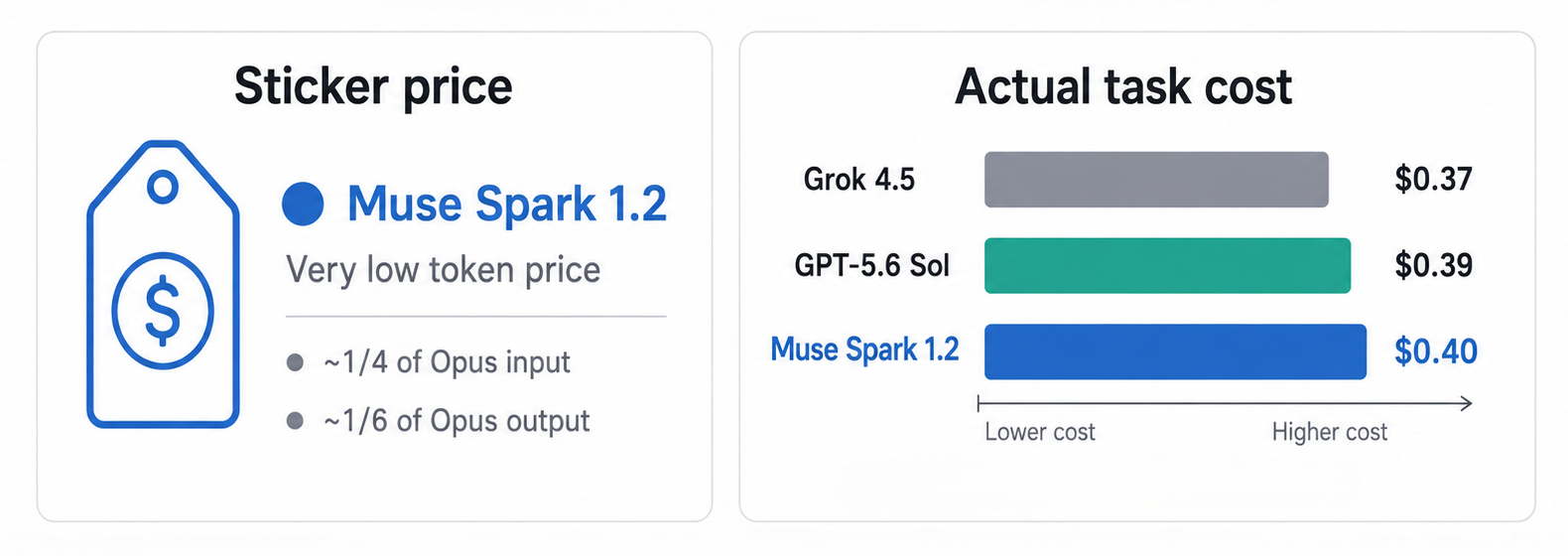
Yes, on the sticker, and less clearly on the invoice. Muse Spark 1.2 costs a quarter of Claude Opus 5 on input and about a sixth on output.
Token price isn’t the same thing as the cost of finishing a task. An agentic coding run makes many model calls, and retries failed patches. Subagents add more calls, and context recompaction adds more again. A cheaper model that needs three attempts can cost more than an expensive one that needs a single pass.
Artificial Analysis measures exactly this, and the result complicates the discount. Muse Spark 1.2 costs $0.40 for each Intelligence Index task, up from $0.29 for Muse Spark 1.1. The rise comes from token usage, since 1.2 spends about 53% more input tokens on the same work.
That $0.40 puts Muse Spark 1.2 mid-pack rather than out in front. In its intelligence cluster, Grok 4.5 at $0.37 and GPT-5.6 Sol at medium effort at $0.39 both come in cheaper. OpenAI also cut Luna and Terra rates on July 30, 2026, so Luna at $0.20 now undercuts Muse Spark’s standard input price outright.
For all these reasons, the standard tier gives no real advantage once you measure cost per completed task. The contributor tier is a different conversation, since $0.10 and $0.20 puts a full agent session under a dollar. Luna comes closest and still costs six times as much on output.
The Contributor Tier Trade
The discount has a price of its own, and it isn’t paid in dollars. A terminal coding agent reads your source and your internal APIs, and whatever your test fixtures contain goes with it. On the contributor tier, all of it may train future Meta models.
For an open-source tree, the trade is close to free money. For a proprietary codebase, it belongs in front of whoever signs off on data handling rather than whoever watches the cloud bill. The discount also applies per token, so the incentive to downgrade grows exactly as your usage does.
One route around the problem is already open. Alexandr Wang, Meta’s chief AI officer, says the company has begun accepting zero data retention requests, which is what a regulated team would need first. Setting that boundary is a governance question as much as an engineering one, and it is where AI integration work usually starts.
Who Should Use Muse Code?
Three groups stand to benefit. First, developers who already live in the terminal and run open-source projects. The contributor tier costs almost nothing, and side projects carry no data risk worth arguing about.
Second, teams whose bill is dominated by output tokens on long agent sessions. Nothing else on the market prices output at $0.20 per million, and the arithmetic is hard to ignore at volume.
Finally, the developers who are experimenting with agent architecture. The event log and the persistent background agents are worth studying even if you never adopt the product, especially for anyone building agent-driven applications of their own.
Everyone else should wait for now. Claude Code and Codex already ship IDE support, cloud execution, pull request review, MCP connectors, and model routing, and Muse Code has none of them. Running the comparison on your own workload is the only way to settle it. The exercise is the kind of question an AI strategy engagement is built to answer.
Is Muse Code a Serious Competitor?
Muse Code competes on price, and only on one tier of it.
The capability case is honest and second place. Claude Opus 5 beat Muse Spark 1.2 by 3.8 points on Terminal-Bench 2.1, 5.7 on DeepSWE 1.1, and 8.8 on Meta’s internal test. Independent scoring agrees. The gap is real, and it isn’t large enough to call the model weak.
The product case is the weak one. Muse Code runs in the terminal on macOS and Linux, with no IDE, no cloud, no MCP, and no subscription. Claude Code and Codex have spent a year absorbing developer complaints.
The economic case is narrower than the headlines suggested. Standard pricing loses its advantage once you measure cost per completed task. GPT-5.6 Luna now undercuts it on input. Only the contributor tier is genuinely unmatched, and it is priced that way because your code is the payment.
Architecture is the open question underneath all of it. Persistent background agents and a replay-exact event log are genuinely different choices. If they hold up over months of real repository work, they will matter more than four benchmark points do. Currently, nobody knows what is the truth behind that claim.
The next thing to watch is whether Meta ships zero data retention generally and an IDE path before the beta ends. Until then, Muse Code is worth an evaluation, not a migration.
Conclusion
Everything above compares three coding agents at today’s prices, and most teams only find out how model-dependent their workflows are when one of those prices moves. We’re happy to walk through your setup on a free 30-minute call and show you where a second agent or a fallback model would save you money.
Book a Free 30-Minute Meeting
Discover how our services can support your goals — no strings attached. Schedule your free 30-minute consultation today and let's explore the possibilities.
Book a Free Call