

Introduction
Signs you can handle data integration in-house
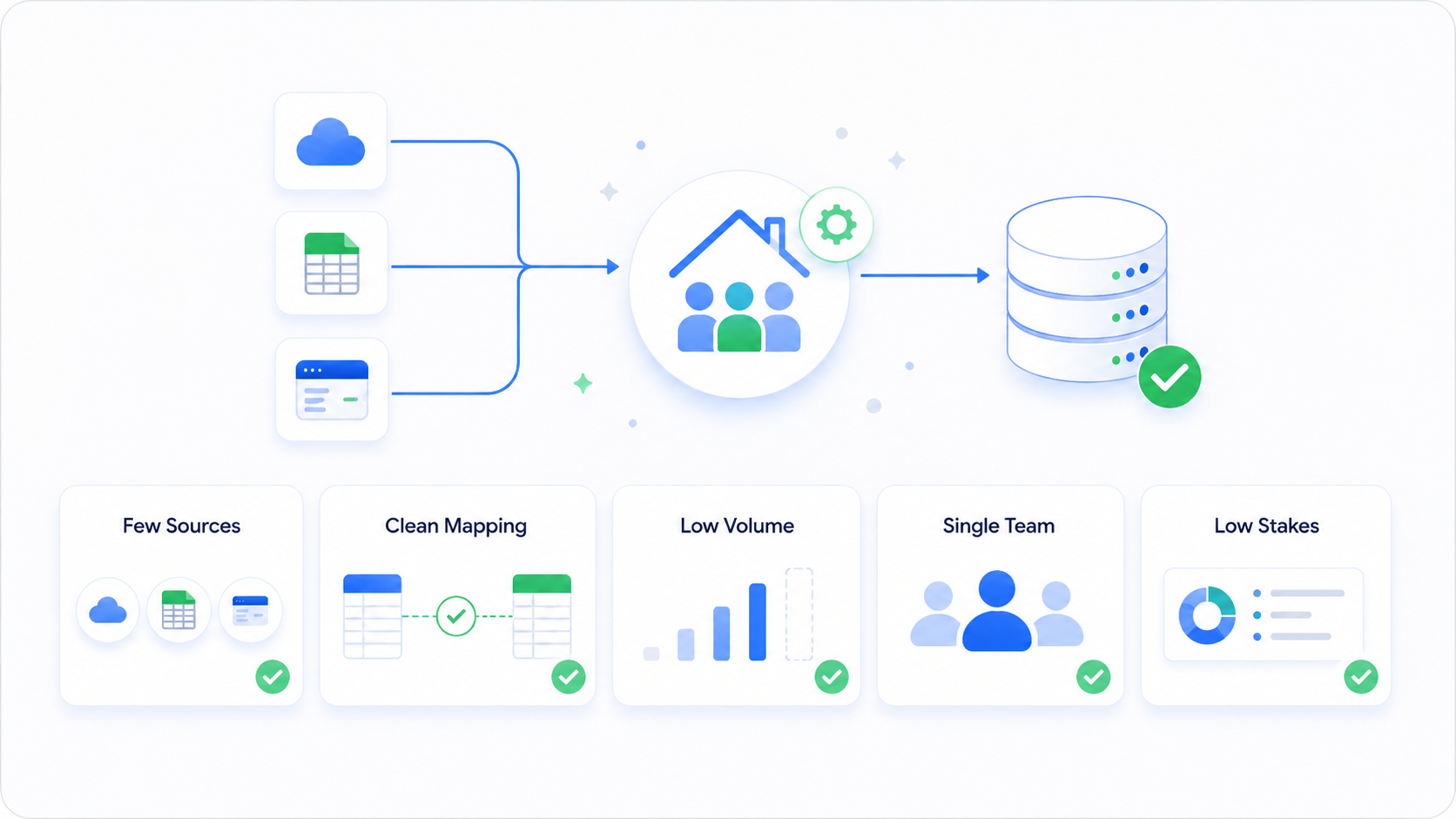
Not every integration job calls for a consultant, and a capable in-house team can carry more of this work than you might expect. In the following paragraphs, I will go over the key scenarios that would tell you that you don’t need a consultant and getting one probably slows you down and costs you money without accomplishing much.
- Your data pipeline draws from only a handful of sources, and each one comes with reasonable documentation or a stable API, you already understand most of what the job asks of you.
- Your cross function schemas line up well. For example, the users table in one system maps neatly onto the customers table in another, with no tangle of special cases sitting between them. Such work is really just careful plumbing. Tools like Fivetran, Airbyte, or Stitch take care of the extract-and-load step.
- Low volume works in your favor here. If your volumes are small enough to be managed internally e.g. in the tens of millions of rows range, then, you are unlikely to hit performance limits that send teams looking for outside help. A nightly sync of a two-gigabyte table is simply not where a consultant earns their fee.
- The rest of the picture comes down to how much is riding on the pipeline. If a single team relies on the data, and they have told you plainly what they need, there is no committee to satisfy and no competing definitions to reconcile.
- If the pipeline feeds an internal report that nobody is staking the quarter on, then a failed run is a mild irritation rather than a genuine incident. And when you have room to try something, watch it break, and try again, you can afford to learn as you go, which is the cheapest classroom there is. Most teams who tell you they worked integration out on their own did it in precisely this setting: low stakes, and plenty of space to fail.
If that sounds like where you stand today, go ahead and build it yourself. The rest of this article is about the moments when it no longer holds.
When you need data integration consultants?
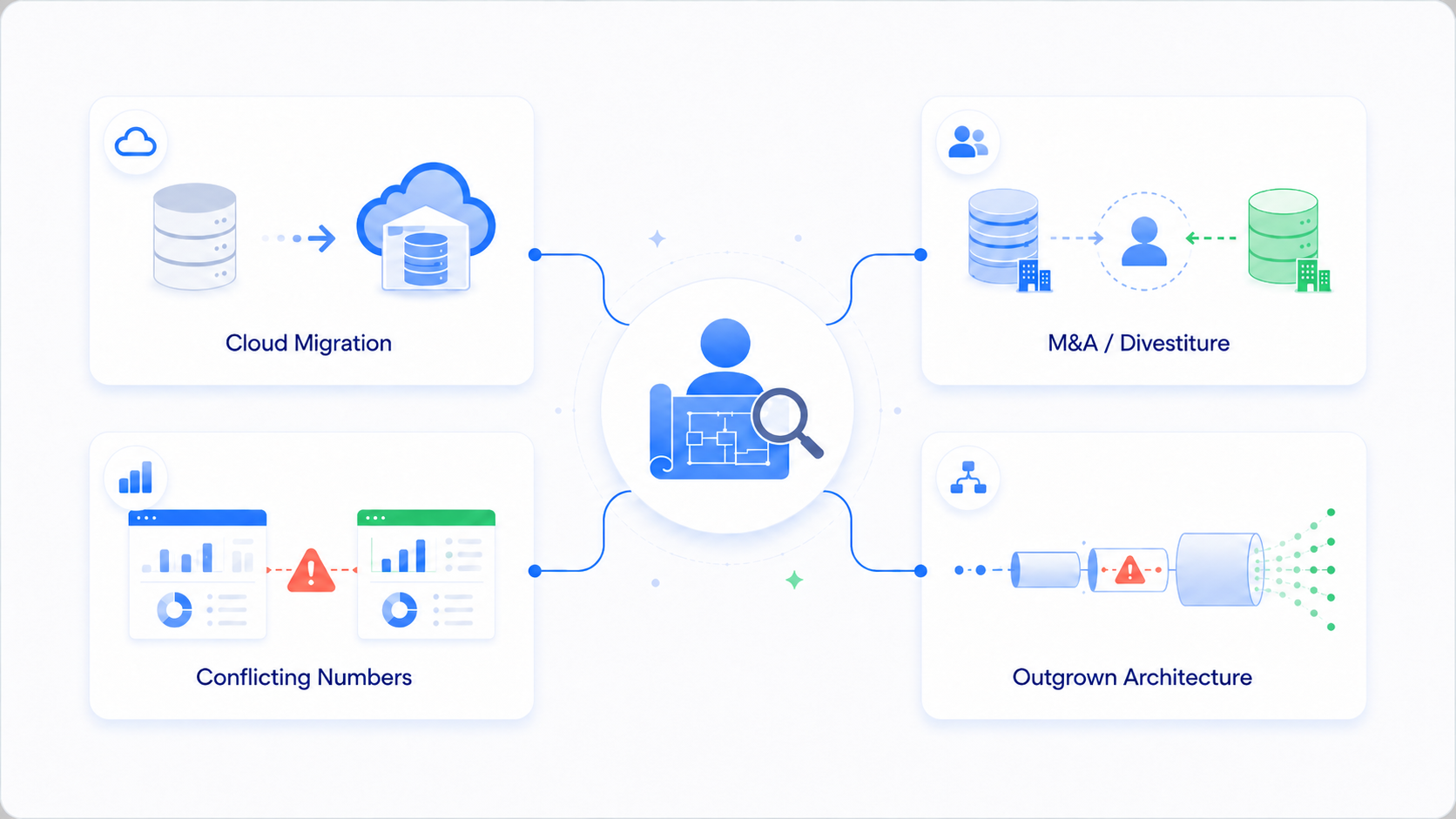
There are four situations where the math flips, and in each of them the price of getting it wrong runs well ahead of the price of bringing in someone experienced. If you see your own company in any of these, treat it as your signal to start the conversation.
You're running a major data cloud migration
Moving a warehouse from one platform to another is the classic case, and it looks deceptively simple from a distance. Lift-and-shift sounds like a copy-and-paste job right up until you meet the parts that refuse to translate: stored procedures written for the old engine, data types that quietly behave differently on the new one, and jobs that lean on quirks nobody ever bothered to document.
I once worked on a migration from PostgreSQL to Snowflake covering a dataset of roughly 250 million records, and the real work was never in copying the data across. It was in rebuilding the transformations so they ran correctly on the new engine and cost less than they had before. I brought the monthly bill down from around $4,000 to about $40, and I did it by rethinking how the loads and warehouses were sized rather than by moving any faster. That kind of saving is easy to walk straight past if you have only made the journey once. Snowflake's own migration documentation will hand you the mechanics; the judgment calls about sizing and cost are where real experience shows its worth.
You're going through a merger, acquisition, or divestiture
A merger or acquisition is where integration gets genuinely difficult, and the first obstacle is rarely technical. It is a matter of meaning. Both companies arrive with a customer table of their own. One keys on the email address, the other on an internal account ID. One counts a free trial as a customer, the other would never dream of it. Combine the two without reconciling any of that, and your merged revenue figure ends up wrong in a way that can take weeks to trace.
A divestiture puts you in the mirror image of the same problem: now you have to extract one business's data out of shared systems without disturbing everything else that depends on them. Either way, the work comes chained to a deal deadline, and that deadline strips away the room to experiment that made the in-house route so comfortable in the first place.
You've stopped trusting your own numbers
Data only earns its keep when the people around it believe what it tells them. The moment two dashboards begin to disagree, and colleagues start quoting whichever figure supports their case, know that your data has quietly become a political problem rather than a technical one. I have seen this 9 out of 10 times in my data career that the trail leads back to data integration: a sync that silently dropped a batch of rows, a timezone mismatch nobody caught, or a join that fanned out and doubled a metric along the way.
Say your revenue dashboard and your finance disagree by six percent and no one can explain why. The fault almost certainly sits upstream, in how the data was stitched together, not in the dashboard displaying it.
Putting it right means tracing every number patiently back to its source, which is slow and unglamorous work, and exactly the sort of thing a consultant can see through without being pulled away onto the next feature request.
You've outgrown your architecture
Your architecture is the backbone that everything else rests on, and like any backbone it has to grow along with the body around it. What comfortably carried your data a year ago will not necessarily carry it a year from now, and the strain usually reveals itself little by little before it announces itself all at once.
You tend to feel it in familiar places. A pipeline that once handled 5 million rows without complaint starts to buckle at 80 million. The nightly batch that used to wrap up by 6 in the morning now grinds on until 11 and misses the report everyone reads over their first coffee. Adding a single new source, once an afternoon's work, somehow swallows two weeks. Each of these is your design quietly telling you it has reached its ceiling, and every patch you bolt on buys you only a few weeks before the next piece gives way.
Rebuilding that foundation while it is still holding production together is a real skill in its own right. It is one of those jobs well worth handing to someone who has done it more than once.
The cost of waiting too long
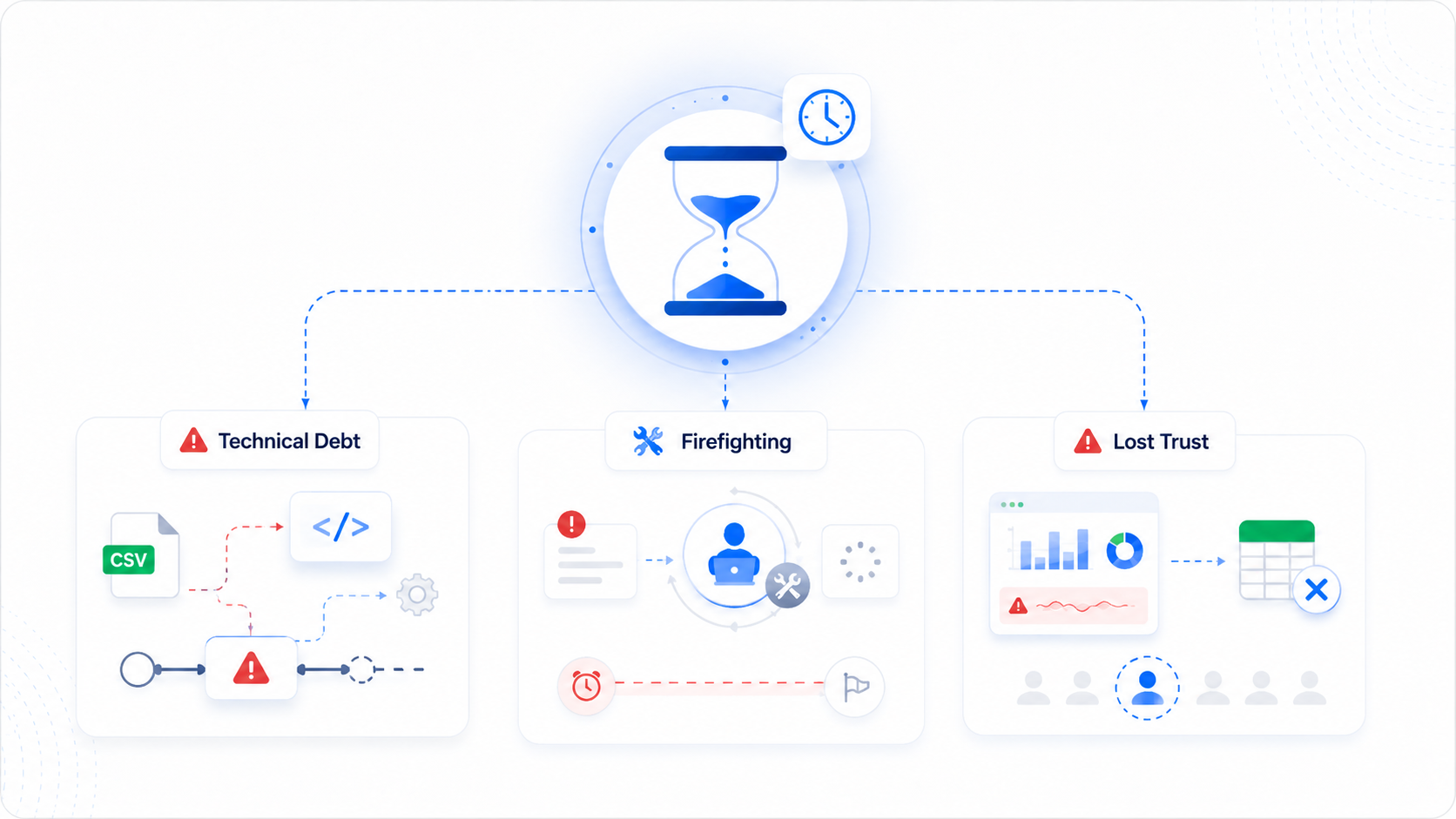
Recognizing that you need help is not the same as acting on it, and the space between those two moments is where the real cost quietly accumulates. Putting the decision off for a quarter or two almost never feels expensive at the time, which is exactly what makes it so easy to keep doing. The bill comes due in three ways:
Technical debt piles up
The first thing to grow in that gap is technical debt. Every workaround you add to keep a straining pipeline alive turns into one more thing the next person has to learn and then work around themselves.
For example, a manual CSV step gets bolted on in one place, a hard-coded date slips in somewhere else, and a retry script gets written at midnight to firefight. Six months later the person who built all of it has moved on, and nobody left can fully explain how the thing still holds together.
Your best people stop building
The second cost is quieter and usually larger, and it is everything your team is not doing while they babysit a fragile system. When your engineers lose two days a week to firefighting broken syncs, those are two days they are not giving to the product your customers actually asked for. None of it ever lands on an invoice, so it slides by unnoticed, but it is real and it keeps compounding.
Trust drains away
The third cost is the hardest of all to win back, and that is trust. Once a leadership team has been burned by a wrong dashboard once or twice, they quietly drift back to gut feel and their own private spreadsheets, and the entire purpose of your data work drains away. Rebuilding that confidence takes far longer than fixing whatever broke it to begin with.
How to get value from a data integration consultant?
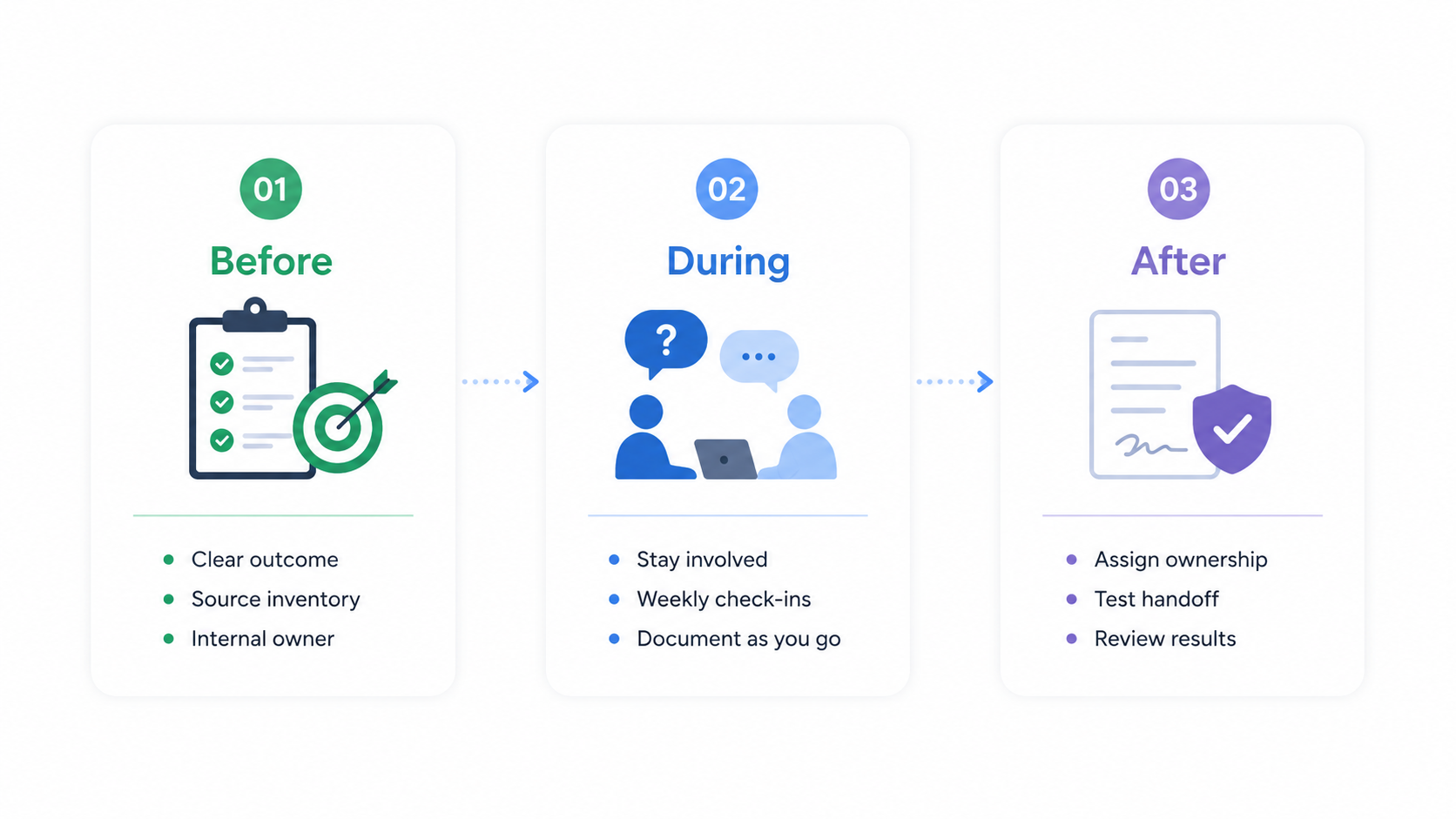
Hiring the right people is only half the job. The engagements that genuinely pay off tend to look different before, during, and after the work, and most of the difference comes down to how closely you stay involved throughout.
Before the engagement
Always start by getting clear on the business outcome you are actually buying. "Integrate our data" is not a goal you can hold anyone to. "Get marketing and sales reporting off two conflicting numbers and onto one by the end of Q3" very much is. Once you have that written down, run through the readiness check below before you ever take the first call. Copy it into a ticket and fill it in honestly:
Good data integration consulting firms will tell you honestly when your deadline is not realistic. If one agrees to everything you ask for, on the exact date you picked, without a word of pushback, let that make you suspicious rather than relieved.
During the engagement
Treat the consultants as part of your team rather than a vendor you have thrown a spec at over the wall. The good ones will ask genuinely uncomfortable questions about how your business really works, and you want them asking, because that is where the useful answers come from.
You should also keep at least one of your own engineers close to the work from start to finish, or you will end up with a system that nobody inside the company truly understands. Set a standing checkpoint as well, and weekly is usually about right, so that problems surface early instead of ambushing you at the final demo.
Whatever you do, do not let anyone skip discovery in the name of saving time. The week spent properly mapping your real data landscape is the same week that saves you a three-week rebuild down the line.
Always insist on documentation as the work happens too, rather than as a deliverable promised for the end, because end-of-project documentation is always the first thing sacrificed the moment the timeline starts to slip.
After the engagement
Before anyone signs off, settle plainly who owns what has been built. Every pipeline, every credential, and every scheduled job should have a name attached to it on your side of the table. Then check that the documentation genuinely lets your team run the system without reaching for the consultant's number, ideally by having someone internally make a real change while the consultant simply watches.
Put a review on the calendar for three months out, so you catch the drift that always creeps in once fresh edge cases start hitting the system in the wild. If you can, keep a light advisory arrangement open as well, even just a few hours a month, so you are not starting from cold the next time something breaks.
Finally, return to the goal you wrote down at the very beginning and check, honestly, whether you actually hit it. If you find you cannot measure it, then it was never defined tightly enough, and that alone is worth knowing before you do this again.
If you would like to get your bearings before any of this, the guide to evaluating data integration solutions walks through the trade-offs one tool at a time. It is free, and it does not ask you to book a call.
Conclusion
Book a Free 30-Minute Meeting
Discover how our services can support your goals — no strings attached. Schedule your free 30-minute consultation today and let's explore the possibilities.
Book a Free Call