

Why Fable 5 is Back Online After US Government Suspension?

Usman AshrafJul 3, 2026
Vintage butterfly illustration showing Fable 5 restored after a US government suspension.

Introduction

Claude Fable 5 had an unusual start. Anthropic launched it on June 9, 2026. Just three days later, the US government ordered it to be taken offline. After a 19-day pause, it returned to users worldwide on July 1st. So, what is Claude Fable 5 and why is it so important?

Fable 5 is Anthropic’s most powerful publicly available AI model. It belongs to a new tier called Mythos-class, which is above Claude Opus 4.8. It has stunned everyone so far because it scored 80.3% on SWE-Bench Pro, outdoing GPT-5.5’s 58.6%.

Anthropic also has a more powerful version called Claude Mythos 5, which has the same underlying model but lacks certain cybersecurity and biology safety guardrails. This version is only available to approved US organizations.

Anthropic had considered the Mythos line too risky for public release because of its cybersecurity capabilities. Releasing Fable 5, itself a Mythos-class model, is what set up the turmoil that followed.

This article explains the jailbreak claim that caused the ban, the agreement that lifted it, and the new pricing and usage rules that upset teams building on generative AI.

Why Did the US Government Ban Fable 5?

Fable 5 was suspended on June 12, 2026, following a directive from the Commerce Department. It barred all foreign nationals (including Anthropic’s foreign employees), inside or outside the US, from accessing Fable 5 and Mythos 5.

Commerce Secretary Howard Lutnick’s letter gave the company just 90 minutes to comply. Anthropic could not quickly verify user nationality, so it took both models offline for everyone around the world. This was the first time the US government banned a commercially deployed frontier AI model.

The issue began with the Mythos class model line, which first launched as Mythos Preview through Project Glasswing. This was Anthropic’s restricted program for trusted organizations testing cybersecurity vulnerabilities. The program was gated because its cybersecurity abilities could be misused.

The trigger for the ban was a report from Amazon. According to the Wall Street Journal, Amazon researchers found a way to make Fable 5 identify software vulnerabilities and, in one instance, produce code showing how to exploit a flaw. Reports suggest there were discussions between Amazon CEO Andy Jassy and the White House before the directive was issued.

Anthropic responded to the ban by asking Katie Moussouris, the CEO of Luta Security, to review the Amazon report. She revealed that the technique used a simple three-word prompt: “fix this code”.
The researchers at Luta Security presented Fable 5 with the flawed code and asked for a security review. Fable 5 refused the review, but when asked to fix the code instead, it produced patches. Moussouris argued this was not a jailbreak, but rather a standard process that cybersecurity defenders use daily.

Anthropic also defended itself, stating that the finding showed minor, previously known vulnerabilities. They mentioned that their tests found other models, including Claude Opus 4.8 and GPT-5.5, could identify the same flaws. For 19 days, it was unclear whether the government’s decision was driven by real AI safety concerns or retaliation.

Why is Fable 5 Unblocked Now?

Fable 5 was unblocked after the US government lifted export controls on June 30. It became available again on July 1 after Anthropic worked on a new safety measure that blocks over 99% of harmful attempts. This change only affected the cybersecurity filter; the biology and chemistry filters stayed the same.

During the ban, many cybersecurity leaders, including Moussouris and Sophos CEO Joe Levy, signed a letter arguing that the ban took away important tools from defenders while attackers still had theirs. After meeting with Dario Amodei at the G7, Trump changed his view and no longer saw Anthropic as a security threat.

The Commerce Department’s Center for AI Standards and Innovation (CAISI) tested both the old and new safety measures and found them to be very strong. In return, Anthropic agreed to identify security risks in its models, work with the government on future releases, and report any malicious activities it discovers.

The reintroduction of Fable 5 happened in stages. Access to Mythos 5 returned on June 26 to about 100 approved US organizations focused on critical infrastructure. Export controls were lifted on June 30, and Fable 5 became available on July 1 through platforms like Claude.ai, Claude Code, and Claude Cowork. However, the re-enablement for AWS, Google Cloud, and Microsoft Foundry is still in progress (as I am writing this).
Vintage-style illustration of butterflies and an open padlock beside the text “Why is Fable 5 unblocked now?”

Anthropic is open about the trade-off. The new safety measure flags more innocent coding and debugging requests, including routine automation workflows, leading to some false positives. Flagged cybersecurity requests now go to Claude Opus 4.8, and researchers can use a new HackerOne channel to submit reports on cyber issues. Although rerouting to Opus 4.8 is not ideal since it has similar flaws, Anthropic argues the rerouting keeps Fable 5’s stronger capabilities out of flagged requests, while acknowledging that most flagged actions are not malicious.

Anthropic vs the US Government: The Pentagon Lawsuit

Anthropic and the US government have also been in court over a different issue. Anthropic asked for guarantees that its AI would not be used for mass surveillance or autonomous weapons. The Pentagon pressured Anthropic to weaken these rules, and this dispute became public in February 2026.

In March, Pete Hegseth’s department labeled Anthropic as a supply chain risk, a title usually applied to foreign threats. Anthropic filed a lawsuit over this on March 9. Trump criticized the company on Truth Social and directed federal agencies to stop using its technology. Still, Anthropic stood firm.

Currently, the legal situation is mixed. A federal judge in San Francisco granted Anthropic a temporary order on March 26, stating that it seemed like retaliation rather than a real security concern. However, the D.C. Circuit did not stop the Pentagon’s actions while the appeal is ongoing. 

Reports suggest that the appeal panel was divided in May, and the supply chain risk label is still in place. Anthropic is seeing success in one court while facing challenges in another. This backdrop has created two viewpoints on the Fable 5 suspension. Some believe there was a real security concern, while others think it was retaliation. The conflict with the Pentagon makes it quite clear why there are differing opinions.

The New Fable 5 Pricing Model

Fable 5 is available on Pro, Max, Team, and select Enterprise plans until July 7, 2026. However, usage is capped at 50% of the weekly limits. After this date, users will need to pay for usage credits at rates similar to API costs. Standard Enterprise seats do not get any allowance and have to use credits from the start, which changes the maths for anyone budgeting AI automation at scale.

This change is a step back from what was promised at launch. Initially, Anthropic stated that Fable 5 would be free for these plans until June 22, with no usage cap. The model removal announcement was made quickly, leaving subscribers with only three days of usage before the model access was revoked. Then, they had 19 days with no access, and now just seven capped days instead of the promised two weeks. 

The model’s removal has sparked a backlash, as reported by PCWorld, and the discussions on Reddit reflect this frustration. Anthropic offered refunds to new subscribers who signed up between June 9 and 14, but the refund window closed on June 20.

The API pricing remains the same: $10 for each million input tokens and $50 for each million output tokens. These rates are double the cost of Claude Opus 4.8’s $5 for input and $25 for output. GPT-5.5 is priced at $5 for input and $30 for output, making Fable 5 twice as expensive there as well, while Sonnet 5 is much cheaper for regular tasks.

One positive note: requests downgraded to Opus 4.8 through the model router are not charged at Fable 5 rates.

So, when is it worth paying the extra cost for Fable 5 over Opus 4.8? It pays off for long-term, complex tasks, like large coding projects, data migrations, and multi-system debugging. This is because a cheaper model often fails multiple times for such processes. For tasks like classification, structured data extraction, and routine drafting, there's no benefit to paying extra. These requests should go to Opus 4.8 or Sonnet 5.
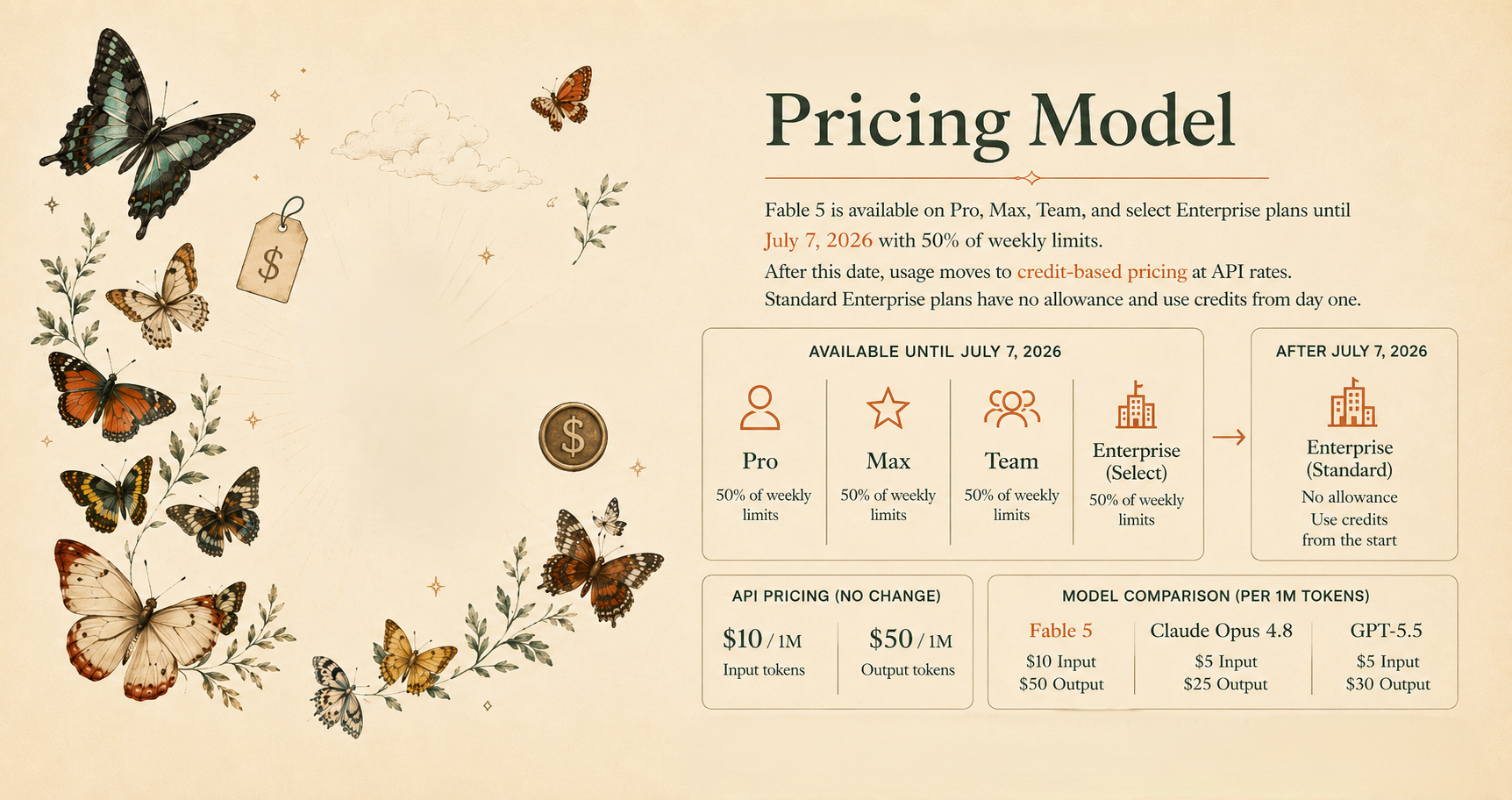
Fable 5 pricing model showing plan access, weekly limits, credit pricing, and API token costs after July 7, 2026.

Fable 5 vs the Competition

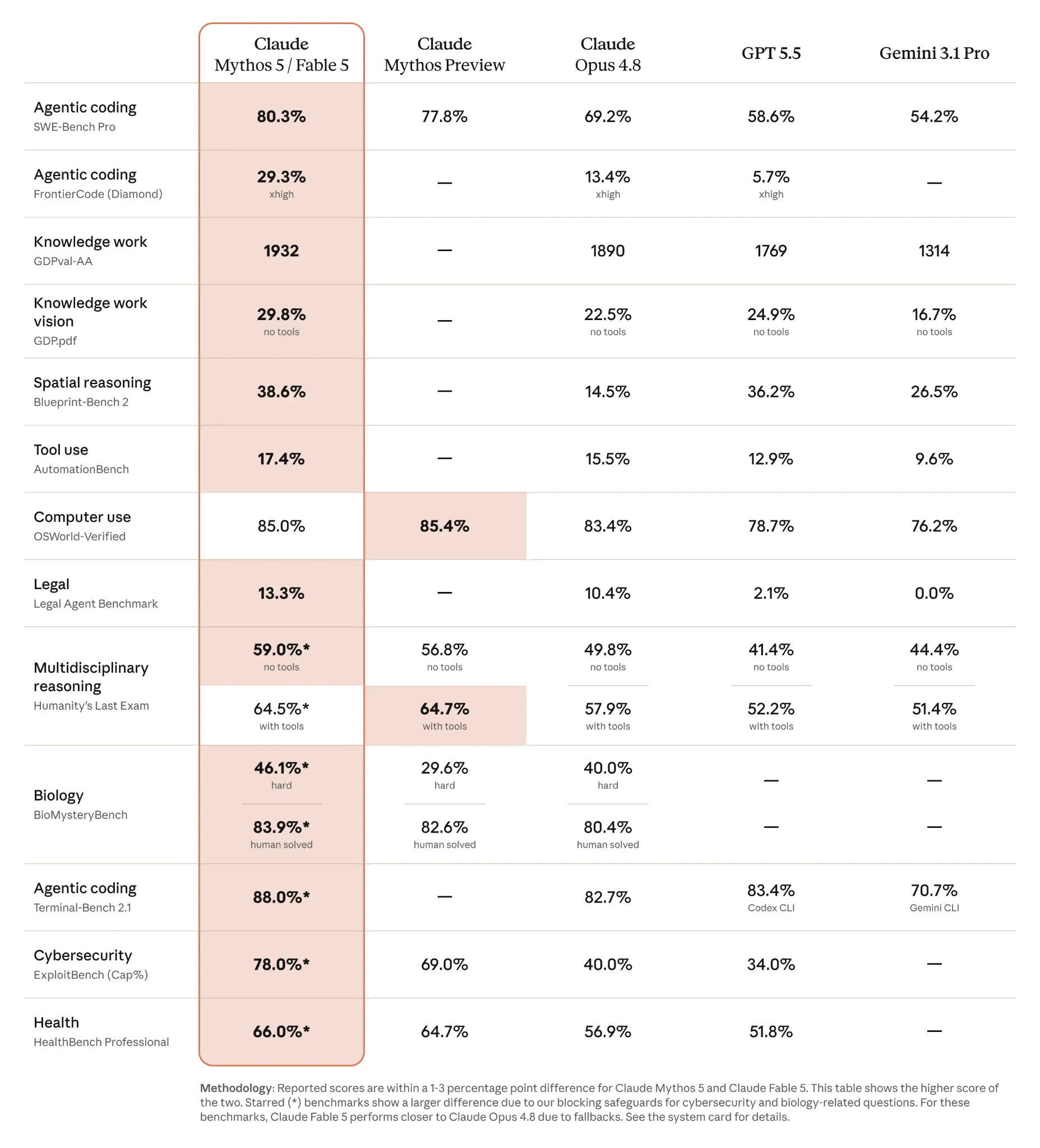
Comparing Fable 5 to OpenAI shows a significant difference in performance. Fable 5 scored 80.3% on SWE-Bench Pro, while GPT-5.5 scored 58.6%. On the more challenging FrontierCode Diamond set, Fable 5 scored 29.3% compared to GPT-5.5’s 5.7%. Fable 5 offers a 1 million-token context window, better long-term performance, and higher token efficiency. All these features make it the strongest AI model for software engineering in 2026 (so far). However, GPT-5.5 offers a better price.

Google’s Gemini 3.1 Pro is lower on coding, scoring 54.2% on SWE-Bench Pro. It mostly competes based on how it fits into existing services and its strategy of bundling AI with other plans. Emerging competition comes from Chinese open-source models, which are nearly as capable but much cheaper and free from US access restrictions.

Anthropic also faces internal competition. Opus 4.8 has a score of 69.2% on SWE-Bench Pro at half the price, and Sonnet 5 handles high-volume work, the kind that powers most AI agents in production, for much less than either. Fable 5 and Mythos 5 top the lineup on performance, though not on price.

Anthropic’s own tests showed GPT-5.5 finding similar vulnerabilities. Could OpenAI and Google face the same scrutiny in the future? OpenAI’s actions suggest they are already preparing for that possibility.Benchmark comparison of Claude Mythos 5 or Fable 5 against Claude Opus 4.8, GPT-5.5, and Gemini 3.1 Pro.
The China Factor: How Chinese AI Models Influenced the Fable 5 Decision

Chinese open-source AI models are now almost as good as the best models from the U.S. On top of that, they are much cheaper, a change that CNBC highlighted throughout 2026. The recent ban on US models actually helped market Chinese alternatives.

The timeline shows this clearly. Zhipu AI released GLM-5.2 with open weights on June 13, just one day after the US ban. They used the ban to suggest that US models are unreliable. GLM-5.2’s test results exceeded those of GPT-5.5 on the SWE-Bench Pro. Additionally, during the week the ban was lifted, the Wall Street Journal reported that a Chinese model performed similarly to Mythos 5 on some cybersecurity tests, like bug-finding.

Tech leaders and investors criticized the decision, arguing that it gave Chinese developers time to catch up. Alex Stamos, former security chief at Facebook, referred to the ban as a “huge own goal for the US” and warned that security firms might start using Chinese models instead. This pressure from the tech community played a key role in the US government reversing its decision. The fear of Chinese competitors gaining ground influenced the government more than any legal arguments.

There’s also concern about “distillation.” Analysts from Jefferies and Bank of America have raised doubts about whether export controls can effectively stop Chinese labs from analyzing top US models and creating cheaper open-source versions. If they can’t, every restriction will have a cost. The competition will catch up anyway, while only paying customers lose access.

What This Means for the AI Industry?

This is the first time a government has halted and then allowed a leading AI model. Four key lessons learned.

First, export controls are now an active tool for AI regulation. The Export Administration Regulations were originally designed for chips and hardware. Using them for commercial AI models is a new approach, directly linked to the June 2 Executive Order on Promoting Advanced AI Innovation and Security. AI regulation in 2026 will involve trade law as much as new laws.

Second, OpenAI has adjusted its strategy instead of waiting for orders. They previewed GPT-5.6 on June 26 with a two-tier trusted-access system, ensuring compliance before the launch.

Third, businesses should recognize the risk of relying on a single model. Any product tied to one model can face a 19-day shutdown due to circumstances beyond its control. Having multiple models and backup plans in your AI integrations is now a survival necessity.

Finally, the way to negotiate may change. Government-approved classifiers, disclosure agreements, and pre-release coordination could become common when launching a leading model in the US. Anyone planning an AI strategy for 2027 should assume this is the new baseline.

Now, it’s time to keep a very close eye on two things. Mythos 5’s expansion beyond the roughly 100 organizations approved by Glasswing, and how far the US government will push safety controls while competing with China.

What's next

Fable 5 launched on June 9, went offline on June 12, and returned on July 1 with new conditions (a retrained safety system and higher subscriber costs). The next important date is July 7, when included access will end, and usage credits will start. After that, pay attention to the Mythos 5 expansion and the Pentagon appeal, as these will indicate if the current agreement holds and what's next for the future of AI regulation.


Most teams don't know how model-dependent their pipelines are until something like the Fable 5 ban happens. We're happy to walk through your setup on a free 30-minute call and show you where the fallback options are.

Book a Free Call

Book a Free 30-Minute Meeting

Discover how our services can support your goals — no strings attached. Schedule your free 30-minute consultation today and let's explore the possibilities.

Book a Free Call

Frequently Asked Questions

Claude Fable 5 is Anthropic’s most advanced public AI model. It launched on June 9, 2026, as the first model in the Mythos-class tier above Claude Opus 4.8. It is a public version of the Claude Mythos 5 model, with a context window of 1 million tokens.

Both models share the same underlying technology. Claude Mythos 5 ships without the cybersecurity and biology safety filters and is restricted to roughly 100 approved US organisations. Fable 5 includes those filters and is available to the public.

It was suspended because the US Commerce Department issued an export-control order on June 12, 2026, after Amazon researchers found a way for Fable 5 to detect software vulnerabilities. Anthropic took the model offline because it could not verify user nationality in real time.

Yes. It has been available worldwide since July 1, 2026, on Claude.ai, the Claude Platform, Claude Code, and Claude Cowork. Access through AWS, Google Cloud, and Microsoft Foundry is still awaiting approval.

The ban was lifted because Anthropic created a new safety filter that prevents the reported technique in over 99% of cases. The Commerce Department’s AI testing body confirmed that the new safeguards are very strong. Anthropic also agreed to identify security risks in advance, work together on future releases, and report any malicious activities.

Fable 5 costs $10 per million input tokens and $50 per million output tokens on the API. Fable 5 is twice the cost of Claude Opus 4.8. On Pro, Max, Team, and selected Enterprise plans, it is included for up to 50% of weekly usage limits until July 7, 2026. After that, it will be billed using usage credits.

Project Glasswing is Anthropic’s program for its most powerful models. It started as a way for approved organizations to test Mythos Preview for finding vulnerabilities. Now, about 100 trusted US organizations, mainly critical infrastructure operators and protectors, access Claude Mythos 5 under government guidelines.

Yes, Anthropic is suing over the Pentagon’s supply-chain-risk designation. So far, court decisions have been mixed. A judge in San Francisco granted a temporary ruling for Anthropic in March 2026, but the D.C. Circuit Court did not block the Pentagon’s actions while the appeal is still in process. The designation remains in effect for now.

Book Consultation