

Complete Guide to Evaluate the Data Integration Frameworks

Usman AshrafJun 18, 2026
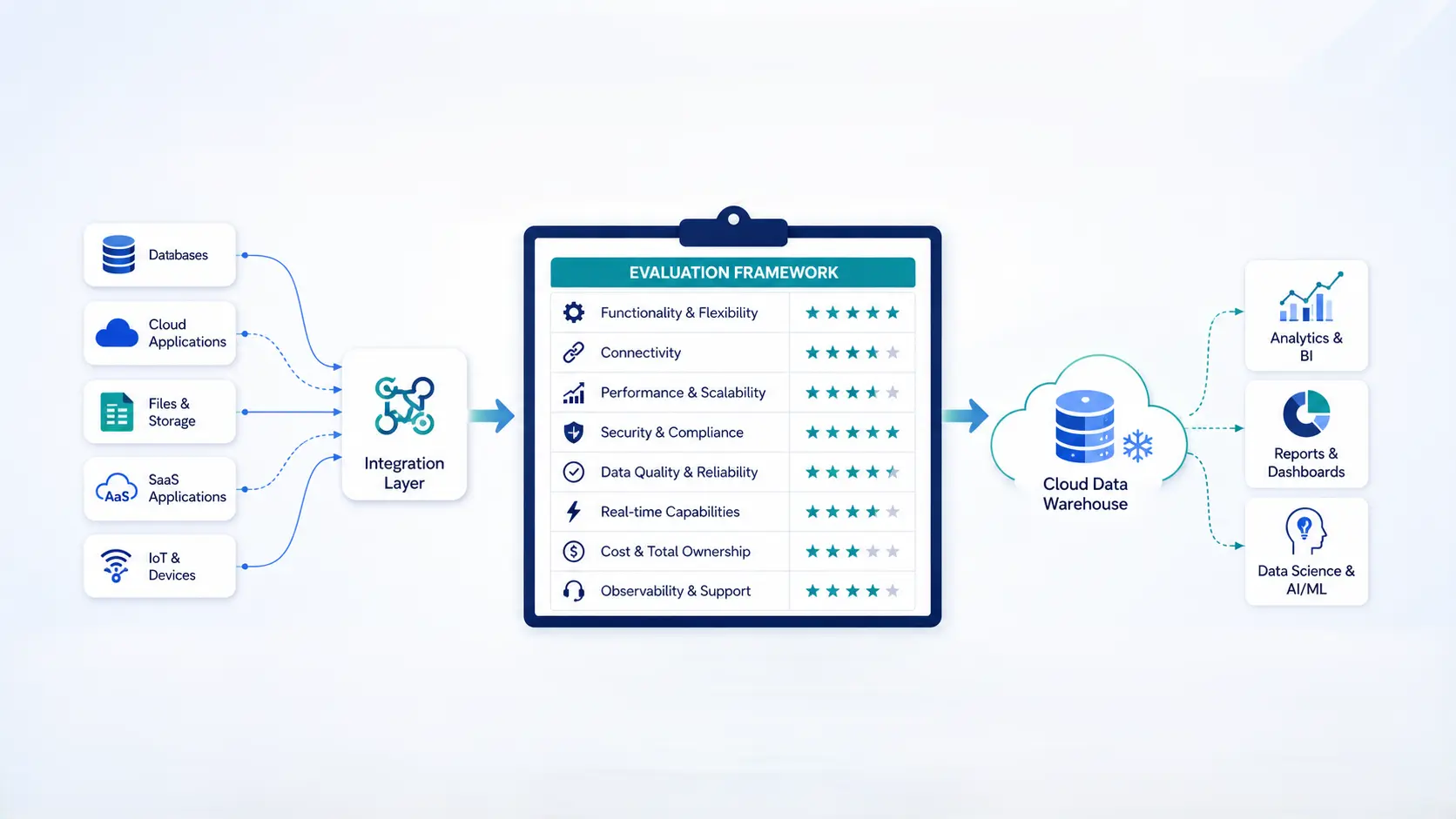
Evaluation framework comparing data integration capabilities before selecting a cloud warehouse for analytics and reporting.

Introduction

The global data integration market reached $14.33 billion in 2026 and is on track to hit $22.17 billion by 2031 (Mordor Intelligence, 2026). This number tells a simple story Yet most companies still struggle to connect their tools. The average enterprise runs 897 applications, but only 29% of them are integrated to a system (Peliqan, 2026). 

Choosing the right data integration solution is not about picking the most popular tool. It's about making a well-informed decision based on your business needs, technical requirements, and long-term goals. This guide shows you how to score platforms, compare ETL and ELT, test leading tools, and run a real proof-of-concept before you sign anything.

What Is Data Integration?

Data integration is the work of combining data from many separate sources into one clear view. It pulls from your tools, cleans the data, then loads it into a central location. The stakes keep rising. About 79% of organizations now use AI agents in some form (IBM, 2026), and those agents are only as good as the data behind them.

Think of data integration as the process that connects all your business systems. Data is collected from sources such as CRMs, ERPs, finance applications, and custom web scraping or extraction tools. It is then standardized, transformed, and delivered to a central destination such as a data warehouse or data lake, where it can be used for reporting, analytics, and AI. 

Without this bridge, your data stays trapped. Each team sees its own slice. Numbers clash in meetings. Good integrated data solutions clean up the mess and give everyone the same truth.
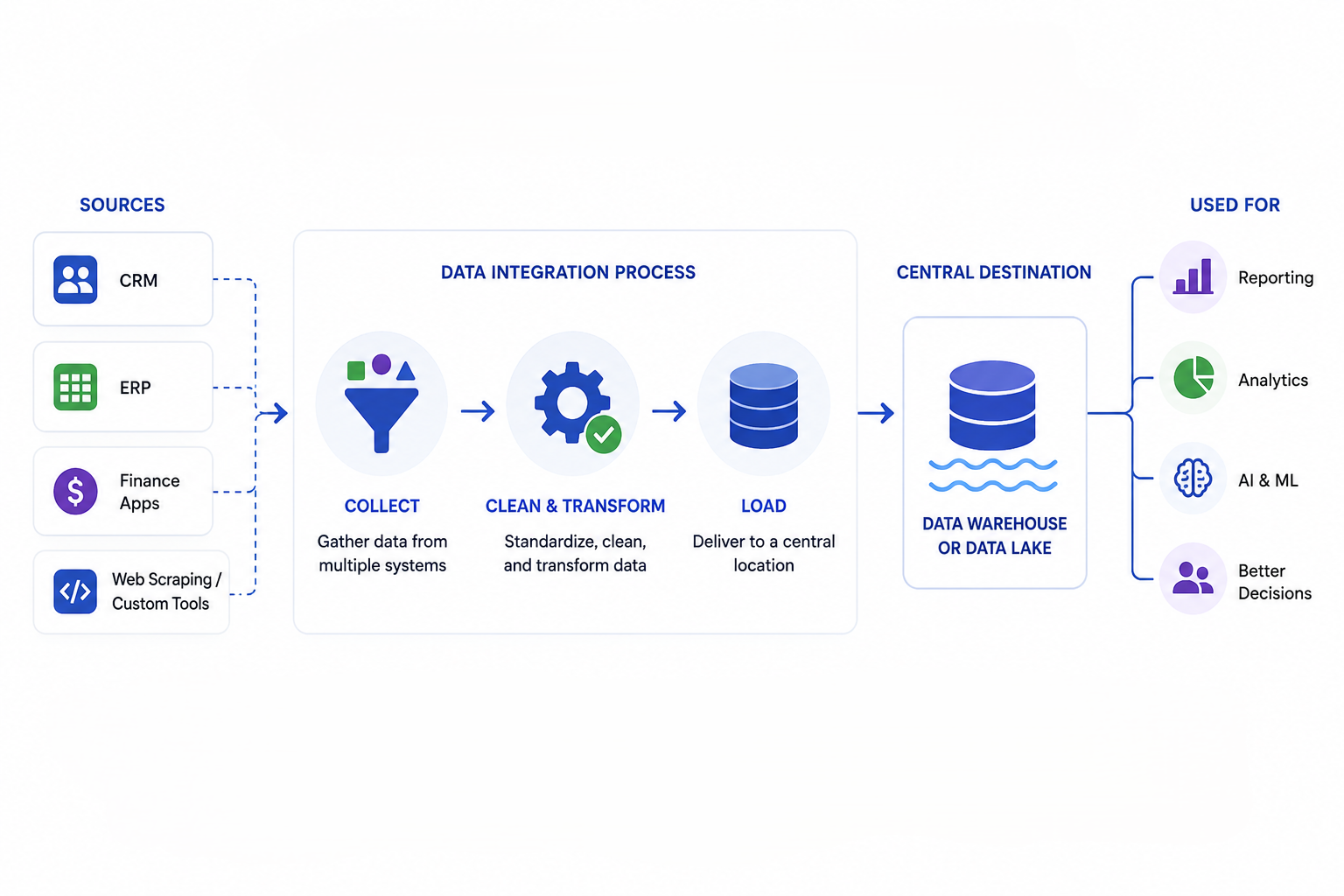
Data integration process combining CRM, ERP, finance, and web data for reporting, analytics, AI, and better decisions.

Types of Data Integration Frameworks

There is no single right model. The fit depends on speed, cost, and how live your data needs to be. Real-time integration alone is set to grow from $15.18 billion in 2026 to $30.27 billion by 2030 (Integrate.io, 2026). Here are the five main frameworks and where each one shines.

Integration Type

How It Works

Best Use Case

ETL (Extract, Transform, Load)

Data is cleaned and transformed on a staging server before it loads into storage.

Strict compliance, legacy on-premise systems, and masking sensitive personal data.

ELT (Extract, Load, Transform)

Raw data lands in a cloud warehouse first, then gets transformed using cloud compute.

Cloud-native stacks like Snowflake or BigQuery that need fast ingestion.

API-Based Integration

Connects live apps through REST or GraphQL APIs and webhooks.

SaaS-heavy setups, CRM syncing, and microservices.

Data Virtualization

Combines data in a logical layer without moving the underlying files.

Ad-hoc reporting where copying data is restricted.

Streaming Integration

Handles a continuous flow of event data in real time through message brokers.

IoT sensors, live fraud detection, and financial transaction logs.

Understanding the Basics: ETL vs ELT

The real difference is timing. It comes down to when you transform the data. This matters more than ever now because about 75% of enterprise data is processed outside traditional data centers (Integrate.io, 2026), mostly in the cloud.

ETL transforms the data first and then it’s stored. Only clean, structured, compliant records enter your system. Which in return makes it the safer route for legacy infrastructure and tight governance rules.

ELT stores the raw data loads straight into the warehouse, and you transform it later with cloud compute. Storage and compute scale on their own, so teams keep raw data and shape it as the business changes, often with tools like DBT.

The right pick is the one that matches your rules and your stack.
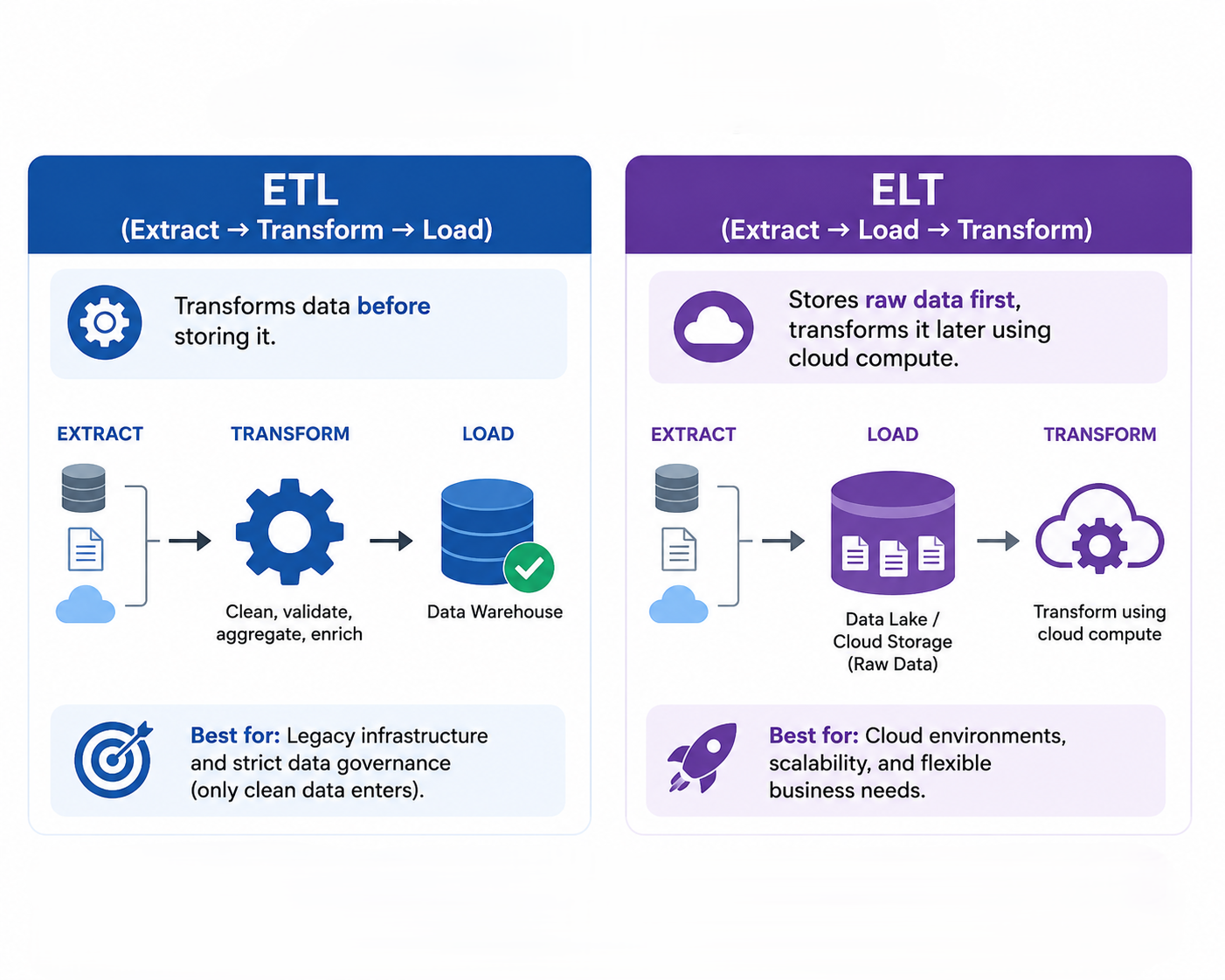
Side-by-side comparison of ETL and ELT workflows, showing when data is transformed and where each approach works best.

Core Criteria: How to Judge Integration Solutions

Judge a data integration solution on how it handles load. The cost of getting this wrong is quite high. Poor data quality drains the average company about $12.9 million a year (Integrate.io, 2026). In our experience, three criteria separate strong integrated data solutions from weak ones.

1. Scalability and Reliability

A good tool grows with your data. When volume jumps from thousands of rows to millions, the pipeline should not choke or drop records. Look for automatic retries and dead-letter queues. If an API rate limit hits mid-sync, a reliable system pauses, holds the payload, and tries again instead of failing outright.

2. Data Movement and Speed

If the business needs data the moment it changes, you need event-driven streaming. If an overnight sync is fine, batch tools do the job at a lower cost. Match the tool to the need. Chasing after the latest shiny tool will end up costing more and it might not be what you need.

3. Low-Code vs. Code-First

Pick the build style your team can run. If you have engineers writing Python pipelines, code-first tools give you full control. If your team is mostly analysts, a visual drag-and-drop tool ships faster. Be honest about your skills here. It saves months later.

The Evaluation Process: Complete checklist

Run a proof-of-concept before you buy. Vendor docs make every tool look perfect, and the shift to easy tools is real. Gartner expects 70% of new apps to use low-code or no-code by 2026. Still, only a real test shows the truth. Follow these four steps.

  1. List every active source
  • Production databases
  • External APIs
  • Scraped endpoints
  • Warehouses and data lakes
  1. Test Before You Invest
  • Deploy two or three tools in a test environment.
  • Connect each one to the same source sandbox.
  • Run them side by side.
  • Measure setup effort, resource use, and speed.
  1. Check the total cost of ownership
  • Legacy tools often charge a flat yearly license. 
  • Cloud tools bill by rows synced or compute used. 
  • Project both across your expected growth.
  1. Test schema drift. 
  • Change a source column type or API payload structure.
  • Verify the tool alerts the team or adapts automatically.
  • Confirm the pipeline continues to function without breaking.

A System We Built to Pull It All Together

Take a system we built called ShareDat. The app pulls a user's data from four very different sources at once.

  • Connects bank through Plaid
  • Email through Gmail
  • Files in Google Drive
  • Schedule through Google Calendar 

Each one speaks a different API, so the hard part is shaping all of it into one consistent form. Pipedream handles the fetching, and the data lands in Supabase as vector embeddings. From there, the user just asks a question in plain language, and the system answers using data drawn from all four sources together. 

This is what API-based integration looks like in practice. The challenge is rarely one connection. It is keeping several live APIs in sync and feeding them into one place a person can actually query.
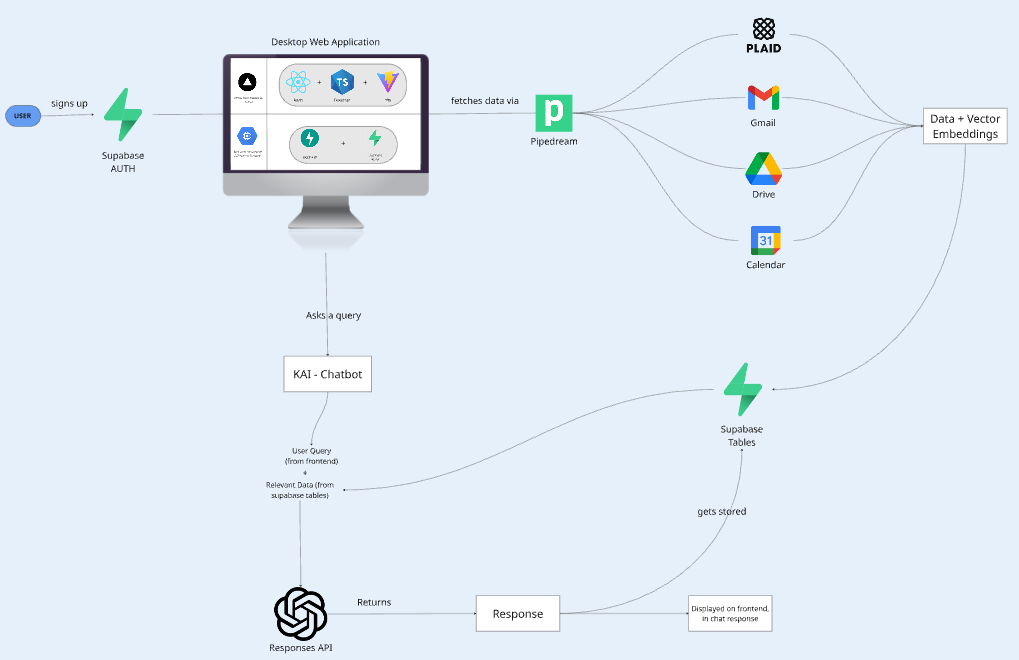
AI chatbot architecture connecting a web app with Supabase, Pipedream, business tools, vector embeddings, and OpenAI.

Evaluation of Leading Data Integration Platforms

A few names, like IBM, Microsoft, Informatica, SAP, and Oracle, lead the market. (Mordor Intelligence, 2026).

  • Airbyte. A popular open-source engine built for ELT. Its modular design lets teams build and scale connectors across many APIs quickly.
  • Informatica and Talend. Enterprise-grade tools for data quality, master data management, and deep compliance across multi-cloud networks.
  • AWS Glue and Azure Data Factory. Serverless suites that scale on their own. A strong pick for teams already settled inside one cloud provider.

For organizations with unusual requirements, off-the-shelf platforms are not always enough, and that is where data integration solutions and consulting earn their place. In those cases, Data Prism can build custom orchestration and data pipelines that work around anti-bot protections, API limitations, and other integration challenges, creating a solution tailored to a specific stack. 

Best Practices You Should Implement

Small habits prevent big losses. More than a quarter of organizations lose over $5 million a year to poor data quality, and 7% lose $25 million or more (IBM, 2026). These three practices cut that risk.

Automate 100% of Validation

Random sampling is no longer enough. Checking 5% of records by hand misses too much at scale. Use programmatic engines that reconcile every row. To see the gap between basic uptime tracking and full validation, read our data migration guide.

Set Clear Threshold Governance

Decide what an acceptable error rate looks like before you go live. Minor formatting gaps in metadata may be fine. For financial or personal records, the rule should be zero tolerance. Write these limits down so nobody guesses later.

Build a Decoupled Architecture

Keep your integration layer separate from storage and processing, ensuring that if you swap your warehouse later, your API integrations and ingestion pipelines stay intact. This one choice protects your stack for years.
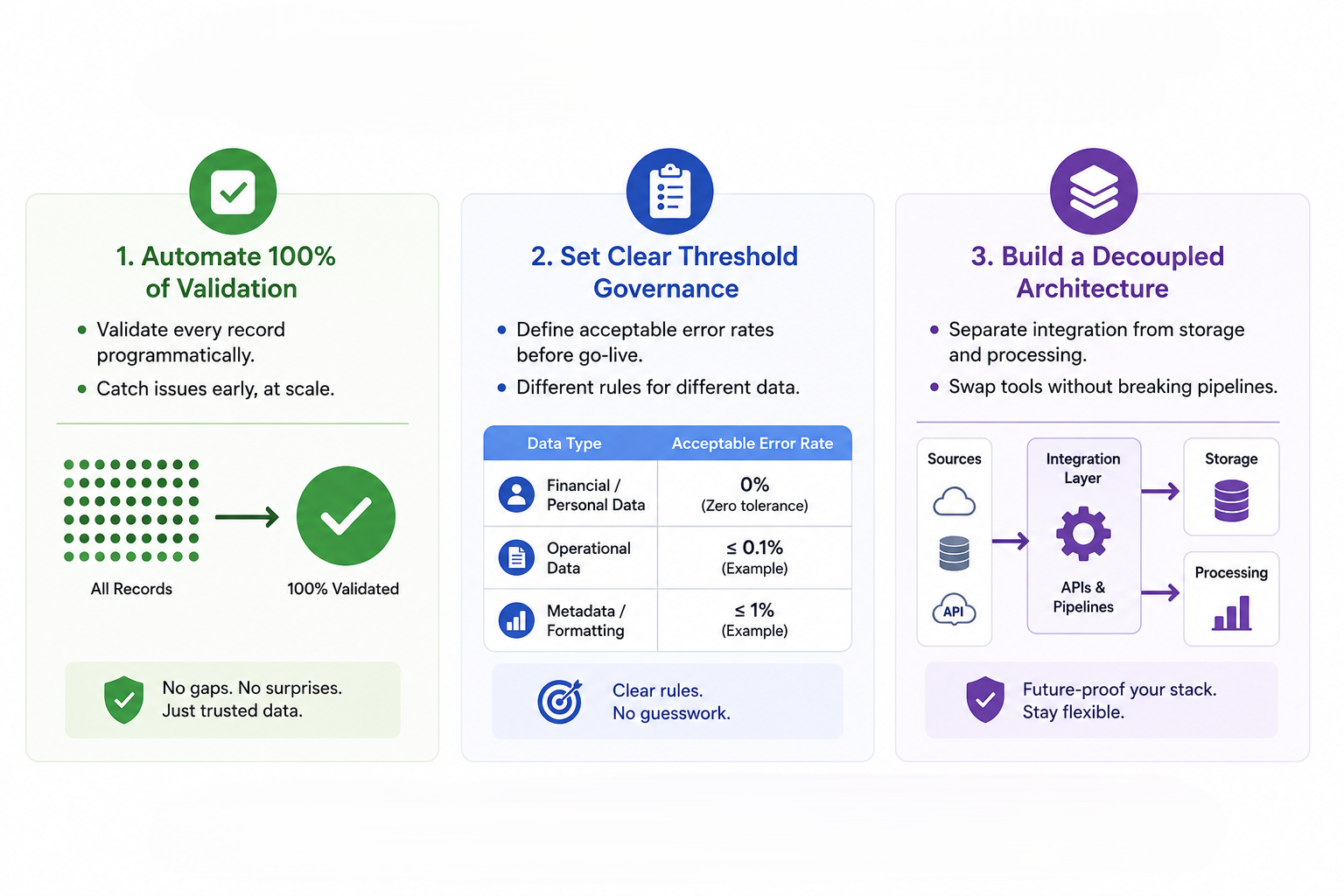
Three data integration practices covering automated validation, error thresholds, and decoupled architecture.

Conclusion

Choosing the right data integration setup comes down to what matters most: control, speed, and ease of use. If you work with sensitive or regulated data, a governed ETL platform is usually the safer choice. Alternatively, if your team is cloud-native and needs to move fast across many SaaS tools, ELT may be a better fit.

Remember: The best integrated data solutions are the ones that have been tested in real workflows, not just in demos. Start with a small proof of concept, measure the results, and choose the option that is secure, reliable, and ready to grow with your team.

Still not sure which platform fits your stack? Our data integration solutions and consulting can match the platform to your data. Book a free 30-minute consultation and we will help you find the right fit.

Book a Free 30-Minute Meeting

Discover how our services can support your goals — no strings attached. Schedule your free 30-minute consultation today and let's explore the possibilities.

Book a Free Call

Frequently Asked Questions

ETL cleans data on a staging server before loading, so only clean records reach your warehouse. ELT loads raw data first, then transforms it inside the cloud warehouse. ELT is faster for ingestion while ETL gives tighter control over sensitive data.

The best platform balances reliable performance, automatic retries during traffic spikes, easy setup, and clear pricing. Reliability beats any single feature, which is why proper data integration solutions and consulting start with your actual needs.

Batch moves data on a schedule, often overnight, at a lower cost. Real-time streams data the moment it changes. Pick real-time for fraud checks or live dashboards. Choose ‘batch’ when an overnight sync is enough.

Automate 100% of your row-level checks instead of sampling by hand. Set clear error thresholds before launch, and keep your integration layer separate from storage. These habits catch problems early, before they reach reports or AI models.

Book Consultation