

How Grok 4.5 Turned The AI Race Into a Pricing Battle

Usman AshrafJul 10, 2026
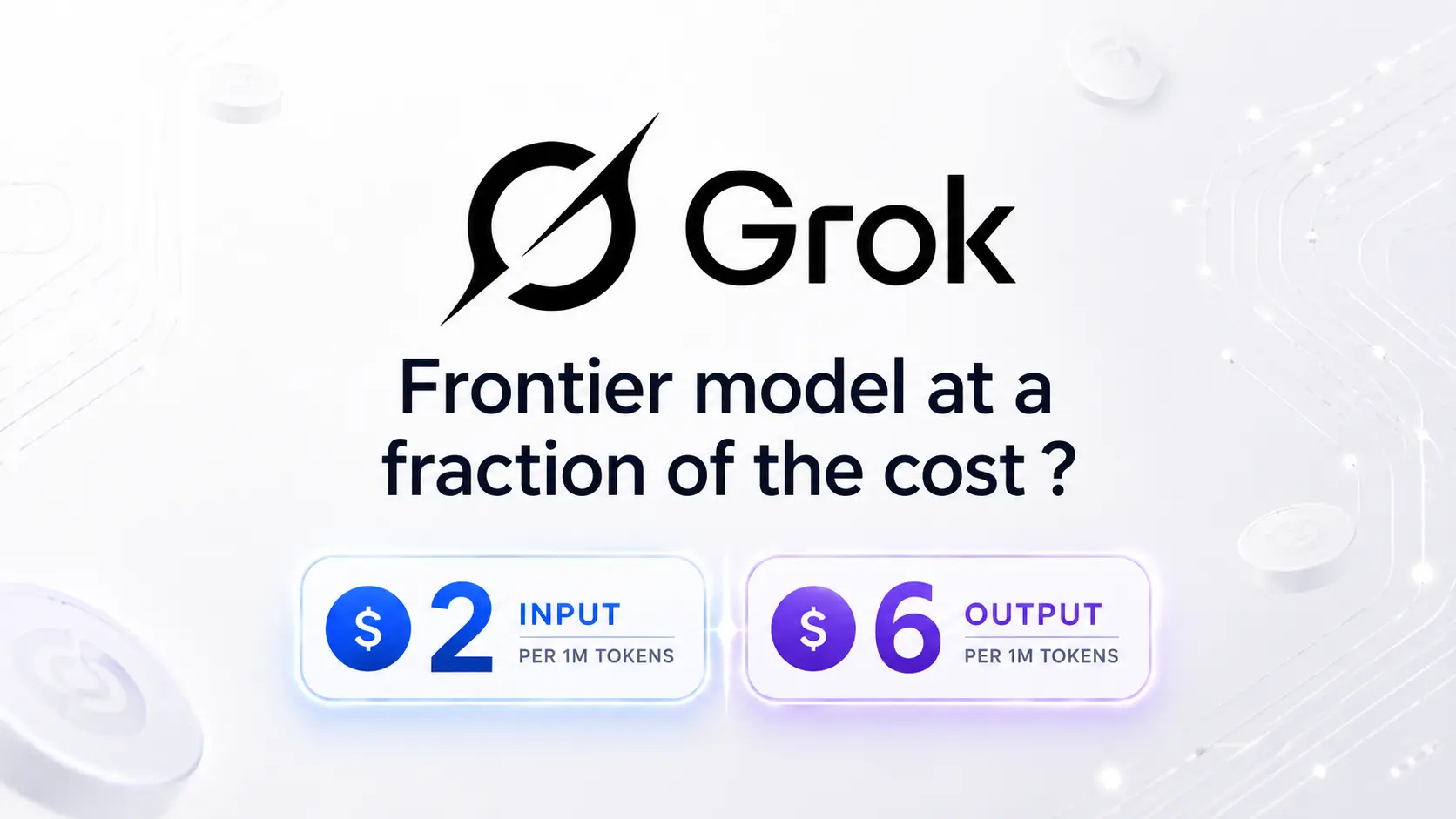
Grok branding with API pricing showing $2 input and $6 output per million tokens, highlighting a low-cost frontier AI model.

Introduction

Elon Musk described Grok 4.5 as "an Opus-class model, but faster, more token-efficient, and lower cost." This single statement describes the entire launch. SpaceX AI does not claim to have the smartest model on the leaderboard. It claims to be the cheapest model that comes close enough, and it has the numbers to make Anthropic's and OpenAI's pricing uncomfortable.

It is the company's first model since its IPO and the deal to purchase Cursor. Grok 4.5 was developed in collaboration with Cursor and focuses on coding, agentic tasks, and knowledge work rather than informal communication. On July 9, public access was made available via grok.com and the X app.

This post discusses what was released, the benchmark figures with caveats, the pricing, and the initial reaction from users on X.

What is Grok 4.5?

SpaceX AI's flagship model (Grok 4.5) was released on July 8, 2026. Its cost is what shocked everyone, with a price of $2 per million input tokens and $6 per million output tokens. This model was created in conjunction with Cursor. It has a 500K-token context window and allows both text and image input.

Grok 4.5 is based on SpaceX AI's new V9 foundation and has around 1.5 trillion parameters. It was trained at the company's Memphis data centers with tens of thousands of NVIDIA GB300 GPUs. Cursor's training used trillions of Cursor data tokens, which represented genuine developer-agent interactions with codebases and tools.

In our experience, model debuts typically begin with a screenshot of the leaderboard. This one begins with a price tag.

How Good Are Grok 4.5 Benchmarks?

Grok 4.5 is close to the frontier but not on top of it. On SWE-Bench Pro, it completes 64.7% of tasks, trailing Claude Opus 4.8 (max) at 69.2% and Anthropic's Fable 5 (max) at 80.4% (SpaceX AI, 2026). On SWE Marathon and Terminal Bench 2.1, it edges out Opus 4.8.

Benchmark

Grok 4.5

Opus 4.8 (max)

Fable 5 (Max)

GPT-5.5 (High)

DeepSwe 1.0

62.0%

55.8%

66.1%

64.3%

DeepSwe 1.1

53%

59%

70%

67%

SWE Marathon (Pass@1)

29.0%

26.0%

24.0%

n/a

Terminal Bench 2.1

83.3%

78.9%

84.3%

83.4%

SWE-Bench Pro

64.7%

69.2%

80.4%

58.6%

Vendor-reported scores from SpaceX AI's launch post on July 8, 2026. Because effort parameters differ between models, cross-model differences should be interpreted as directional.
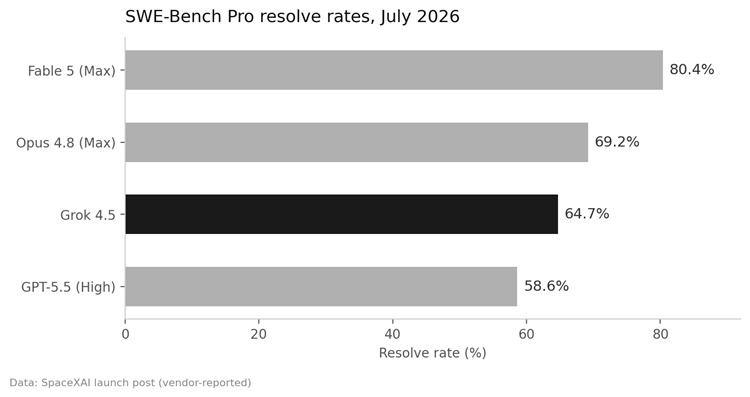
Bar chart comparing SWE-Bench Pro resolve rates (July 2026): Fable 5 Max 80.4%, Opus 4.8 Max 69.2%, Grok 4.5 64.7%, GPT-5.5 High 58.6%.
Chart: SWE-Bench Pro resolve rates in July 2026. Data: SpaceX AI launch post (as reported by the vendor).

The efficiency figure is more relevant than the individual scores. According to SpaceX AI, Grok 4.5 resolves SWE-Bench Pro tasks with an average of 15,954 output tokens, which is around 4.2 times less than Opus 4.8's (max) of 67,020. It is served at 80 tokens per second, allowing agent loops to run faster.

Independent signals arrive early but persist. Grok 4.5 is ranked fourth out of 168 models on the Artificial Analysis Intelligence Index, trailing only Fable 5, GPT-5.5, and Opus 4.8. Near the top, for a fraction of the cost per work. That's a straightforward one-line summary.

What is Grok 4.5's performance comparable to?

The closest comparison is Claude Opus 4.7. Musk estimates that Grok 4.5 is nearly identical to Opus 4.7 but significantly faster, but Anthropic's current best is still a generation ahead.

The published figures corroborate this claim and provide additional evidence. Grok 4.5 outperforms Opus 4.7 (max) on all of SpaceX AI's charts, including DeepSWE 1.0 (62.0% vs 40.1%), Terminal Bench 2.1 (83.3% vs 78.9%), and SWE-Bench Pro. It competes with Opus 4.8 (max), outperforming Terminal Bench and SWE Marathon while trailing SWE-Bench Pro and DeepSWE 1.1. So, in terms of capability, Opus 4.7 and Opus 4.8 are roughly comparable, with Fable 5 and GPT-5.5 outperforming both.

So, where does this leave the buyer? Opus 4.7 launched as Anthropic's flagship, priced at $5/$25 per million tokens. Six months later, essentially the same functionality costs $2/$6 and runs at 80 tokens per second. The performance objective does not tell the entire story.
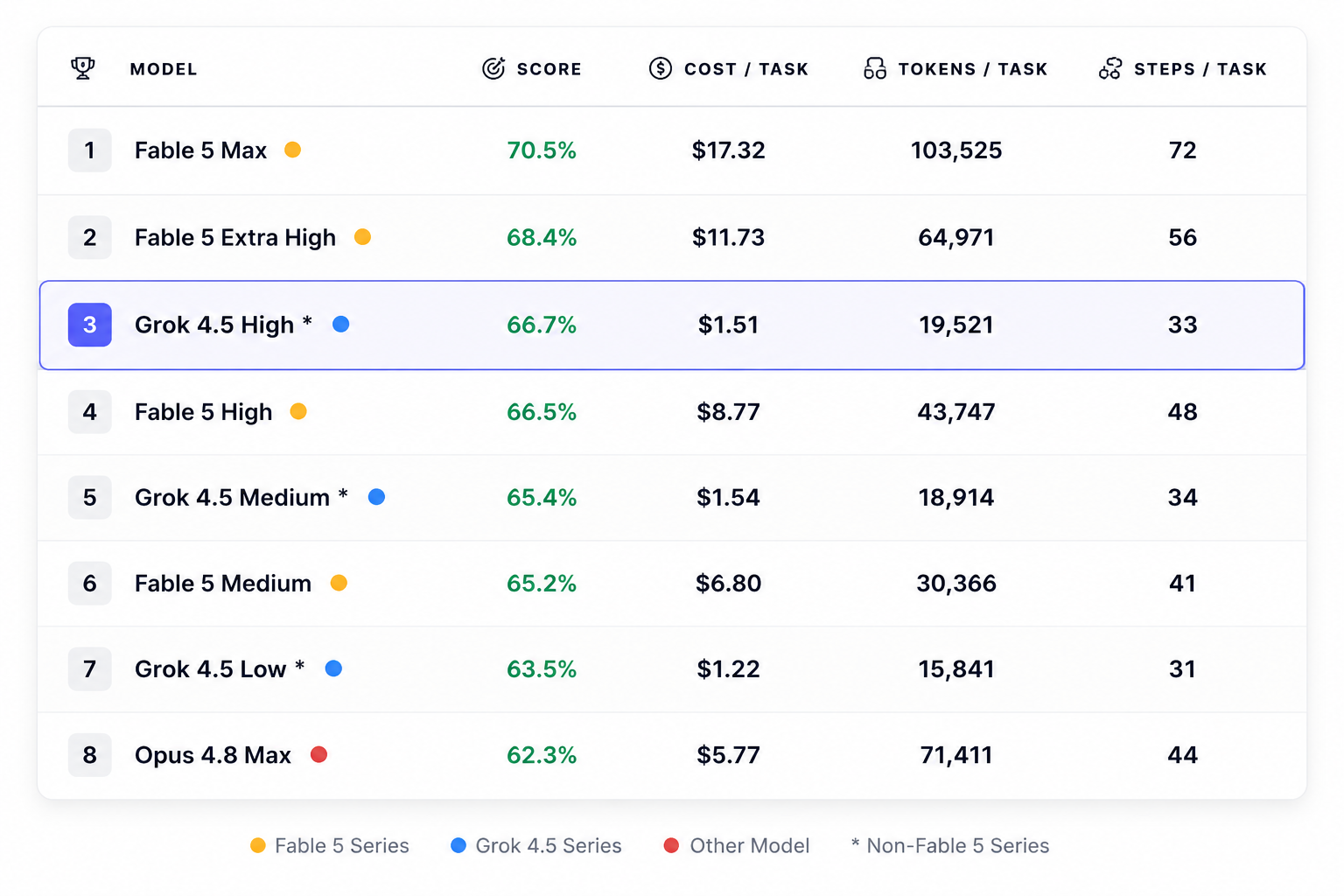
Benchmark leaderboard comparing AI coding models by score, cost per task, tokens per task, and steps per task, with Fable 5 Max ranked first.

How much does Grok 4.5 cost?

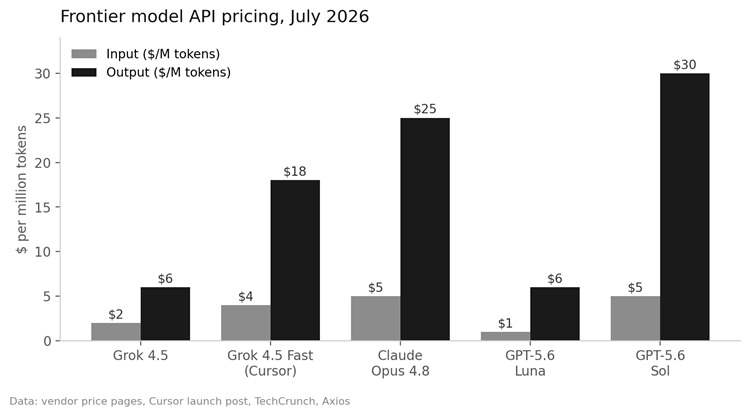
The API costs $2 per million input tokens and $6 per million output tokens, with cached input priced at $0.50 (SpaceX AI documentation, 2026). Opus 4.8 costs $5 (input) or $25 (output). GPT-5.6 Luna equals Grok's output at $6 but is a lower-tier model (TechCrunch, 2026).

Model

Input ($/M tokens)

Output ($/M tokens)

Grok 4.5

$2.00

$6.00

Grok 4.5 Fast (Cursor)

$4.00

$18.00

Bar chart comparing frontier AI model API pricing in July 2026, showing input and output costs per million tokens for Grok, Claude Opus 4.8, and GPT-5.6.
Chart: Frontier model API pricing per million tokens in July 2026. Data from vendor price pages and TechCrunch.

The disparity grows when the arithmetic is applied to a real-world task. Assume that an agent task requires 100,000 input and 20,000 output tokens. On Opus 4.8, that is about $1.00. Grok 4.5 costs $0.32, even before accounting for the 4.2x token-efficiency claims. If that assertion holds for your codebase, the cost difference per task approaches an order of magnitude.

This was precisely measured during launch-night testing. Grok 4.5 placed third overall at 66.7%, trailing only Fable 5 Max at 70.5% (for $1.51 per job) versus Fable's $17.32. It delivered nearly identical results for about a tenth of the price, easily outperforming Fable 5 High and Opus 4.8 Max on that leaderboard. This cost column alone is why the launch quickly dominated developer feeds.

The $60 Billion Cursor Deal – Explained.

Grok 4.5 exists because of an acquisition. SpaceX has agreed to buy Anysphere, the company behind Cursor, for $60 billion in mid-June 2026, just days after its IPO on June 12th. Grok 4.5, the first model developed by the two companies in collaboration, was released three weeks later.

What Does Each Side Receive?

SpaceX AI's transaction addresses a publicly acknowledged weakness. The company had fallen behind on coding and was rebuilding its workforce while pursuing enterprise clients (TNW, 2026). Cursor provides two resources that money cannot buy from elsewhere, behavioural training data and dissemination.

For Cursor, the transaction solves the frontier problem. Why? Because Cursor lacked the compute power to train a frontier model from scratch. This is why it built Composer 2.5 on Moonshot AI's open Kimi K2.5 platform. 

SpaceX AI provides the company with tens of thousands of NVIDIA GB300 GPUs in Memphis data centers and a $60 billion stockholder valuation.

The Training Agreement

Cursor explains how the effort is distributed. SpaceX AI supplied the V9 base model and computing. Cursor collected trillions of tokens of usage data from real developer-agent interactions. This data shows how developers and AI agents work with codebases and technologies introduced after pre-training, during supplemental training.

Cursor also built a distributed agent system that creates challenging reinforcement learning environments. These tasks are difficult enough for frontier models to fail and cover areas such as software engineering, data science, finance, and law.

Anthropic and OpenAI can match each other's compute resources. However, neither company has an editor that records millions of real developer-agent sessions. These sessions capture failures, retries, and recoveries that standard benchmarks do not measure.

Where The Deal Stands Today?

The acquisition has been agreed to but not yet finalized. Completion is expected in the third quarter of 2026. Until then, the companies are working as partners under a common joint model. Cursor maintains its own model line, which means that Composer 2.5 remains on the market. Cursor also clarified that it will continue to develop models in the smaller weight class alongside the jointly trained frontier models.

What happens next?

SpaceX AI has committed to releasing new models on a monthly basis until the end of 2026, with Grok 4.5 being the first. Grok 5 is right behind it, apparently targeting 6 to 10 trillion parameters and training on the Colossus 2 cluster. 

In the near future, availability for Grok 4.5 in the EU is also expected (around mid-July). Third-party integrations have already begun, with Notion and Convex announcing their support within a day of debut. 

What are developers saying about X?

The launch night reaction was divided into two camps. Folks who re-ran the benchmark tables and people who re-ran the invoices. The second camp was louder.

Cursor (@cursor_ai)  ·  8 July 2026

Cursor announced the joint release, naming Grok 4.5 its most powerful model and the first created for work beyond software engineering, with availability across all Cursor plans and increased usage for the first week.

View post on X

BridgeMind (@bridgemindai)  ·  8 July 2026

BridgeMind provided CursorBench results within hours: Grok 4.5 placed third overall at 66.7%, close behind Fable 5 Max at 70.5%, despite costing $1.51 per job against Fable's $17.32. Their conclusion: "The intelligence war just became a price war."

View post on X

Drew Pavlou (@DrewPavlou)  ·  July 8, 2026

Big news: Grok-4.5 has landed #3 in the Code Arena: Frontend.

- On par with GLM-5.2 (Max) and Claude Opus 4.8 (Thinking)
- Significant improvement over Grok-4.3 (#62 -> #3)
- #2 for Content Creation Tools, Simulations, Gaming and Reference-Based Design
- #3 for Consumer Product

View post on X

How Do You Get Grok 4.5?

Grok 4.5 was released on July 8, 2026, across three platforms at the same time: Cursor on all plans, Grok Build (where it's the default model), and the SpaceX AI API via console.x.ai (SpaceX AI, 2026). Public access to grok.com and the X app began on July 9, and SpaceX AI is currently offering free Grok Build and Cursor usage for a short time.

The API requires about two minutes to set up. Retrieve a key from the console and call the model:

Bash
curl -s https://api.x.ai/v1/responses \
  -H "Authorization: Bearer $XAI_API_KEY" \
  -H "Content-Type: application/json" \
  -d '{
	"model": "grok-4.5",
	"input": "Find and fix the bug: function median(a){a.sort();return a[a.length/2]}"
  }'

What Should You Watch Before Switching?

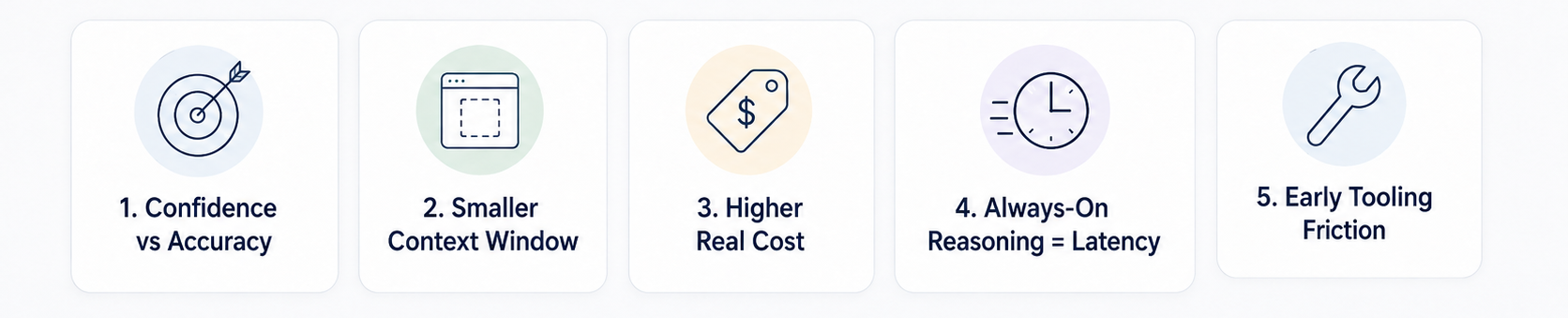
The launch revealed five specific issues, the most significant of which is accuracy. On Artificial Analysis's AA-Omniscience test, Grok 4.5's hallucination rate increased from 25% to 54% compared to Grok 4.3, while raw accuracy improved from 35% to 52% (Artificial Analysis via Roo, 2026). In other words, it knows more, and when it's wrong, it now sounds more certain about it.

1. The trade-off between confidence and accuracy

With a 54% hallucination rate, SpaceX AI's model is best suited for legal, financial, and client-facing output that requires human verification.

2. The context window has shrunk

Despite being about three times larger than Grok 4.3, SpaceX AI's launch page does not note the fact that the context window has shrunk to 500K tokens from 1M in Grok 4.3. Long-context workflows should continue to use 4.3 or a comparable model.

3. "Lower cost" is relative

Grok 4.5's output price of $6 is more than double that of Grok 4.3's $2.50, and a surcharge kicks in at 200K context tokens. "Lower cost" means cheaper than Opus and GPT. Existing Grok customers will see a price increase rather than a decrease.

4. Always-on reasoning adds latency

Reasoning runs at "high" by default and cannot be totally turned off, so artificial analysis took around 16.7 seconds to the first token. After that, throughput is quick at 80 TPS, but latency-sensitive interfaces will feel the wait.

5. Early friction inside Cursor

On launch night, developers tested it in Cursor and found it weaker than Opus and Fable on frontend and UI design but fast and reliable on backend work, comparing the feel to GPT-5.5 inside Codex. 

Cursor's own forum also logged early friction. A usage-attribution bug that billed Grok 4.5 against the wrong pool and confusion over which reasoning-effort settings are actually exposed in the model picker.
Seven migration risk indicators: multiple source systems, poor data quality, near-zero downtime, regulated data, limited migration experience, fixed deadline, and prior failure.

Conclusion

Taking advantage of prices like this only works if switching models is cheap for you too. If Grok 4.5 looks right for part of your workload but your stack is welded to one provider, AI integration service wires up multi-model routing so you can chase the best price per task without re-architecting.

Book a Free 30-Minute Meeting

Discover how our services can support your goals — no strings attached. Schedule your free 30-minute consultation today and let's explore the possibilities.

Book a Free Call

Frequently Asked Questions

For the time being, SpaceX AI is offering free Grok 4.5 usage in Grok Build and Cursor for a limited time. X Premium and SuperGrok subscribers can use it directly in the Grok interface, and public access on grok.com and the X app became available on July 9, 2026. API usage is paid from the start at $2/$6 (input/output) per million tokens.

Cursor has quadrupled use allowances for the first week, making early testing extremely inexpensive. It is now available on all Cursor plans, including desktop, web, iOS, CLI, and the SDK, and is part of the first-party model pool. A fast variation is also available for $4/$18 per million tokens.

On raw benchmarks, No. Opus 4.8 leads on SWE-Bench Pro (69.2% vs. 64.7%) and DeepSWE 1.1, while Grok 4.5 wins Terminal Bench 2.1 and SWE Marathon. Grok has a 4x cheaper output and uses 4.2x fewer tokens per operation.

Opus 4.7 capability is delivered faster and cheaper. It is not a claim to match Anthropic's current best. The vendor charts confirm that placement, with clear wins over Opus 4.7, split results versus Opus 4.8, and Fable 5 ahead of both.

Grok 4.5 will not be available in the EU in any of its products or the API console until mid-July 2026. Also, European teams will need to confirm access before building on it.

It accepts text and image input, generates text output, and allows function calling and structured outputs. It has a 500K token limit, which is less than Grok 4.3's 1M window. Above 200K context tokens, there is a pricing surcharge.

Book Consultation