

Introduction
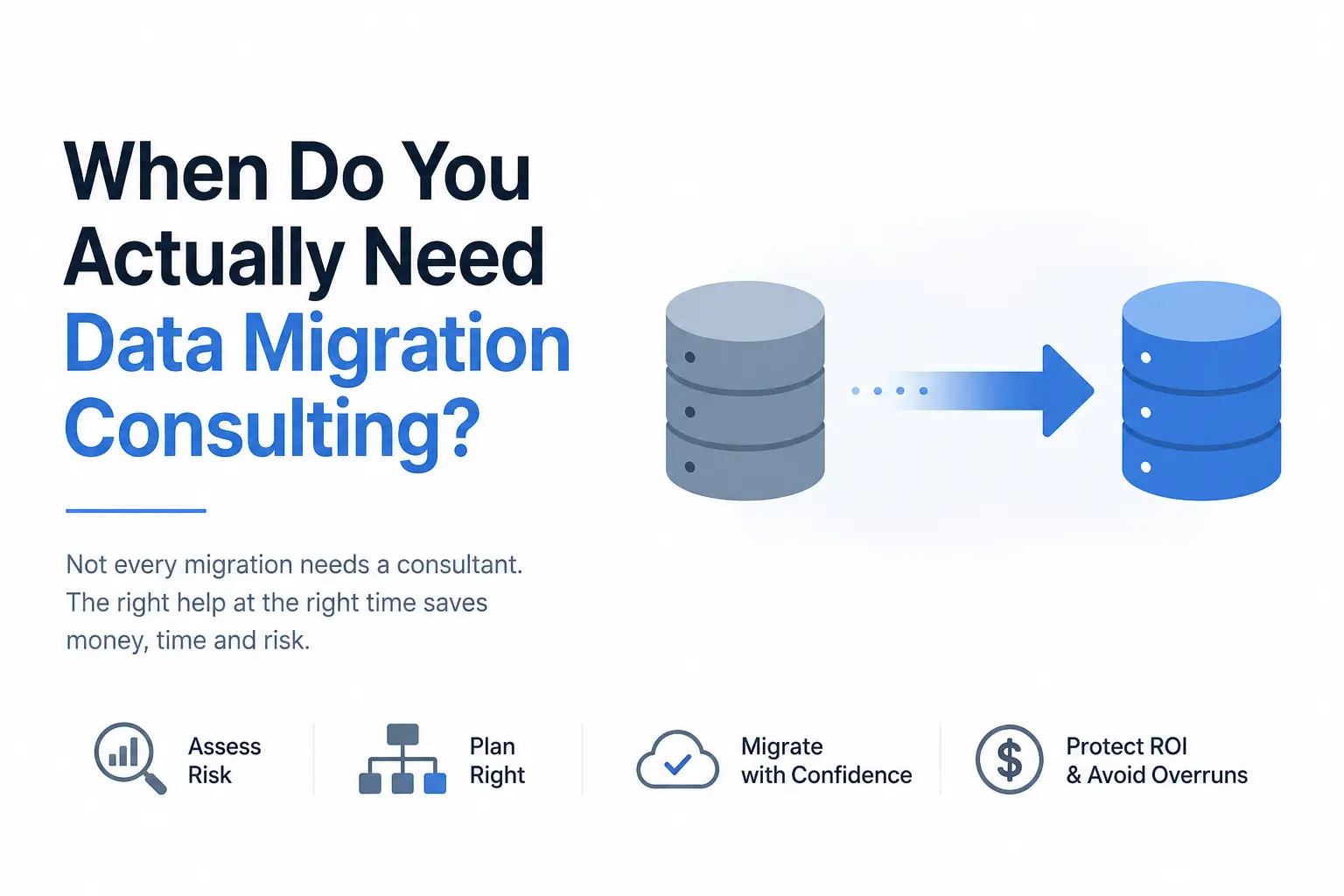
Most data migrations don't need a consultant. An internal team, a well-tested script, and a weekend cutover window handle the average job fine. No one hires outside help to move a tidy 40 GB database between two well-documented systems, and they shouldn't. But there is another side of the story.
The projects that do need help are expensive to get wrong. Three in four organisations miss the expected ROI on their first cloud migration, according to 2026 research compiled by WifiTalents, and 38% overrun their budget by more than 25%.
So, what are you dealing with? Answer this before you sign a statement of work, not after a delayed cutover answers it for you. This guide covers what a data migration consultant does, the seven signs you need one, the cost of hiring one, and a 10-minute self-assessment to help you decide.
What Does a Data Migration Consultant Actually Do?
A data migration consultant decides which records move between systems, how they should look when they arrive, and how to prove they arrived intact. The transfer itself is the smallest part of the job, and a migration tool handles it for you.
Most of the work happens before anything moves. The consultant audits the source data for duplicates, orphaned records, and undocumented quirks. They then map every field to its target, including fields that will split, merge, or change type. They also pick a migration method (big bang, trickle, or zero-downtime sync) based on how much risk the business can absorb. CACI’s 2026 research found that 38% of cloud migrations run more than three months late, with dependency mapping problems, exactly this pre-move work, among the leading causes.
After the move comes validation, the step internal teams most often improvise. It includes row counts, checksums, referential integrity checks, and reconciliation reports to confirm that the target matches the source.
When Can You Skip the Consultant?
If your project has one source, one target, a clear schema, and a business that can tolerate maintenance downtime, an experienced internal team can usually handle the migration. Consultants rarely volunteer this. Vendor-supported options, such as a SaaS platform's built-in importer or a managed database service's migration tool, can make the job even easier.
For example, moving a 50 GB PostgreSQL database to a managed cloud service with pg_dump on a Saturday is well within the reach of a competent team. This assumes the restore script has been tested in advance.
So is merging two SaaS accounts with the vendor's importer. That works best when the content is clean and hasn't been heavily customised.
Simple migrations are less about the technology than the team's experience. The deciding factor is whether anyone on your team has handled this specific type of migration at a similar scale and can explain the rollback plan from memory. If the answer is yes, you can usually skip the consultation.
7 Signals You Do Need Data Migration Consulting
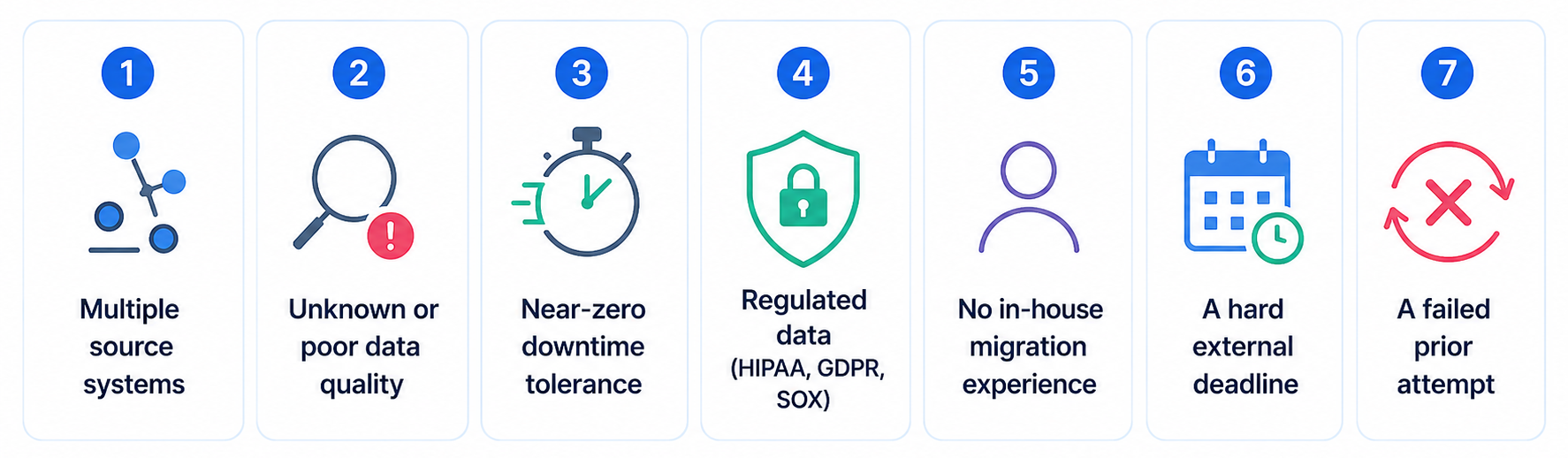
Failed migrations share one pattern: a complex move treated like a simple one. In Experian’s research, 48% of organisations said data quality issues alone delayed their migration projects. These seven signals are how that complexity shows up early.
|
# |
Signal |
Why it raises risk |
|
1 |
Multiple source systems |
Field conflicts, duplicate customers, and competing "sources of truth" multiply mapping work. |
|
2 |
Unknown or poor data quality |
Migration inherits every defect in the source, and defects you haven't profiled are defects you'll find in production. |
|
3 |
Near-zero downtime tolerance |
Zero-downtime cutovers need sync patterns, dual writes, and rehearsals, not a bigger weekend. |
|
4 |
Regulated data (HIPAA, GDPR, SOX) |
Lineage, encryption, and audit trails must survive the move; regulators don't accept "lost in transit." |
|
5 |
No in-house migration experience |
First-timers discover edge cases in production; specialists discover them in profiling. |
|
6 |
A hard external deadline |
Licence expiries, contract ends, and data centre exits remove your schedule buffer entirely. |
|
7 |
A failed prior attempt |
A rollback means the plan, the mapping, or the validation was wrong. Repeating it repeats the result. |
Two of these deserve a closer look.
Signal 1 is the classic post-acquisition trap. Two CRMs, overlapping customer bases, and 30,000 records that are “the same customer” in three inconsistent formats. Deduplication rules become business decisions, and someone has to own them.
Signal 2 is the quiet one. Research published in MIT Sloan Management Review puts revenue lost to poor data quality at 15 to 25% a year. Still, most teams start a migration without profiling what they’re about to move. Profiling first, before anyone quotes a timeline, is what separates clean cutovers from stalled ones. Pairing the move with ongoing data management keeps the cleaned data clean after go-live.
What Does a Failed Migration Cost?
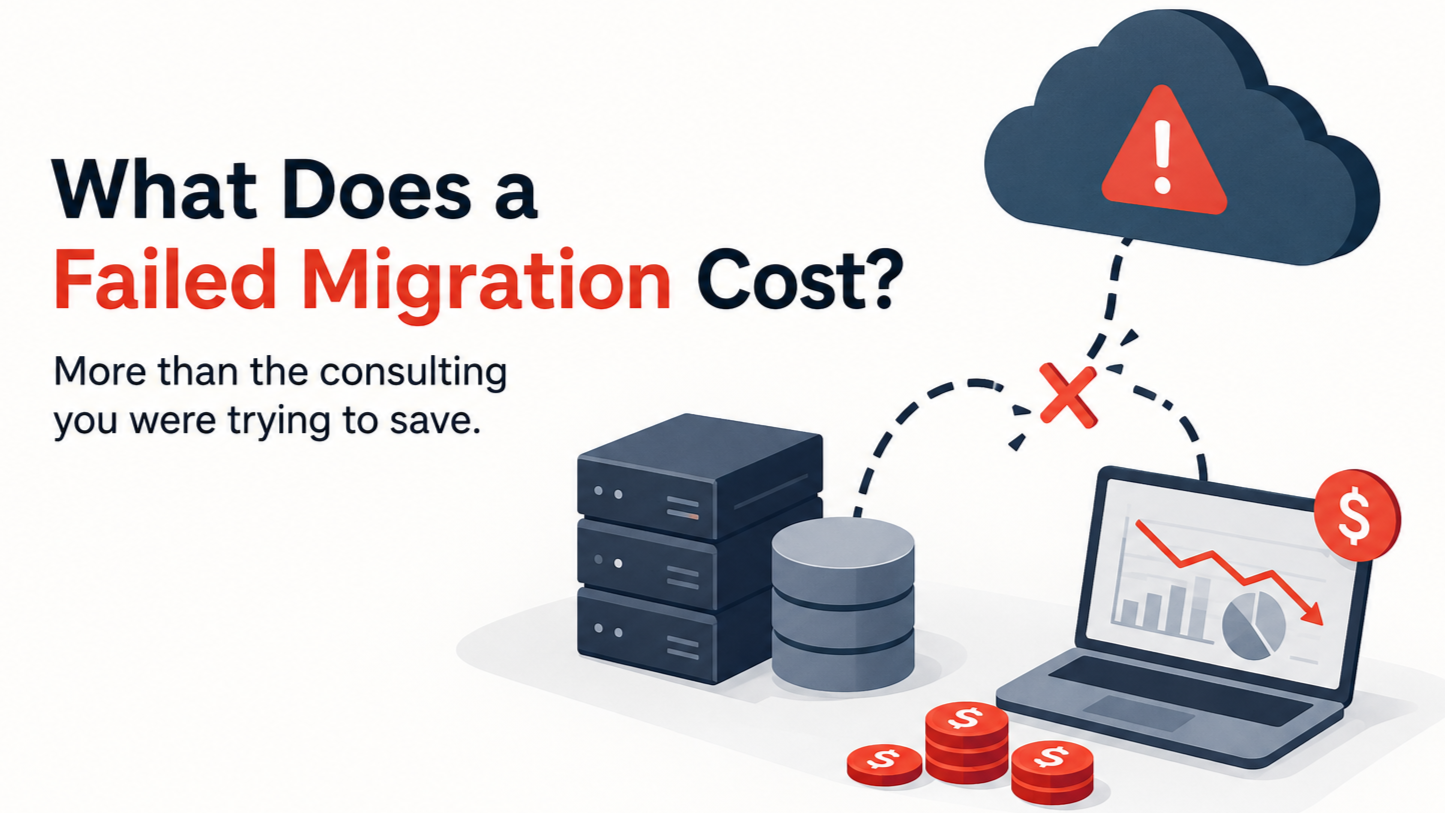
The final bill can easily exceed the consulting fee you were trying to save.
MigrationCost estimates that most cloud migration budgets are understated by 40 to 60%. Much of the gap comes from costs that rarely make the initial budget. These include egress fees, downtime, retraining, and parallel running.
Most of the extra spending comes from running the legacy and target environments in parallel while testing continues, approvals slip, and edge cases surface. Every extra week duplicates infrastructure costs, software licensing, and staff attention.
Data warehouse migrations are especially vulnerable to improvised cutovers. When reports break, the impact is often visible across the business.
And a failed migration doesn’t cost money once. Bad data that survives the move keeps draining that 15 to 25% of revenue until someone cleans it, in a system your team now trusts even less than the old one.
What Does Data Migration Consulting Cost?
Typically less than the overrun it prevents.A credible consultant bases their price on an assessment of your actual data. Any quote given before profiling is just a guess.
|
Engagement |
Typical duration |
Typical range and what drives it |
|
Assessment only |
1 to 2 weeks |
Low four to low five figures; often credited toward a full engagement. |
|
Mid-market migration |
2 to 6 months |
Five figures, driven by system count and validation depth. |
|
Enterprise migration |
6 to 12+ months |
Six to seven figures, driven by volume, compliance scope, and downtime tolerance. |
Four factors determine the price:
- Data volume
- Number of source systems
- Downtime tolerance
- Compliance requirements
For example, moving five systems with zero downtime is a very different project from a weekend database transfer, even if both involve the same amount of data.
What Good Data Migration Consulting Looks Like?
Every stage of a well-run engagement ends with something you can review before the next one starts. In our experience of migrating client data to BigQuery and Snowflake, projects that skipped the assessment stage ran months late. Skipping that stage was the strongest predictor of project delays.
|
Stage |
What you should get |
|
Assessment |
An inventory of sources and targets, data profiling results, and a risk map. No credible timeline exists before this. |
|
Design |
Documented migration method, field mappings, validation rules, downtime windows, and a rollback plan. |
|
Execution |
Staged loads, monitored from the first batch rather than the last. |
|
Testing |
Reconciliation reports, parallel runs, and sign-off criteria agreed before cutover, not during it. |
|
Hypercare |
Post-migration validation, performance tuning, and documentation so the knowledge stays with your team. |
Be wary of any consultant who quotes a fixed price before seeing your data or can't show a sample reconciliation report. You should also question anyone who treats a rollback plan as a sign of doubt. Confidence without artefacts is how projects end up in the delayed 38%.
A 10-Minute Self-Assessment
Each question below maps to one of the seven signals. Answer yes or no:
- Are you moving data from more than one system?
- Is it more than a year since anyone profiled or audited your data?
- Would more than two hours of downtime hurt the business?
- Is any of the data covered by legal or security rules (HIPAA, GDPR, SOX)?
- Is this the first migration of its type for everyone on your team?
- Do you have a fixed deadline you can’t miss?
- Have you attempted this migration before and rolled it back?
0 to 1 yes answers: Run it internally with a tested rollback plan.
2 to 3 yes answers: Commission an assessment first, then decide. A two-week profiling exercise is cheap insurance against a 25%+ overrun.
4 or more yes answers: Bring in data migration consulting now, before the deadline compresses your options further.
Every migration starts with a free strategy call. You’ll leave knowing the project’s scope, risks, and likely costs before deciding whether to move forward.
Book a Free 30-Minute Meeting
Discover how our services can support your goals — no strings attached. Schedule your free 30-minute consultation today and let's explore the possibilities.
Book a Free Call